Electric heat strips, often called heat tape or pipe-heating cable, help protect exposed water pipes from freezing by adding heat when temperatures fall. The best choice depends on the length of pipe, voltage, thermostat features, and whether the cable is suitable for the pipe material and installation. Frost King’s 6-foot cable is a practical option for a longer short run; its 3-foot model suits a smaller area. BDDFOTO and Cupohus offer thermostat-controlled short cables, while Wufoty provides a 15-foot option with listed mounting parts.
| Product | Best suited for | Listed length and output |
|---|---|---|
| Frost King HC6A | Longer short pipe runs | 6 feet, 7 W/ft |
| Frost King HC3A | Small pipe sections | 3 feet, 7 W/ft |
| BDDFOTO | Short runs needing thermostat control | 3 feet, 8 W/ft |
| Cupohus | Short runs with automatic on/off control | 3 feet, 5 W/ft |
| Wufoty | Longer runs with mounting hardware | 15 feet, 5 W/ft |
Frost King HC6A 6-Foot Heat Cable
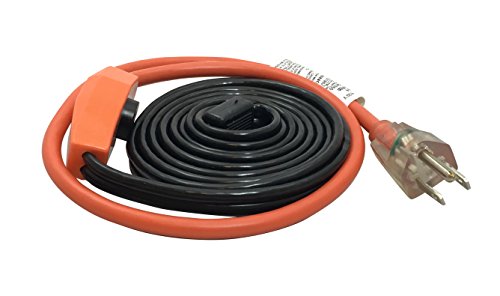
The Frost King HC6A is a 6-foot, 120-volt heating cable rated at 7 watts per foot. Its listed use includes both metal and plastic water pipes, and the product information says it keeps water flowing in temperatures down to -40°F.
Best for: Homeowners protecting a short-to-medium exposed pipe section who need more coverage than a 3-foot cable. Its length is the main reason to choose it over the shorter Frost King model.
Compare before buying: The provided product details do not describe a thermostat’s activation and shutoff temperatures or specify installation instructions. Check the package and manufacturer guidance to confirm the control and installation requirements suit your pipe and location.
A 6-foot cable may not cover a longer run. Measure the pipe and follow the cable’s directions rather than assuming it can be extended or overlapped.
Frost King HC3A 3-Foot Heat Cable

The Frost King HC3A is a 3-foot, 120-volt cable rated at 7 watts per foot. The listed application covers metal and plastic water pipes, and the product information states that it keeps water flowing down to -40°F.
Best for: A short exposed pipe section where a 6-foot cable would provide more length than needed. It offers the same listed voltage, wattage per foot, pipe-material range, and low-temperature claim as the HC6A in a shorter cable.
Choose this if the measured pipe section fits within the cable’s usable length and you want a compact option. Choose the HC6A instead when the run needs more coverage.
Limitation: At 3 feet, it is not intended to cover a long pipe run. The supplied product details do not state the thermostat’s operating temperatures, so verify those details and installation directions before purchase.
BDDFOTO 3-Foot Thermostat Heat Tape
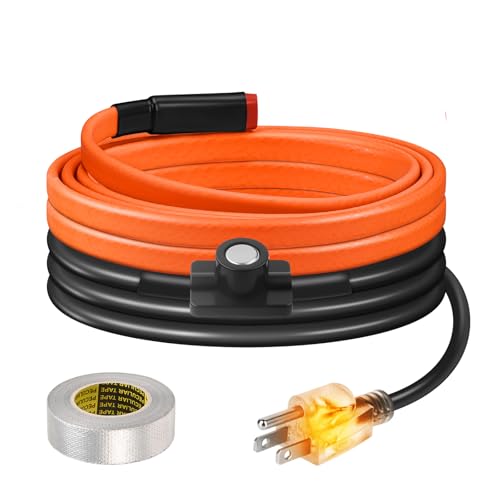
BDDFOTO’s 3-foot cable is listed at 8 watts per foot and 110 volts. It has a built-in temperature sensor, a 3-foot power cord, and an IP65 waterproof rating in the product description. The listed thermostat turns the cable on below 5°C (41°F) and off above 15°C (59°F).
Best for: A short metal or PVC water-pipe section where automatic temperature control and a stated waterproof rating are useful selection factors. The product description says the preassembled cable can be installed linearly, spirally, or overlapping.
Important caution: The listing notes that product-box printing may incorrectly show 5 W/ft, while the cable is described as supporting up to 8 W/ft. Confirm the specifications on the cable and current manufacturer instructions before installation. The product information does not list PEX as a compatible material.
Its 3-foot heating length is a key constraint. Measure the pipe first, and do not infer suitability for every wet or outdoor installation from the IP65 description alone.
Cupohus 3-Foot Thermostat Heat Tape

The Cupohus cable is a 3-foot, 120-volt model rated at 5 watts per foot. Its built-in thermostat is described as turning on below 41°F (5°C) and shutting off at 59°F (15°C). The product information lists metal and plastic pipes and says the cable is designed to help maintain pipe temperature above 59°F.
Best for: Buyers seeking a short heat cable with stated automatic on/off temperatures. Those thermostat thresholds make this model easier to compare with products whose control settings are not specified in the supplied details.
The listing describes encapsulated internal wires intended to block water infiltration. It also says models 30 feet and longer come with a GFCI power plug; this is the 3-foot version, so do not assume it includes that plug feature.
Limitation: Its 3-foot length and 5 W/ft rating may not fit longer or higher-heat-demand installations. Confirm pipe compatibility and installation requirements for the specific material and location.
Wufoty 15-Foot Pipe Heat Cable

Wufoty’s listed 15-foot cable operates at 120 volts and 5 watts per foot. The product description identifies it for metal and plastic home pipes and says it includes a 5-foot grounded plug with an indicator light. It also describes an aluminum-alloy shield, a TPE jacket, and metal retainers intended to help secure the cable.
Best for: Buyers who need more length than a 3- or 6-foot cable and value the listed mounting parts. The 15-foot length may reduce the need to combine several short cables, but the product details do not establish whether multiple cables may be connected.
The listing claims the cable can maintain pipes 10–15°F above ambient temperatures in conditions down to -40°F. Treat this as a manufacturer claim, not a guarantee for every pipe, installation, or weather exposure.
Limitation: No thermostat activation and shutoff temperatures are supplied in the listed features. Confirm whether the selected model has the control method required for your installation, and follow its instructions for pipe material, spacing, and mounting.
Buying Guide: How to Choose Electric Heat Strips for Water Pipes
How much cable length do you need?
Measure the pipe section that needs protection before selecting a cable. Compare the usable heating-cable length—not just the power-cord length—with the pipe run. The options here range from 3 feet to 15 feet. A short cable can suit an isolated vulnerable section, while a longer run may require a longer model. Do not assume a cable can be cut, extended, or joined unless its instructions expressly allow it.
Should you choose a thermostat-controlled cable?
A thermostat can switch a cable on as temperatures fall and off after warming reaches a stated threshold. Compare the actual temperatures in the product details: BDDFOTO and Cupohus list on/off points of 5°C/41°F and 15°C/59°F. For other models in this selection, the supplied information does not give those thresholds. Ask the manufacturer or consult current instructions if precise control behavior matters.
What voltage and wattage should you compare?
Check that the cable’s voltage matches the available power source and its instructions. The listed models include 110-volt and 120-volt products. Wattage per foot is another useful comparison, but a higher number alone does not establish that a cable is better for a particular pipe. Consider cable length, thermostat operation, installation rules, and the manufacturer’s intended use together.
Does pipe material affect the choice?
Product listings may specify metal, plastic, PVC, or other pipe types. Match the cable to the exact pipe material and follow its installation directions. “Plastic” does not automatically confirm suitability for every plastic pipe, including PEX. Check the product documentation for the specific material and any required insulation or spacing.
What safety details should you verify?
Read the current product instructions before installation. Confirm the required electrical protection, grounding, approved installation locations, and whether a GFCI-protected outlet or plug is needed. Do not infer that a cable is safe for every wet location because a listing gives a waterproof rating or describes a protective jacket. Avoid using a product contrary to its instructions, and contact a licensed electrician if the electrical setup is unclear.
Can heat tape be overlapped?
Only overlap a cable if the manufacturer explicitly permits it for that model and provides instructions. BDDFOTO’s supplied description says linear, spiral, or overlapping installation is possible, but instructions for other products are not included in the supplied details. Do not assume that one cable’s overlap guidance applies to another.
Frequently Asked Questions
What are electric heat strips for water pipes?
They are electric heating cables installed along water pipes to add heat and help reduce the risk of freezing in cold conditions. They are also commonly called heat tape or pipe-heating cable.
Are these products suitable for plastic pipes?
Several listings specify metal and plastic pipes, while BDDFOTO specifically mentions metal or PVC. Confirm the exact pipe material is approved in the product’s current instructions before installation.
Do all pipe heat cables turn on automatically?
No. Some product descriptions specify a built-in thermostat and its temperature thresholds, while others do not provide those details. Verify whether the selected model includes automatic temperature control.
Can a heat cable prevent freezing at -40°F?
Some listings claim protection or continued water flow down to -40°F. Actual performance depends on the installation and conditions, so treat that temperature as a product claim rather than a guarantee for every situation.
How do I know which cable length to buy?
Measure the pipe section that needs protection and compare it with the heating-cable length stated for the product. Do not count the power cord as heating length or assume cables can be joined unless the instructions say so.