The best electric heater for a kitchen is a compact model that can sit securely on the floor or be mounted in an appropriate location, away from water, cooking appliances, and walkways. The GiveBest is best for portable spot heating, the Amazon Basics heater is a simple compact choice, and the JIBUFI adds a remote and timer. For broader airflow, consider the Lasko tower; for a wall-mounted option with app controls, consider the DREO.
| Product | Best For | Standout Feature |
|---|---|---|
| GiveBest Portable Heater | Portable spot heating | Two heat levels and fan-only mode |
| Amazon Basics Ceramic Heater | Simple, compact use | Three settings in a small design |
| JIBUFI 17-Inch Heater | Adjustable operation | Three power levels, remote, and timer |
| Lasko Ceramic Tower | Wider heat distribution | Oscillation and remote control |
| DREO Wall Heater | Wall-mounted convenience | App, remote, and Alexa controls |
GiveBest Portable Ceramic Heater

Best for: Someone who wants to move a small heater between a kitchen and another room. GiveBest lists 750W and 1,500W heat settings, a thermostat, and a carry handle. It also includes a fan-only setting for circulating cool air.
The heater is described as suitable for spaces up to 200 square feet. Its automatic overheat shutoff and tip-over protection are relevant features for a portable unit, though they do not replace careful placement. The compact format makes it easier to position near a seated work area than a tall tower heater.
Why it was selected: Its portability, two heat levels, and thermostat provide practical flexibility for spot heating rather than trying to warm an entire home. The product information cautions against operating it on the same circuit as other high-power appliances. Avoid this model if a fixed, out-of-the-way heater is a priority.
Amazon Basics Compact Ceramic Heater

Best for: Buyers who want a small, straightforward heater for occasional kitchen spot heating. This model weighs 3 pounds and measures about 7.5 by 6.3 by 9.5 inches, making it relatively easy to move and store.
Its three settings are high at 1,500W, low at 900W, and fan-only. Built-in tip-over and overheat protection are listed, along with a power indicator light. Unlike the Lasko tower, this heater is non-oscillating, so its output is directed from one position rather than swept across a wider area.
Why it was selected: The compact footprint and simple settings suit a buyer who needs direct warmth without extra controls. Limitation: It does not oscillate, and the product details do not specify a room-coverage area. Do not choose it expecting broad, even heat distribution.
JIBUFI 17-Inch Oscillating Heater
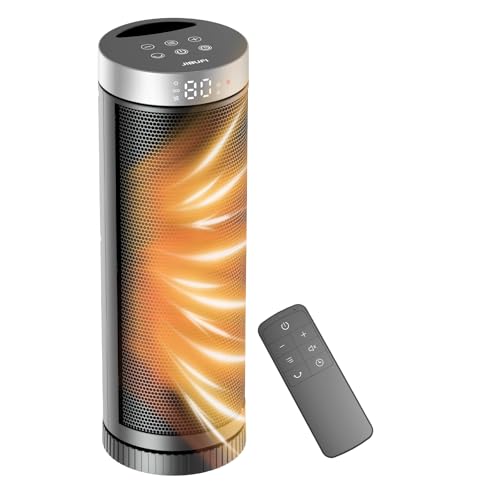
Best for: Buyers who want more control over heat output and operating time. The JIBUFI offers 700W, 1,000W, and 1,500W settings, plus a thermostat, remote control, and a timer adjustable from one to 12 hours.
The manufacturer describes its heating element as PTC ceramic and says it provides warmth in three seconds. Its 70-degree oscillation is intended to spread heat across a wider area than a fixed-output compact heater. The remote requires two AAA batteries, which are not included.
Why it was selected: The range of power settings makes it easier to choose a lower setting when full output is unnecessary, while the timer supports scheduled operation. Limitation: It is a taller freestanding unit, so it needs a stable location that does not obstruct kitchen traffic. Avoid it if counter or floor space is too limited for safe placement.
Lasko 23-Inch Ceramic Tower Heater

Best for: A kitchen or adjoining area where a taller heater and wider heat movement are more useful than a small desk-style unit. The Lasko has 1,500W of ceramic heat, two heat settings, and widespread oscillation.
A remote controls the heat settings, oscillation, and timer. The timer runs for up to seven hours. Listed safety features include overheat protection and a cool-touch housing; the product is also described as ETL-certified. These features make its controls convenient, but the heater still needs open space around it.
Why it was selected: Oscillation can distribute warm airflow across a broader area than a non-oscillating compact heater. Choose this model if you want remote operation and a tower format. Limitation: Its 23-inch height and oscillating movement require a clear, stable floor location, which may not suit a crowded kitchen.
DREO Smart Wall-Mounted Heater

Best for: Buyers who prefer a wall-mounted heater rather than a portable appliance occupying floor space. DREO lists app and remote controls, Alexa voice control, ECO mode, and a digital thermostat. The heater has 30-degree manual oscillation and is described as operating at 28 dB.
The product information lists an IP24 rating. That detail should not be treated as permission to install the heater near a sink, stove, or other source of water, grease, or high heat. Follow the manufacturer’s installation instructions and check that the intended location is appropriate for the specific appliance.
Why it was selected: Wall mounting can keep the heater away from floor-level foot traffic, while app and voice controls add operating options. Limitation: It requires suitable wall placement and installation; choose a portable model if you need to move the heater from room to room.
Buying Guide: Choosing a Kitchen Electric Heater
How much heat output do you need?
Compare the wattage settings before buying. Several heaters here offer a 1,500W high setting, while the GiveBest and EXNOS product information also lists a 750W option. Lower settings can provide less heat output when full power is unnecessary. A higher wattage does not guarantee that a heater will warm every part of a kitchen; room layout, drafts, and heater placement also matter.
Check the manufacturer’s stated room coverage when it is provided. The GiveBest is listed for spaces up to 200 square feet, while the EXNOS fireplace heater is listed for up to 300 square feet. Coverage claims are product specifications, not a guarantee of identical results in every kitchen.
Should you choose a portable, tower, or wall-mounted heater?
A compact portable heater is a practical choice for temporary spot heating and can be stored when it is not needed. A tower heater with oscillation may suit an open area where broader airflow is useful, but it needs a stable floor position. A wall-mounted model can free up floor space, but it depends on suitable installation and placement.
Before choosing, consider whether the heater can sit clear of cabinet doors, walkways, curtains, paper towels, and other combustible materials. Keep portable heaters on a level, stable surface, and do not place them on a counter unless the manufacturer specifically permits that use.
What controls are useful in a kitchen?
A thermostat can help maintain a selected temperature by controlling heater operation. Timers are useful when you want the heater to run for a limited period, while a remote can make adjustments without walking back to the unit. The JIBUFI includes a one-to-12-hour timer, the Lasko a timer of up to seven hours, and the DREO offers app, remote, and Alexa controls.
Consider whether simpler controls would be easier for your household. The Amazon Basics heater has three basic settings, while models with remotes or app features offer more ways to adjust operation.
What safety points matter most near a kitchen?
Keep an electric heater away from sinks, wet floors, cooking surfaces, and splashes. Do not use a heater where it could be knocked over, block an exit, or contact a hot appliance. Follow the instructions for clearance and operation, and plug the unit directly into an appropriate outlet unless its instructions say otherwise. Avoid overloading the electrical circuit; the GiveBest listing specifically warns against using it on the same circuit as other high-power appliances.
Tip-over and overheat shutoffs are useful safeguards, but they do not make unsafe placement safe. Do not leave a portable heater operating where it could be obstructed or exposed to water, and switch it off when it is not needed.
Is a heater a substitute for central heating?
These products are portable or room-focused electric heaters, not replacements for a home’s main heating system. They can be considered for localized warmth when the kitchen feels cooler than the rest of the home. For a large or open-plan kitchen, compare stated coverage and airflow features, and remember that doors, drafts, and room shape affect results.
Frequently Asked Questions
Which electric heater is best for a small kitchen?
A compact model such as the Amazon Basics or GiveBest may suit a small kitchen when it can be positioned safely. The GiveBest lists a 200-square-foot coverage area; Amazon Basics does not specify coverage in the provided product details.
Can I put an electric heater on a kitchen counter?
Only do so if the heater’s manufacturer explicitly allows countertop use. Keep any heater away from water, cooking appliances, combustible materials, and edges where it could fall.
Are oscillating heaters better for kitchens?
Oscillation can move warm airflow across a wider area than a fixed-direction heater. It does not guarantee even room temperatures, and an oscillating heater needs clear space around its base and airflow path.
What wattage should a kitchen space heater have?
Choose wattage based on the room, desired heat output, and the electrical circuit’s capacity. Many models in this selection offer up to 1,500W, but the heater should not share an overloaded circuit with other high-power appliances.
Does an IP24 rating mean a heater is safe beside a sink?
No. An IP24 listing is a product specification, not permission to place a heater where it can be splashed or exposed to standing water. Follow the manufacturer’s placement and installation instructions.
Is a wall-mounted heater a good choice for a kitchen?
It can be useful when keeping floor space clear is important. Confirm that the wall and location are suitable, follow installation instructions, and keep the heater away from water, cooking heat, and combustible items.