Answer: Energy efficient baseboard heaters offer steady, zone-based warmth with minimal noise, ideal for bedrooms, offices, and living spaces. This guide highlights five top options that balance efficiency, safety, and easy installation. The best fits include compact models for small rooms, versatile units for mid-sized spaces, and portable options for flexible layouts. Read on to find the right heater for your needs, whether you prioritize low energy use, quiet operation, or simple setup.
| Product | ||
|---|---|---|
| Comfort Zone CZ600 | 1500W Convection Baseboard | Medium rooms, home or office spaces |
| Cadet F Series 24″ | 350W (Model 2F350W) | Small rooms, budget-conscious spaces |
| Cadet F Series 48″ | 1000W (Model 4F1000W) | Mid-size rooms, retrofit projects |
| DREO Space Heater | 1500W Portable | Home office, spot heating, mobile use |
| 1128/1500W Baseboard | 208/240V Convection | Larger rooms, durable electrical setups |
Comfort Zone CZ600 Electric Baseboard Space Heater

The Comfort Zone CZ600 is a 1500W convection baseboard heater designed for medium-sized rooms. It offers two heat settings and an adjustable thermostat for precise control. This model emphasizes safety with features like a tip-over switch, overheat protection, and a stay-cool body, making it suitable for bedrooms and offices where kids or pets are present. Whisper-quiet operation helps maintain a calm environment. Best for buyers who want straightforward, reliable heating with easy temperature adjustments and strong safety protections.
Best for: Medium rooms in homes or small offices that require consistent warmth with quiet performance.
Why selected: Balanced power, practical safety features, and silent operation; fits standard wall outlets and typical room layouts.
Caution: May consume significant energy in very large spaces; consider zoning or supplementary heating for larger areas.
Cadet F Series 24″ Electric Baseboard Heater

Cadet F Series 24″ White baseboard heater is a compact, steel-bodied unit designed for small spaces. It provides 350W of heating at 240/208V, with simple color-matched finish and straightforward electrical compatibility. This option is best for tiny bedrooms, offices, or dorm rooms where space and power limits require a smaller footprint. It’s chosen for its ease of installation and unobtrusive presence in tight areas.
Best for: Very small rooms or spaces where limited wall space and basic heat are needed.
Why selected: Small footprint and easy wiring options make it a practical fit when upgrading older systems in compact layouts.
Caution: Low wattage may be insufficient in larger rooms or drafty spaces; consider pairing with additional heating if needed.
Cadet F Series 48″ Electric Baseboard Heater
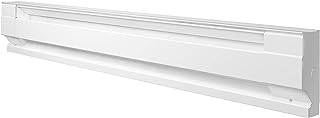
The 48″ Cadet F Series model provides 1000W of heating at 240/208V, with universal wiring and pre-punched knockouts for straightforward installation on walls or floors. Built with a focus on safety, it includes a high-temperature safety shutoff. This unit is best for mid-size rooms or as a retrofit option in existing baseboard installations, offering robust heat without a complicated setup.
Best for: Mid-sized rooms or renovations where a longer heater profile is helpful for even heat distribution.
Why selected: Combines higher heat output with installation flexibility and solid safety features.
Caution: Larger footprint requires adequate wall space and proper mounting to ensure proper clearances.
DREO Space Heater 1500W with Adjustable Tilt

The DREO 1500W space heater is a portable option designed for flexibility. It offers 60° tilt for full-body warmth and rapid heat delivery, with a claimed 53.9% more heated air than traditional heaters. It includes multiple safety protections, such as tip-over prevention and ETL-certified materials. Best for space heaters that can be moved between rooms or desks, especially in home offices or drafty spots near workstations.
Best for: Mobile heating in a home office or living area where you need quick, room-to-room warmth.
Why selected: High heat output in a portable form with tilt functionality for targeted warmth.
Caution: Portable devices require careful placement to avoid tripping or tip-overs in high-traffic areas.
1128/1500W Baseboard Heater

The 1128/1500W baseboard heater uses convection to deliver even warmth from floor to ceiling without a blower. It emphasizes allergy-friendly operation by avoiding forced-air dust movement. Quick wiring is supported by a large wiring compartment, dual knockouts, and a built-in cable clamp for easier installation. Best for users seeking steady, quiet heating with minimal air movement.
Best for: Larger rooms or homes seeking consistent, silent heat distribution without fans.
Why selected: Convection-based warmth provides steady comfort and lower noise, with straightforward wiring options.
Caution: Wattage and length should match room size to prevent underheating in very large spaces.
Buying Guide: Key Considerations For Baseboard Heaters
- Room size and heat load: Choose wattage that matches the space. Larger rooms need higher wattage or multiple units for even heat distribution.
- Mounting style: Wall-mounted baseboards save floor space; consider length and mounting height for optimal airflow and safety clearance.
- Electrical compatibility: Confirm voltage and wiring requirements (commonly 120V for some models, 208/240V for higher outputs). Ensure panel capacity and circuit availability.
- Safety features: Look for tip-over switches, overheat protection, and stay-cool surfaces to minimize burn risks.
- Noise and airflow: Baseboards are typically quiet; if you are sensitive to fan noise, avoid blowers and opt for convection designs.
- Installation ease: Pre-punched knockouts, wiring compartments, and universal mounting options simplify retrofits in older homes.
- Energy efficiency: Convection baseboards minimize energy waste by delivering consistent warmth and reducing hot/cold spots; pair with insulation for best results.
- Mobility vs. permanence: Portable models offer flexibility, while fixed baseboards provide stable, long-term heating.
FAQ
- What is the main difference between convection baseboard heaters and portable space heaters?
– Convection baseboards provide steady heat along walls without fans, ideal for whole-room warmth. Portable space heaters offer quick, directed heat and mobility but may be less energy-efficient for long-term use. - Do baseboard heaters use a lot of electricity?
– They can, especially in larger spaces, but efficiency improves with proper insulation and appropriate wattage for the room. - Are baseboard heaters safe around children and pets?
– Yes, when they feature safety shutoffs and stay-cool surfaces. Placement and supervision also matter to prevent accidental contact. - Can I install baseboard heaters myself?
– Simple units may be DIY-friendly if you have basic wiring knowledge and comply with electrical codes; consult a professional for larger or high-wattage installations. - Should I choose a fixed baseboard or a portable heater for a home office?
– Choose fixed baseboards for consistent room-wide warmth and lower ongoing management. Portable heaters work well for flexible, occasional warmth and quick spot-heating needs. - How do I maintain energy efficiency with baseboard heating?
– Keep insulation tight, seal drafts, use thermostats or zoning, and select appropriate wattage per room size to avoid unnecessary heat loss.