The best energy-efficient heater for a basement is one that can maintain a comfortable set temperature without heating an empty room unnecessarily. These five electric heaters offer features such as ECO modes, thermostats, timers, or app controls that can help manage heating. The GiveBest is best for Wi-Fi control and flexible mounting; the DREO oscillating wall heater suits buyers who want broad heat distribution; and the DR Infrared model is a portable option with stated tip-over and overheat protection.
| Heater | Best For | Standout Features |
|---|---|---|
| GiveBest 1500W Wall Heater | App control and flexible mounting | Wi-Fi, ECO mode, thermostat, timer |
| DREO Smart Wall Heater, 120° | Wide heat distribution | Oscillation, scheduling, precise temperature setting |
| DREO Smart Electric Wall Heater | Quiet operation and app controls | 28 dB noise level, ECO mode, Alexa |
| JNDRO Wall-Mounted Heater | Adjustable oscillation options | Three angles, ECO mode, 24-hour timer |
| Dr Infrared DR-968 | Portable room heating | Dual heating system, timer, tip-over and overheat protection |
GiveBest 1500W Electric Wall Heater

Best for: Basement owners who want a wall-mounted heater with app access, a remote, and temperature-based operation. Its combination of a precision thermostat and ECO mode makes it a practical choice for managing warmth without relying only on continuous full-power heating.
The GiveBest offers three heating modes and Wi-Fi, remote, and touch-panel controls. The LED panel displays room temperature, while the 24-hour timer can be used to align operation with a household schedule. Its wall-mounted design is intended to save floor space, which can be useful in a basement with limited room for furniture or storage.
Why it was selected: Its control choices and scheduling features address two common basement needs: adjusting the heater without walking over to it and limiting operation to selected periods. The product description also lists use in a basement among its intended room applications.
Consideration: Wall mounting requires drilling and following the installation guide. Choose this if you want a mounted unit and app-based control; avoid it if you need a portable heater that can be moved between spots without installation.
DREO Smart Wall Heater With 120° Oscillation
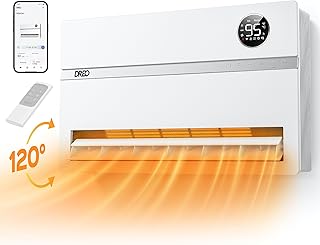
Best for: Buyers who want a wall-mounted heater that can direct warm air across a wider area. Its 120-degree oscillation is designed to distribute heat more evenly than a fixed-direction wall heater.
This DREO model uses a PTC ceramic heating system and provides a temperature-setting range from 41°F to 95°F. The listing states temperature accuracy of 1°F. Users can schedule heating hours, control settings through the DREO app, or use voice controls with Alexa or Google Home.
Why it was selected: A basement’s layout may leave some areas farther from a fixed heat outlet. The wide oscillation and scheduling options make this model a useful choice for buyers focused on distributing warmth and controlling when the heater runs.
Consideration: The product information does not state a coverage area, so do not assume it will heat every basement or multiple separated rooms. Choose it if broad directional movement and smart scheduling matter more than portability.
DREO Smart Electric Wall Heater

Best for: Basement users who value quiet operation, remote adjustment, and app or voice control. The listed operating noise level is 28 dB, and the heater includes ECO mode for temperature-based heating management.
The DREO wall heater uses a PTC heating system and optimized airflow. Its stated airflow speed is 11.5 feet per second, and it has 30-degree manual oscillation to direct heat. Controls are available through the included remote, the DREO app, and Alexa voice commands. The app also provides temperature calibration, according to the product description.
Why it was selected: For a basement used as a home office, recreation room, or other occupied space, lower listed noise and multiple control methods can be useful. ECO mode and a settable room temperature provide more control than simply switching the unit on and off manually.
Consideration: Its oscillation is manual and limited to 30 degrees, rather than the wider automatic movement offered by some alternatives. The listing states an IP24 rating, but buyers should still check the product instructions and the conditions in their basement before installation.
JNDRO Wall-Mounted Heater With ECO Mode

Best for: Buyers who want a wall heater with several oscillation angles and straightforward remote operation. The JNDRO offers 60-, 90-, and 120-degree oscillation choices, allowing the user to select how broadly it distributes warm air.
The heater has a thermostat with an ECO mode that adjusts heating power according to ambient temperature. Its stated temperature range is 41°F to 95°F. A remote controls temperature, timer, fan speed, and oscillation angle, while an LED display shows the current settings. The 24-hour timer can help set a planned operating period.
Why it was selected: The selectable angles make it a flexible option for buyers who want to tailor airflow to a particular room arrangement. The thermostat, timer, and remote provide useful controls for a basement that is not occupied all day.
Consideration: The remote requires two AAA batteries, which are not included. The listing does not provide a specific room coverage figure, so compare the heater’s stated capabilities with the size and layout of your space before choosing it.
Dr Infrared Heater DR-968 Portable Space Heater

Best for: Buyers who prefer a portable heater rather than a wall-mounted unit. The DR-968 is listed at 1500 watts and combines an infrared quartz tube with PTC heating. Its high and low settings and automatic energy-saving mode provide options for adjusting operation.
The product description lists a 12-hour automatic shut-off timer, an infrared remote, and a low-noise blower rated at 39 dB. It also specifies tip-over protection and overheat protection. The heater is described as suitable for a large room, with a stated rating of around 5200 BTU.
Why it was selected: Portability can suit a basement where heat is needed in different areas at different times or where permanent mounting is not desired. Its timer and high/low settings provide basic ways to manage use.
Consideration: Unlike the wall-mounted models, this unit occupies floor space. Its listed current draw is 12.5 amps, so check the product instructions and the electrical circuit requirements before use. Choose it if moving the heater is more important than freeing up floor space.
Buying Guide: Choosing a Basement Heater
Which heater controls can help manage energy use?
Look for features that make it easier to heat only when needed. A thermostat can maintain a selected temperature, while ECO modes may adjust heating output based on room temperature. Timers and schedules can help limit operating hours. Wi-Fi or app access can be useful if you want to adjust settings remotely, but it does not by itself establish how much energy a heater will use.
Electric resistance heaters convert electricity into heat at the point of use. Features such as ECO mode and scheduling can affect when or how the unit operates; they do not change the basic fact that a heater needs electricity to produce heat. Compare the control features, rather than relying on the phrase “energy efficient” alone.
Should you choose a wall-mounted or portable model?
A wall-mounted heater keeps the unit off the floor and can make sense when you have a preferred heating location. Installation takes planning, and you should follow the manufacturer’s mounting instructions. A portable model is easier to reposition, but it takes up floor space and needs a suitable location during operation.
Consider how the basement is used. A dedicated work or recreation area may benefit from a fixed heater aimed at that zone. If you need heat in different areas at different times, a portable design may provide more flexibility.
How much coverage do you need?
Measure the room and consider its layout before selecting a heater. A single open area is different from a basement divided into several rooms, and a heater in one location may not distribute warmth evenly through separate spaces. Check the manufacturer’s stated coverage and installation guidance for the model you are considering.
Some products in this comparison emphasize oscillation, including 120-degree movement on two wall-mounted models and selectable angles on the JNDRO. Oscillation can spread airflow across a wider direction, but it should not be treated as proof of a specific room-size capability.
What should basement owners check before installation?
Basements can have conditions that differ from the rest of a home, including damp areas or limited outlets. Check the heater’s instructions for placement, clearances, mounting, and electrical requirements. If the space is damp, verify that the product is appropriate for those conditions rather than assuming any indoor heater is suitable. The DREO electric wall heater listing specifies IP24, but the rating and manual should be reviewed for the intended location.
Keep the heater in a location that follows its instructions and does not obstruct airflow. For a portable model, read the product guidance about placement and operation. If you are unsure whether an outlet or circuit is suitable, consult a qualified electrician rather than relying on the heater’s wattage alone.
Which features matter most for comfort?
Prioritize the control that matches your routine. App access and voice control are available on some DREO and GiveBest models. Remote controls are listed for all five products. For an occupied office or bedroom area, the noise information may matter; the DREO electric wall heater lists 28 dB, while the DR-968 lists 39 dB.
Temperature range, oscillation, and timers are also useful comparison points. The DREO 120-degree model specifies a 41°F to 95°F range and 1°F accuracy. The JNDRO also lists a 41°F to 95°F range. Confirm that the functions you need are included in the specific model, since features vary across heaters.
Frequently Asked Questions
What is the best type of heater for a basement?
The best type depends on the room layout and how you use the space. A wall-mounted heater can save floor space, while a portable heater can be moved. Choose based on installation preferences, controls, coverage information, and the basement’s conditions.
Does ECO mode guarantee lower electricity bills?
No. ECO mode can adjust heating output according to a thermostat or ambient temperature, but actual electricity use depends on settings, operating time, the room, and other conditions. A timer or schedule can help limit operation to selected periods.
Is a 1500-watt heater enough for an entire basement?
Not necessarily. Room size, layout, insulation, and the heater’s stated coverage all matter. Check the manufacturer’s coverage information; do not assume that one heater will warm a large or divided basement evenly.
Are wall-mounted heaters better than portable heaters?
Neither is universally better. Wall-mounted models save floor space but require installation. Portable heaters can be repositioned but occupy floor space and must be placed according to their instructions.
Can any indoor heater be used in a damp basement?
No. Check the product documentation and rating for the conditions where the heater will be installed. Do not assume an indoor-use label means a heater is appropriate for a damp area.