Whether you’re warming a bedroom, home office, or small living area, energy efficient portable heaters can deliver targeted comfort while keeping energy use in check. This guide highlights five reliable options, emphasizing who they’re best for and why each stands out. Ideal buyers include budget-conscious apartment dwellers, small-space workers, dorm residents, and anyone seeking quiet operation alongside safe, programmable heat. A quick reference table compares core traits to help you decide at a glance.
Product Comparison Snapshot
- DREO Space Heater, Portable Electric Heaters for Indoor Use with Thermostat — 1500W, smart thermostat, ETL safety
- GiveBest Space Heater, Portable Space Heaters for Indoor Use — dual 1500W/750W, safety features
- JIBUFI Portable Space Heater for Indoor Use with 70° Oscillation and Remote — broad coverage, ECO mode
- DREO Space Heater, Portable Electric Heaters for Indoor Use with Thermostat — fast heat, ECO mode
- DREO Quiet Space Heater, 1500W Portable Heaters for Indoor Use with Remote — whisper-quiet, fast heat
DREO Hyperamics 1500W Space Heater With Thermostat

Best for: small apartments or desks where quick, localized warmth is needed without running a full-room heater. This model uses Hyperamics 1500W technology and a heat funnel design to project warmth efficiently across a room, extending reach beyond traditional units.
Why selected: It combines rapid heating with a smart thermostat and ETL-listed safety features, making it suitable for frequent, indoor use where precise comfort matters. The 41–95°F adjustable range in 1°F steps helps conserve energy by avoiding overshoot.
Limitation: The heat direction is optimized for near-field warming; larger open-plan spaces may require additional heaters for even coverage.
GiveBest 2-in-1 Ceramic Heater With Fan

Best for: users seeking versatile seasonal use from a compact unit, including winter warmth and summer cooling with the fan mode. Ideal for desks, small bedrooms, or home offices where flexibility matters.
Why selected: Dual heating modes (1500W/750W) plus a cool air setting support year-round comfort. Automatic thermostat cycling maintains a preset temp, while automatic shut-off and tip-over protection enhance safety.
Limitation: The built-in safety alarm and beeper can be disruptive in very quiet rooms for some users; consider placement away from study areas if noise sensitivity is high.
JIBUFI 70° Oscillating Portable Heater

Best for: small-to-medium rooms where broad heat distribution is helpful, such as bedrooms, offices, or studios. The 70° oscillation expands coverage without increasing wattage.
Why selected: Delivers 1500W of rapid heating with ETL safety certification, flame-retardant materials, and enhanced plug protection. ECO mode supports energy savings by adjusting temperature automatically.
Limitation: Oscillation can reduce concentration of heat in a single spot; best used when you’re moving around or need even room warmth rather than focused heat at a desk.
DREO 1500W Thermostat Space Heater (Quick Heat)
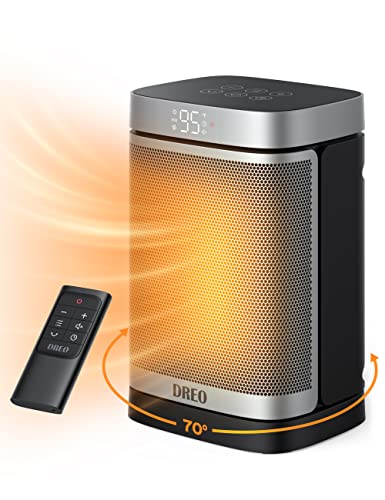
Best for: users who want fast warmth at their feet or near a workstation, with exactly controlled temperatures. Great for dorms, bedrooms, or home offices where precise comfort matters.
Why selected: Hyperamics technology enables rapid heating up to 1500W, with Shield360° safety including tip-over and overheat protection. The ECO mode helps trim energy usage while preserving comfort, and the digital thermostat spans 41–95°F in 1°F steps.
Limitation: Some users may prefer silent models; this unit’s fan and airflow can produce noticeable sound at higher power levels.
DREO Quiet 1500W Heater With Remote

Best for: bedrooms or nurseries where quiet operation matters, yet warmth is needed quickly. The whisper-quiet performance supports restful sleep and focused work.
Why selected: Combines Hyperamics 1500W heating with a quiet brushless DC motor and winglet fan design to minimize disturbance. ETL safety, tip-over and overheat protections, and a safety plug add layers of security.
Caution: Quiet operation may still be audible at maximum 1500W; consider lower settings if ultra-low noise is essential for your space.
Buying Guide: Key Considerations For Choosing an Energy Efficient Portable Heater
- Room size and heating needs: Match wattage and coverage to the space you want to warm. Larger rooms may benefit from oscillating models or multiple units, while smaller spaces can suffice with 1500W portable heaters.
- Heat distribution and control: Look for models with automatic thermostats, ECO modes, and wide-angle oscillation to balance comfort and energy savings.
- Safety features: PrioritizeETL listings, tip-over protection, overheat protection, flame-retardant materials, and sturdy power cords. Avoid using extension cords with direct wall-plug models.
- Noise level: For bedrooms or study areas, consider quiet operation specifications and brushless motors to minimize disruption.
- Placement and usage: Place heaters away from moisture, curtains, or combustibles. Direct airflow toward the center of the room rather than onto people for even warmth.
- Power considerations: Most 1500W units draw significant current. Ensure your outlet and circuit can handle the load without frequent tripping.
FAQ: Quick Answers For Energy Efficient Portable Heaters
- What size heater should I choose for a small bedroom? — A compact 1500W unit with ECO mode is usually sufficient for up to 200 square feet, depending on insulation.
- Is it safe to use a space heater in a dorm room? — Yes, when using ETL-rated models with tip-over and overheat protections and avoiding extension cords.
- Do portable heaters waste energy? — Efficient models with automatic thermostats and ECO modes reduce energy usage by maintaining the desired temperature without overheating.
- Is oscillation important for warmth distribution? — Yes, 60–70° or wider oscillation helps distribute heat across a room evenly, reducing hotspots.
- Can I use these heaters year-round? — Yes, many models offer a cool air/fan setting for warmer months, extending their usefulness beyond winter.
- What safety features should I look for? — Look for tip-over protection, overheat protection, flame-retardant materials, and ETL certification.