The best choice depends on whether you need compact point-of-use hot water, a whole-home electric unit, or a gas-powered system. The products below include options for each use, but the supplied product information does not establish that any model is manufactured in Europe or designed to meet European plumbing or electrical standards. The 27 kW WINTEMP is best for several household uses with substantial electrical capacity; the 3,000 W unit is best for a sink; and the Westinghouse gas model is best for higher-flow whole-home demand.
| Product | Best For | Fuel | Stated Capacity |
|---|---|---|---|
| WINTEMP 27 kW | Several household points of use | Electric | Up to 6.5 GPM |
| 3,000 W 110 V unit | Sink or other low-flow use | Electric | Temperature rise varies by flow |
| Rheem 18 kW | Moderate electric demand | Electric | Up to 4.4 GPM |
| Westinghouse 180,000 BTU | Multiple fixtures | Natural gas | Up to 7.9 GPM |
| Baococo 18 L | Portable outdoor or RV use | Propane | 4.76 GPM |
WINTEMP 27 kW Electric Tankless Heater

The WINTEMP WM27V is a 240-volt electric tankless water heater rated at 27 kW. Its listed maximum flow is 6.5 gallons per minute, and the manufacturer describes it as suitable for two to four points of use. Flow control is intended to help maintain water temperature when demand approaches the unit’s capacity. Its self-modulating feature adjusts power according to water flow and temperature demand.
Best for: Households considering an electric whole-home or multi-fixture system and able to provide the required high-capacity electrical service. It is a stronger electric option than the 18 kW Rheem for buyers comparing the stated maximum flow rates.
Important limitation: The product information recommends 200-amp household service and specifies a maximum current of 113 amps, three 40-amp double-pole breakers, three sets of 8 AWG wiring, and 3/4-inch NPT water connections. Have a qualified electrician confirm the electrical panel and installation requirements before purchase. The stated 6.5 GPM is a maximum, not a guarantee at every incoming-water temperature or simultaneous demand level.
3,000 W 110 V Point-Of-Use Heater
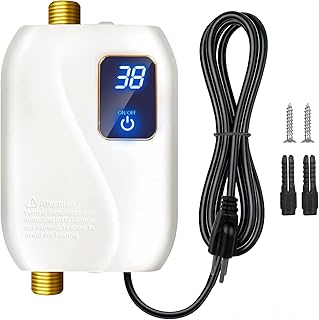
This compact, wall-mounted electric heater is designed for localized hot-water needs, such as a kitchen sink, bathroom, apartment, RV, or camping setup. The listing specifies 3,000 watts at 110 volts, an LED display, and selectable Fahrenheit or Celsius readings. It claims a temperature rise of 82°F at 0.3 GPM and 131°F at 0.5 GPM. Those flow-specific figures are useful when comparing a small point-of-use unit with a whole-home heater.
The listed safety features include water-and-electricity isolation, leakage protection, dry-boil protection, overheat shutoff, inactivity shutoff, and an IPX4 waterproof rating. The product description also states that it qualifies for the ETL standard; verify the exact listing and applicable certification details for your installation.
Best for: A buyer who wants hot water at one low-flow fixture without installing a large central heater. Its lower power requirement makes it a different category from the 18 kW and 27 kW electric models.
Important limitation: A 3,000 W unit is not presented as a high-volume whole-home solution. The stated temperature rise changes with flow, so do not assume it can supply multiple showers or deliver the same output in colder incoming water.
Rheem 18 kW Electric Tankless Heater

The Rheem 18 kW model operates on 240 volts and has a stated maximum flow rate of up to 4.4 GPM. Its external digital thermostatic control has an LED display and is specified at plus or minus one degree of accuracy. Self-modulation adjusts power to meet hot-water demand, while the two copper immersion heating elements are described as field-serviceable.
Best for: Buyers comparing a mid-range electric tankless unit with a stated flow capacity below the WINTEMP 27 kW model. The digital temperature control and self-modulating operation are relevant features for users who want to set and monitor a target temperature.
Why it was selected: It provides a clearly stated 240-volt electrical format, a maximum flow figure, and information about its controls and heating elements. These details make it easier to compare with other electric options in this list.
Important limitation: The listing’s “up to 4.4 GPM” figure does not specify the temperature rise at that flow. Actual usable output depends on incoming-water temperature and simultaneous demand. Confirm electrical requirements and local installation rules before purchasing.
Westinghouse 180,000 BTU Gas Heater

This indoor natural-gas tankless model is rated at 180,000 BTU and lists a maximum output of 7.9 GPM. The product description says it is intended to serve three to five fixtures and describes capacity for up to three showers at once. It includes Wi-Fi app and voice control for adjusting temperature, checking operating status, and receiving fault alerts. The stated temperature range is 95°F to 149°F, with temperature stability listed at plus or minus one degree.
Best for: A household comparing gas-powered whole-home options and seeking higher listed flow than the electric models here. It is also a fit for buyers who value remote monitoring and adjustment.
Why it was selected: Among the listed products, it has the highest stated maximum flow and is explicitly described for multiple household fixtures. The listing identifies it as indoor and natural gas, helping buyers distinguish it from the portable propane model.
Important limitation: The stated maximum flow and simultaneous-shower claim are product specifications, not a promise of the same performance in every climate or installation. Confirm gas supply, venting, combustion-air, installation, and code requirements with a qualified professional. The product information identifies CSA certification; check the exact certification and local acceptance before installation.
Baococo 18 L Portable Propane Heater

The Baococo propane model is listed at 115,425 BTU per hour and 4.76 GPM. Its description targets camping, RV travel, outdoor bathing, and pet washing. The adjustable temperature range is listed from 17°F to 113°F. The product also specifies protections for overheating, dry combustion, antifreeze conditions, low-flow ignition lockout, flame failure, and high water pressure.
Best for: Buyers who need portable hot water for outdoor or travel use and have a suitable propane setup. It is more appropriate to compare with other portable heaters than with the indoor natural-gas Westinghouse or the household electric units.
Why it was selected: It offers a stated flow and heating output in a propane-powered format, making it the clearest choice in this group for mobile or outdoor applications.
Important limitation: The supplied description positions the unit for portable and outdoor use, not as an indoor whole-home replacement. Follow the manufacturer’s operating and ventilation instructions, and confirm that the temperature range and installation suit the intended use.
Buying Guide: How To Choose A Tankless Water Heater
What does “European tankless water heater” mean?
The phrase can refer to a European-made brand, a unit intended for European electrical and plumbing systems, or simply a compact on-demand heater in a European style. The product information provided for these five options does not confirm European manufacture or European-market specifications. Check the manufacturer, voltage, frequency, pipe fittings, approvals, and installation documentation if European origin or compatibility is essential. Do not assume a 110-volt or 240-volt U.S. listing will work with a different electrical system.
Do you need point-of-use or whole-home hot water?
A point-of-use heater serves a nearby sink or another limited demand. The 3,000 W unit is the most clearly localized option in this selection. A whole-home heater must handle the combined demand of showers, sinks, laundry, and appliances that may run together. Compare the unit’s flow capacity with the total flow of the fixtures likely to operate at once.
How should you compare flow rates?
Maximum GPM figures are not directly interchangeable without knowing the temperature rise at that flow. Incoming water temperature matters: colder water requires more heating to reach the same outlet temperature. Ask the installer to estimate the required flow and temperature rise for your location and household. Treat “up to” specifications as maximums rather than guaranteed output in all conditions.
Should you choose electric, natural gas, or propane?
- Electric: The WINTEMP and Rheem are 240-volt models; the smaller point-of-use unit is listed at 110 volts. Check available circuit capacity, breaker requirements, wiring, and panel load before buying.
- Natural gas: The Westinghouse is described as an indoor natural-gas model. Confirm the home’s gas supply and required venting and installation conditions.
- Propane: The Baococo is positioned for portable and outdoor use. Verify the fuel setup and follow the product’s safety instructions.
What electrical requirements should you verify?
Tankless electric heaters can require substantial electrical capacity. The WINTEMP listing calls for 200-amp household service, three double-pole breakers, and three wiring sets. Have a qualified electrician assess the service panel and installation before purchase. Requirements for the Rheem and other models should also be confirmed from their full installation documentation rather than inferred from wattage alone.
Which features matter beyond capacity?
Temperature controls, self-modulation, fault alerts, and safety shutoffs may help with operation, but they do not replace correct sizing and installation. The WINTEMP and Rheem describe self-modulating electric output; the Westinghouse lists app control and temperature stability; the compact unit and Baococo list several protective functions. Choose features that address a specific need, such as remote monitoring or a limited point-of-use application.
What should an installer assess?
Ask a qualified professional to verify fuel and electrical supply, water connections, mounting location, venting where applicable, local code requirements, and expected temperature rise. For a retrofit, confirm the existing system can support the new heater and that the unit’s connections match the plumbing. Product listings alone are not a substitute for installation instructions or local requirements.
Frequently Asked Questions
Are any of these products confirmed to be made in Europe?
No. The supplied product information does not establish that any of the five heaters is European-made. Verify manufacturing origin with the seller or manufacturer if that is a deciding factor.
Which listed model has the highest stated flow rate?
The Westinghouse natural-gas model lists up to 7.9 GPM. The WINTEMP electric model lists up to 6.5 GPM, followed by the Baococo propane model at 4.76 GPM and the Rheem at up to 4.4 GPM.
Can a 3,000 W heater supply an entire house?
The listing describes the 3,000 W, 110 V unit for compact spaces and point-of-use applications. It does not provide support for treating it as a high-flow whole-home heater.
Does a listed maximum GPM guarantee that many gallons of hot water?
No. Maximum output depends on conditions such as incoming-water temperature and the required temperature rise. Confirm expected performance for the home and intended simultaneous fixtures.
Should I install a tankless water heater myself?
Electrical, gas, plumbing, and venting requirements can be substantial. Have a qualified professional determine whether the selected model and home meet applicable installation and code requirements.