Flat panel wall heaters deliver steady warmth with minimal footprint, making them ideal for small-to-medium rooms, apartments, and zones where space is at a premium. This guide highlights five well-suited options, clarifying who benefits most from each and why they stand out. If you want quiet operation, energy efficiency, or simple installation, you’ll find practical recommendations here.
Summary of selected products (quick reference):
- EconoHome Wall Heater Panel with Thermostat — Best for standard-sized rooms and energy savings.
- 350W Infrared Space Heater with Thermostat — Best for quick heating and remote/app control.
- Envi Plug-in Electric Panel Heaters — Best for plug-in, silent operation, and USA-made quality.
- EconoHome Convection Wall Heater with Thermostat (400W) — Best for evenly distributed convection heat.
- EconoHome Convection Wall Heater with Thermostat (250W) — Best for compact spaces and lower wattage needs.
EconoHome Wall Heater Panel With Thermostat

Best for medium rooms up to 120 sq ft and energy savings. This 400-watt convector heater operates at 120V and includes a heat reflector and adjustable temperature range from 41 to 86 °F. It’s designed to be energy efficient, consuming about 0.6 kW/h, which helps lower heating costs compared with conventional space heaters. It’s cETL approved and RoHS compliant, with overheat protection for safety. The unit may be hard-wired in some setups, so installation should consider wiring possibilities. Best for rooms where steady convection warmth is preferred.
350W Infrared Space Heater With Thermostat

Best for quick warm-up in smaller areas. This wall-mounted infrared heater uses graphene technology to deliver far-infrared heating with high thermal efficiency and low power use. It includes remote control and app connectivity, plus 3 adjustable modes and 7-day scheduling. Suitable for areas of 3–8㎡, it warms rapidly to comfortable levels in minutes. A potential limitation is ceiling installation requiring extra hardware, so verify mounting options before purchase. Choose this if you want smart control and rapid heating response.
Envi Plug-in Electric Panel Wall Heaters

Best for easy plug-in usage and spaces that require a quick setup. This plug-in panel heater emphasizes a quiet, fan-less design and 24/7 heating capability with safety sensors. It is designed for simple 2-minute installation and is made in the USA, making it appealing for users who prioritize straightforward setup and domestic production. Best for zones like bedrooms or offices where you want minimal noise and simple placement. A limitation is that plug-in models may be less suited to rooms with high electrical demand or long daily use without a dedicated circuit.
EconoHome Convection Wall Heater With Thermostat (400W)

Best for balanced room warmth with steady convection. This updated 400W convection wall heater offers controlled thermostat settings for rooms up to 120 sq ft. It emphasizes even heat distribution, reducing cold spots. Consider potential hard-wiring requirements and ensure the wall area supports a fixed installation. Suitable for living rooms or home offices that benefit from consistent ambient heat rather than rapid warmth. A caution is selection based on preferred heat distribution rather than instantaneous heating.
EconoHome Convection Wall Heater With Thermostat (250W)
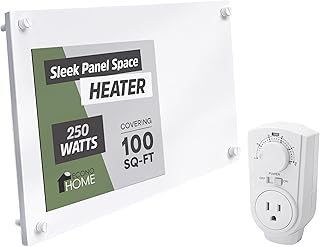
Best for compact spaces and lower-wattage needs. The 250W panel heater is suitable for smaller rooms or zones requiring mild, steady warmth. It features a thermostat and convection-based heat distribution, with similar safety protections and compliant design. Choose this option if you want a space-saving heater that maintains ambient warmth without occupying much wall space. Better for smaller bedrooms, offices, or enclosures where power consumption must stay very minimal.
Buying Guide
- Heat Type: Convection panel heaters distribute warmth through air currents, ideal for consistent room temperature. Infrared panels heat objects and occupants directly, delivering faster warmth for immediate comfort.
- Wattage and Room Size: Match wattage to room area. Larger rooms benefit from higher wattage models; smaller spaces can rely on 250–400W panels for steady comfort.
- Installation: Consider whether the unit is designed for hard-wiring or plug-in use. Wall-mounted models save floor space but may require professional wiring, especially for high-wattage units.
- Thermostat and Controls: Look for accurate thermostats and scheduling capabilities. Remote or app control adds convenience and potential energy savings through smarter usage.
- Safety and Compliance: Confirm safety features such as overheat protection, temperature limits, and certifications (e.g., UL, cETL). A cool-touch exterior and safe electrical design reduce risk in households with children or pets.
- Energy Efficiency: Models with lower energy consumption and efficient convective or infrared heating can reduce operating costs over time.
- Noise and Aesthetics: Fan-less or quiet operation is preferable for bedrooms and study areas. Consider whether you want a discreet panel that blends with decor.
Frequently Asked Questions
- What is a flat panel wall heater best used for? It’s ideal for zone heating in small-to-medium rooms, apartments, or offices where wall space is at a premium and you want consistent ambient warmth.
- Do these heaters require professional installation? Some models are plug-in and easy to install, while others may require hard-wiring. Check installation notes for each model.
- Are these heaters energy efficient? Many are designed to be energy efficient, using convection or infrared heating to minimize waste and lower total energy usage compared to older space heaters.
- Which heater is best for silent operation? Plug-in, fan-less panel heaters tend to be quietest, suitable for bedrooms and study areas.
- Can I control these heaters remotely? Several models offer remote or app control, enabling programmable schedules and easier operation.
- What should I know about safety? Look for overheat protection, temperature limits, and certifications to ensure safe operation in living spaces.