Answering the demand for endless hot water, these gas-powered tankless systems heat water on demand, saving space and improving efficiency. This guide highlights five models best suited for typical American homes, including indoor and outdoor installations, single- or multi-bath scenarios, and varying flow needs.
The following table summarizes the five selected products, focusing on best-use cases, flow rates, and installation notes to help buyers compare quickly.
| Product | Best For | Estimated Flow (GPM) | Installation | Notes |
|---|---|---|---|---|
| Ranein Natural Gas Tankless Water Heater | Homes needing strong indoor performance | 8.5 | Indoor | Compact, easy install, safety-focused blower |
| Rheem RTG Series 8.4 GPM Outdoor | Outdoor installation, larger homes | 8.4 | Outdoor | High BTU output; venting outside |
| Rheem RTGH Series 8.4 GPM Indoor Condensing | Indoor, high efficiency | 8.4 | Indoor | Condensing, ultra-low NOx |
| ThermoMate CZ422NG 5 GPM Indoor | Smaller homes or apartments | 5 | Indoor | Smart control with safety protections |
| APUS Natural Gas Tankless Water Heater | Budget-friendly, compact demand | 4.42 | Indoor | High flow for two showers plus sink |
Ranein Natural Gas Tankless Water Heater, 8.5 GPM

The Ranein model is designed for indoor use and delivers 8.5 GPM for steady hot water. It includes a safety-focused blower system that adapts to wind pressure and water temperature to ensure complete combustion and reduced backflow risk. The unit is compact (about 24.25 inches long) and uses standard 3/4″ NPT fittings for faster installation. It is best for households requiring ample hot water for multiple points of use without preheating delays.
Best for: homes needing strong indoor performance with quick hot water on demand. Better for: spaces where a compact footprint matters. Choose this if: you want reliable on-demand water without long preheat times. Caution: ensure proper venting and clearance for the blower exhaust in tight spaces.
Rheem RTG Series 8.4 GPM Outdoor

This outdoor model offers 8.4 GPM with a 180,000 BTU/hr output, designed for whole-house use with outdoor installation and venting considerations taken care of externally. Its non-condensing design emphasizes simplicity and strong hot-water delivery for larger homes or multi-bath scenarios where indoor space is limited. It’s a solid pick for people who prefer outdoor installation and a straightforward setup.
Best for: homes where outdoor installation is feasible and significant hot-water demand exists. Better for: installations with existing outdoor venting paths. Choose this if: you want a high-output unit without indoor ventilation requirements. Caution: outdoor units require weatherproofing and protection from the elements.
Rheem RTGH Series 8.4 GPM Indoor Condensing
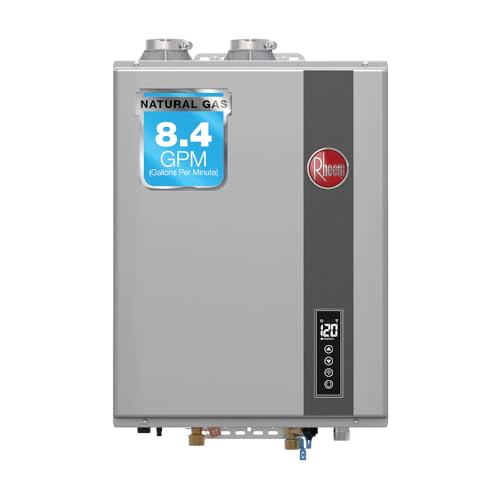
Rheem’s indoor condensing model uses advanced heat exchange with Ultra-Low NOx emissions and a high 0.93 UEF. It delivers about 8.4 GPM at a 35°F rise and is suitable for indoor installation with direct venting. This option targets households seeking efficiency and strong performance across multiple showers with reduced energy use.
Best for: households prioritizing efficiency and indoor installation. Better for: homes with modern venting and a need to minimize NOx emissions. Choose this if: you want high efficiency without sacrificing performance. Caution: indoor venting must be correctly installed by a qualified professional.
ThermoMate CZ422NG, Indoor 5 GPM

ThermoMate CZ422NG offers up to 5 GPM for indoor use, with a focus on stable water temperature and safety protection. It features smart flow sensing and a control chip that maintains temperature within ±1°F, making it suitable for households with two showers running simultaneously. It’s designed for easy wall mounting and can be a practical option for mid-size homes.
Best for: smaller homes or apartments needing reliable two-point hot water. Better for: users who want precise temperature control. Choose this if: you need solid performance without the largest household footprint. Caution: 5 GPM may limit simultaneous usage in very hot climates or high-demand periods.
APUS Natural Gas Tankless Water Heater
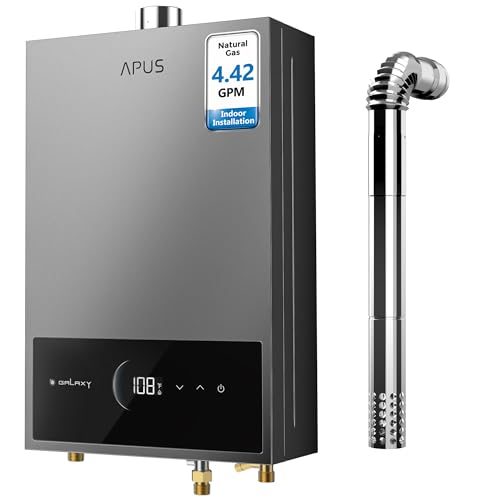
APUS offers 95,000 BTU heating with a 4.42 GPM flow rate for indoor use. It emphasizes high-capacity performance with precise temperature control and durable materials, including an LED smart display for easy setup. This model is a practical option for households needing dependable hot water for multiple fixtures without oversizing the unit.
Best for: budget-conscious buyers needing a compact, capable indoor unit. Better for: modest hot-water demand without sacrificing control. Choose this if: you want a cost-effective solution with reliable on-demand performance. Caution: 4.42 GPM may be limiting for high simultaneous demand in larger homes.
Buying Guide
Key considerations when choosing a gas tankless water heater include capacity, installation location, venting requirements, energy efficiency, and multi-point hot-water needs. Use the following questions to refine your choice:
- What is my peak simultaneous hot-water demand (showers, sinks, appliances)? Choose higher GPM models for busy households.
- Indoor vs outdoor installation: Indoor units require proper venting; outdoor units simplify venting but need weather protection.
- What climate considerations exist? Colder inlet temperatures reduce effective GPM; look for units with higher BTU output or condensing efficiency.
- Efficiency ratings matter: UEF and NOx emissions can affect operating costs and environmental impact.
- Space and installation ease: Compact wall-mount designs save floor space; ensure accessible service clearances.
Frequently Asked Questions
- What is a tankless gas water heater? A unit that heats water on demand as you open a hot-water tap, without storing hot water in a tank.
- How do I decide the right GPM? Consider your household’s simultaneous hot-water needs; more showers and sinks require higher GPM ratings.
- Do I need professional installation? Yes. Gas connections, venting, and code compliance typically require a licensed installer.
- Is indoor venting required for all models? Most indoor units require direct-venting; outdoor models avoid indoor venting but need weatherproofing.
- Are condensing models worth the extra cost? Condensing units are more efficient and can reduce operating costs, especially in colder climates.
- Can I retrofit a tankless heater to an existing home? Retrofitting depends on gas supply, venting, and existing plumbing; a professional assessment is recommended.