Finding the right hanging propane garage heater means balancing heating capacity, safety, and install practicality for your workshop, garage, or barn. This guide highlights five top options that are well-suited for ceiling-mount setups, covering a range from high-capacity units to versatile electric alternatives. The selections cater to different space sizes and usage patterns, helping buyers pick the best fit for their needs. Each entry notes who benefits most, plus practical cautions to consider before purchase.
| Product | Best For | Key Benefit |
|---|---|---|
| Mr. Heater 80,000 BTU Forced-Air Unit Heater | Large garages and workshops | High heat output for big spaces |
| Mr. Heater 50,000 BTU Forced-Air Unit Heater | Medium garages and barns | Solid balance of power and installability |
| Mr. Heater 125,000 BTU Forced-Air Unit Heater | Industrial or very large spaces | Top-end capacity with added features |
| ROVSUN 7500W Electric Ceiling Mount | Electric-ready spaces or where propane isn’t preferred | Smart controls and fast warm-up |
| Reznor 60K BTU Propane Ceiling Unit | Residential workshops and light commercial | Ceiling-mounted flexibility and efficiency |
Mr. Heater 80,000 BTU Propane/Gas Ceiling Unit Heater

Best for: Very large garages, barns, or workshops that require rapid, sustained heat. This ceiling-mounted unit delivers 80,000 BTUs, capable of warming up to about 2,667 square feet. The unit can run on propane or natural gas, making it flexible for various fuel ecosystems. Choose this for spaces where heat demand is consistently high and ceiling mounting is the preferred installation method. Note that color may vary between grey and tan, which can influence visibility in certain shop aesthetics.
Mr. Heater 50,000 BTU Electric/Propane Ceiling Heater

Best for: Medium-sized garages or barns where 50,000 BTUs are sufficient to maintain comfortable temperatures. This ceiling-mounted unit heats up to around 1,667 square feet and supports standard 24-volt thermostats, including newer Wi-Fi-enabled options sold separately. It’s a solid choice when you need a reliable balance of power, compatibility with existing thermostats, and a simpler installation in mid-size spaces.
Mr. Heater 125,000 BTU Propane/Gas Forced-Air Heater

Best for: Industrial or large commercial garages needing maximum heat output. The 125,000 BTU unit includes electronic ignition, powered exhaust, and a liquid propane conversion. This is suitable for spaces that require rapid, robust heating and have the infrastructure to support a higher-capacity unit. A potential limitation is upfront installation complexity and energy cost considerations in very large or poorly insulated areas.
Reznor 60K BTU Ceiling-Mount Propane Unit Heater
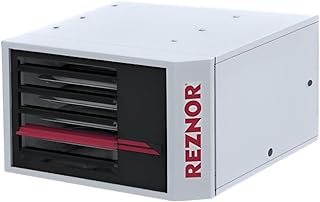
Best for: Residential workshops or light commercial spaces that benefit from ceiling mounting and a dedicated propane solution. The 60,000 BTU capacity offers strong heat for medium-to-large rooms, with a focus on industrial-style installation flexibility. It’s important to consider mounting requirements and the availability of suitable suspension hardware, as mounting is sold separately. This model emphasizes high thermal efficiency and indoor use suitability.
Buying Guide: Key Considerations for Hanging Propane Garage Heaters
- Space size and heat load: Larger spaces require higher BTU output. For garages around 1,000–2,000 sq ft, consider 50,000–80,000 BTU units; for spaces above 2,000 sq ft, 100,000 BTU+ units may be necessary.
- Fuel type and availability: Propane vs natural gas depends on fuel accessibility and running costs. Propane offers versatility for spaces without a gas line; natural gas requires a supply line but can be cheaper to run long-term.
- Ceiling mounting and clearance: Ensure there is adequate ceiling height and fan clearance around the heater. Proper mounting reduces heat stratification and improves safety.
- Thermostat compatibility: Some units support standard 24-volt thermostats or newer Wi-Fi-enabled controls. Verify compatibility with your current setup or smart-home plans.
- Ventilation and safety: Propane heaters often require proper venting or exhaust systems, especially in enclosed spaces. Check local codes and ensure adequate airflow to prevent carbon monoxide buildup.
- Efficiency and maintenance: Look for units with reliable ignition, efficient burn efficiency, and accessible maintenance features. Consider units with powered exhaust for better indoor air quality in smaller spaces.
- Electric vs dual-fuel options: Electric ceiling heaters provide an alternative where gas isn’t available or desired. Electric units typically offer precise control and easy wiring but require electrical capacity.
Frequently Asked Questions
- What size heater do I need for a 2,000 sq ft garage? Answer: A typical range is 60,000–100,000 BTU for uninsulated or poorly insulated garages; better insulation reduces the required BTU load.
- Is ceiling mounting safer for propane heaters? Answer: Ceiling mounting can improve heat distribution and keep units away from foot traffic, but requires proper installation and clearance per the manufacturer.
- Can I run a propane heater with a standard thermostat? Answer: Some units support standard 24-volt thermostats, while others require a dedicated control or Wi-Fi-enabled thermostat sold separately.
- Do I need ventilation for propane garage heaters? Answer: Yes. Proper ventilation reduces the risk of carbon monoxide buildup, especially in tightly sealed spaces. Follow local codes and manufacturer guidance.
- What’s the advantage of higher BTU units? Answer: Higher BTU units heat larger areas more quickly and maintain temperature more steadily in spaces with high heat loss or tall ceilings.
- Are electric ceiling heaters suitable for garages? Answer: Electric ceiling heaters work well in spaces where gas is unavailable or undesirable, but they require sufficient electrical capacity and may have different operating costs.