Answering the top buyer question, these heat cables for roof systems are designed to prevent ice dams, improve water flow, and protect roofing and gutters during winter. The following selections cover various roof types, wattage needs, and installation preferences. They’re best for homeowners who want reliable, plug-in de-icing solutions, property managers seeking commercial-grade options, and handy DIYers aiming for straightforward, maintenance-free setup. Below, you’ll see five carefully chosen options with clear use cases and practical trade-offs.
Buying table (selected products at a glance):
| Product | Best For | Key Benefit | Approx. Cable Length |
|---|---|---|---|
| TOPDURE TDRD 240FT | Long gutters, large roofs | Fully certified safety and maintenance-free | 240 ft |
| HEATIT HIRD 80 ft | Durable, versatile roofs | UL/ETL/CSA safety, pre-assembled | 80 ft |
| RADIANT SOLUTIONS HeatTapePro | High-end, reliable performance | GlowCap verification, 10-year warranty | |
| Eastrexon Heat Tape 152FT | All roof/gutter types | 4-layer safety design, versatile use | |
| Frost King RC160 160Ft | Standard residential roofs | Pre-assembled, easy installation |
TOPDURE TDRD 240FT Roof & Gutter De-Icing Cable
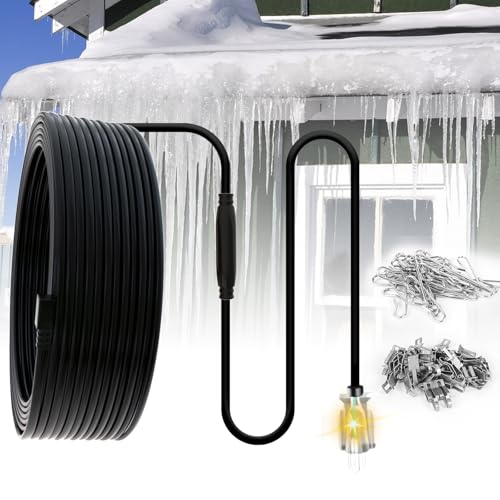
Features: 240 ft length, 5W/ft. The product emphasizes safety with ETL and CSA certifications, plus a UL-certified plug. Pre-assembled with a 6 ft 18/3 lead, ready for installation. Includes an instruction manual, clips, and spacers. Outer insulation and shielding provide durability in cold conditions.
Best for: Large roofs and long gutters where a single, continuous trace is needed. This is a solid pick for properties with extensive roof lines and challenging gutter runs.
Why chosen: It combines long reach with strong certifications and a complete installation kit, reducing guesswork during setup.
Caution: Fully unroll and route cables to avoid overlapped sections that can overheat in tight bends.
HEATIT HIRD 80 Feet 5 Watts Per Foot Roof & Gutter Cable

Features: ETL & CSA certified with UL-certified plug, pre-assembled with a 6 ft 18/3 cord. Uses tough XLPE insulation and a weather-resistant jacket. Fully rounded safety design includes aluminum foil shield and tinned copper braid for enhanced durability and safety.
Best for: Homeowners seeking a trusted safety profile with strong certifications and a manageable length for standard roofs and gutters.
Why chosen: The comprehensive safety certifications and ready-to-install package reduce risk and complexity for typical residential applications.
Caution: Not ideal if you need very long runs beyond the listed 80 ft without additional splices or extensions.
RADIANT SOLUTIONS HeatTapePro

Features: Self-regulating, GlowCap technology for end-to-end operation verification. Heavy-duty construction with injection-molded connections and a best-in-class 10-year warranty. UL-listed and certified for use on diverse roof types, including flat, metal, asphalt, and wood roofs.
Best for: Commercial-grade or high-demand residential projects where long-term reliability and easy monitoring are priorities.
Why chosen: The GlowCap feature provides a practical advantage for ongoing assurance and reduces maintenance concerns over time.
Caution: Higher upfront cost relative to basic cables; suitability for smaller projects may be limited by cable length options.
Eastrexon Heat Tape for Roof and Gutters 152FT

Features: 152 ft length, 8 W/ft rating, wide compatibility with noncombustible shingles, metal or plastic gutters and downspouts. Four-layer safety design includes waterproof outer jacket, insulation, shielding, and PTC layer. Constructed with AL-MG alloy wire, polyolefin, and a copper core for robust performance.
Best for: Homeowners with varied roof and gutter configurations who want a versatile, all-in-one de-icing solution.
Why chosen: The broad compatibility and multi-layer safety design support durable performance across diverse roof profiles.
Caution: Verify cord length meets your installation path to avoid near- or far-from-outlet reach issues.
Frost King Electric Roof Cable Kit RC160

Features: 120V x 800W x 160 ft, preset for easy installation with pre-assembled components and clear instructions. Ready-to-install package designed for straightforward setup.
Best for: Typical residential roofs with moderate length runs, especially when a simple, pre-assembled solution is preferred.
Why chosen: The pre-assembled design minimizes installation guesswork and helps ensure a reliable, ready-to-use system.
Caution: Length is substantial; ensure routing avoids sharp bends to maintain heat distribution and prevent cable fatigue.
Buying Guide: How to Choose The Right Roof Heat Cable
What should you consider before buying? Think about roof size, gutter complexity, and whether you need a long run with minimal installation effort. Self-regulating cables adapt heat output to ambient temperature, reducing the risk of overheating; constant-wattage cables deliver steady heat but require careful placement. Certifications matter for safety and compliance, especially in regions with strict codes. Cable length should cover peak roof and gutter spans without excessive overlaps.
How do I determine the right length and wattage?
Estimate total length by measuring roof edge and gutter span. For large roofs, consider longer runs or multiple cables. Wattage per foot (5 W/ft, 6 W/ft, etc.) affects heat output. In cold climates or for heavily shaded roofs, higher wattage is often advantageous but requires proper power supply planning.
What about safety certifications?
Look for ETL and CSA certifications, plus UL-listed plugs where available. These indicate adherence to North American safety standards and reliable performance across temperatures and weather conditions.
Fixed installation vs pre-assembled kits?
Pre-assembled kits simplify installation and reduce wiring errors. Self-regulating cables are easier to manage around gutters because they adjust heat output, while constant-wattage cables may require more careful routing to prevent overheating at overlaps or turns.
Which is best for different roof types?
Flat or metal roofs often benefit from high-end, durable cables with robust shielding. Shingle roofs may require flexible cables that can navigate around roof edges and downspouts. Always check compatibility with your roof material and gutter design.
Maintenance and longevity considerations?
Most modern cables require little maintenance beyond verifying a clean, unobstructed path for heat distribution. A good warranty, like a 10-year term on some models, signals long-term reliability and peace of mind.
Frequently Asked Questions
- Do heat cables cause roof damage? Properly installed cables are designed to complement roof systems and prevent ice dams without damaging shingles or gutters.
- Can I install heat cables myself? Yes, many kits are designed for DIY installation with included instructions and clips. Follow the manufacturer’s guidelines for safe wiring and routing.
- What’s the difference between self-regulating and constant-wattage? Self-regulating cables adjust heat output based on temperature, reducing the risk of overheating. Constant-wattage cables maintain a steady heat, requiring careful placement and protection against overlap.
- Are certifications necessary for every purchase? Certifications provide safety assurance and compliance with standards; they are highly recommended for residential and commercial use alike.
- What maintenance is required after installation? Periodically inspect for exposed insulation, damaged jackets, or loose clips. Ensure outlets and cords remain dry and accessible.