When selecting a heat lamp temperature controller, the best options provide precise temperature regulation, simple setup, and reliable safety features. This guide highlights five reliable models suitable for reptile tanks, seed germination, greenhouses, and home brews. Each product section explains who benefits most, why it was selected, and any limitations. The following summary table helps you compare key points at a glance.
| Product | Best For | Key Benefit |
|---|---|---|
| BN-LINK Reptile Thermostat | Reptile tanks, seed mats, small heat lamps | Easy setup with clear indicators and durable sensor probe |
| Inkbird ITC-308 | Homebrewing, greenhouses, terrariums | Dual stage control for heating and cooling |
| REPTIZOO Dimming Thermostat | Heat lamps, reptile habitats | PID-based dimming for stable temperatures |
| WILLHI WH2408 | Terrariums, greenhouses, fermentation projects | Two-knob setup, wide range, memory on outages |
| VIVOSUN Digital Heat Mat Controller | Seedling mats, incubation, germination | Reliable with root-zone temperature sensing |
BN-LINK Reptile Thermostat Temperature Controller

Best for reptile habitats and seedling heat mats, this digital thermostat is designed for heating devices only. Its three-button interface makes it easy to program a temperature in Fahrenheit or Celsius, and the display is bright for visibility in low-light settings. A sensor probe enables precise monitoring, while the 3.94 ft power cord and 4.92 ft probe support flexible placement. Use this controller for heat lamps and seed mats that require dependable on/off control rather than cooling. Caution: not suitable for cooling applications.
Inkbird ITC-308 Digital Temperature Controller

Best for setups requiring dual-stage control, this model supports both heating and cooling equipment, with a dual-relay system and a dual-display window showing current and set temperatures. It’s well-suited for carboys, homebrewing fermenters, greenhouses, and terrariums where you need to actively regulate against ambient fluctuations. Caution: ensure the connected equipment is within the 110V, 10A rating.
REPTIZOO Dimming Thermostat
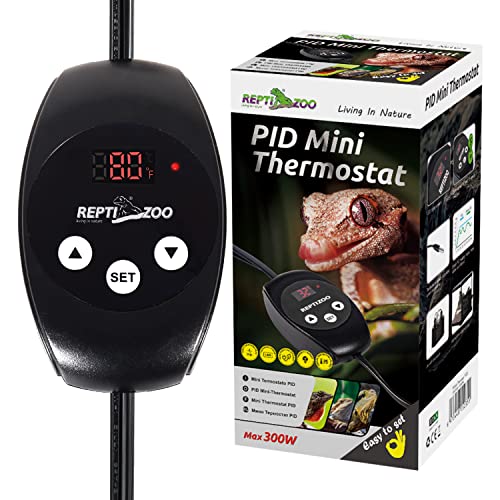
Best for precise, gradual temperature changes in reptile habitats, this dimming thermostat uses a PID-like dimming mode to stabilize temperatures and extend bulb life. It monitors real-time temperature with a sensitive sensor, adjusting output smoothly. Suitable for heat bulbs and general heaters, but not recommended for sunlamps. Caution: not ideal for very high-temperature sunlamp setups; verify bulb compatibility first.
WILLHI WH2408 Temperature Controller

Best for versatile, robust control, this unit provides a simple two-knob interface and covers a broad range (-58°F to 230°F, -50°C to 110°C). It memorizes settings during outages to reduce reconfiguration time. Ideal for reptile tanks, greenhouses, seedling mats, and even homebrewing applications. Caution: the probe is not waterproof; keep it dry, especially in humid setups.
VIVOSUN Digital Heat Mat Thermostat Controller
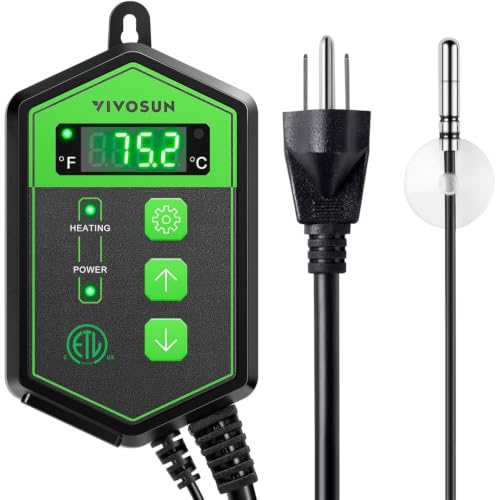
Best for root-zone temperature management in seedlings and germination projects, this controller targets a 40–108°F range with a dedicated sensor probe for accurate root temperature tracking. Its rugged plastic housing resists wear, and operation relies on three buttons, enabling quick Fahrenheit/Celsius switching and setpoint changes. Caution: ensure the sensor is placed away from direct heat sources to avoid erroneous readings.
Buying Guide: Key Purchase Considerations
What should you evaluate when choosing a heat lamp temperature controller?
- Temperature range: Match the device to your target environment, whether it’s a terrarium, greenhouse, or seed mat. Consider whether you need heating-only, cooling-inclusive, or dimming modes.
- Control method: Decide between on/off control, dimming, or dual-stage control. Dimming provides smoother transitions; dual-stage supports dynamic environments with both heaters and coolers.
- Probes and placement: Look for a probe long enough to reach the critical zone and a design that withstands your setup’s humidity or soil contact. Avoid probes exposed to direct heat where readings would be inaccurate.
- Power handling: Ensure the unit handles the wattage of your heater or mat. Overloading a controller can cause failures or safety concerns.
- Safety features: Seek devices with clear indicators, auto-shutoff capabilities, and robust construction to withstand daily use in potentially damp or dusty spaces.
- Ease of use: Favor models with simple interfaces, clear displays, and quick setup to minimize confusion and errors during installation.
Frequently Asked Questions
- What is a heat lamp temperature controller used for?
– It regulates temperatures in habitats, greenhouses, incubators, and seedling environments to protect plants and animals from overheating or chilling. - Do I need a dual-stage controller for a reptile tank?
– Dual-stage is beneficial if you also need cooling in addition to heating, but for heating-only setups, a simple on/off or dimming controller may suffice. - Can I use these controllers with sunlamps or high-wattage bulbs?
– Check the device’s wattage rating and compatibility notes. Some controllers are not suited for high-intensity sunlamps or very high-power bulbs. - Is a sensor probe necessary?
– Yes, a probe provides real-time temperature feedback, ensuring the controller can maintain the desired setpoint accurately. - Can I deploy these controllers for brewing or fermentation?
– Some models support fermentation and sous vide-like applications; verify the probe range and stability features match your process needs.