Answering the search intent: these thermostats optimize comfort and energy use for electric underfloor heating. They suit homeowners upgrading a bathroom or kitchen, remodelers installing radiant floors, and DIYers seeking reliable GFCI protection. The top picks balance ease of use, compatibility with 120/240V systems, and smart features. Below, you’ll find five solid options with quick-within-reach details and why each is best for specific needs. A quick summary table follows the introduction to help you compare at a glance.
| Product | Best For | Voltage |
|---|---|---|
| BOWSEN Programmable Thermostat | Best overall for underfloor mats with built-in GFCI | 120/240V |
| MAXKOSKO WiFi Smart Thermostat | Best for remote control and Alexa/Assistant integration | 120/240V |
| OJ Microline UDG4 Touchscreen | Best for intuitive touchscreen with adaptive learning | 120/240V |
| Nuheat Element Dual-Voltage | Best non-programmable, simple control | 120/240V |
| SunTouch SunStat ConnectPlus | Best for remote access and advanced scheduling | 120/240V |
BOWSEN Programmable Thermostat for Underfloor Heating
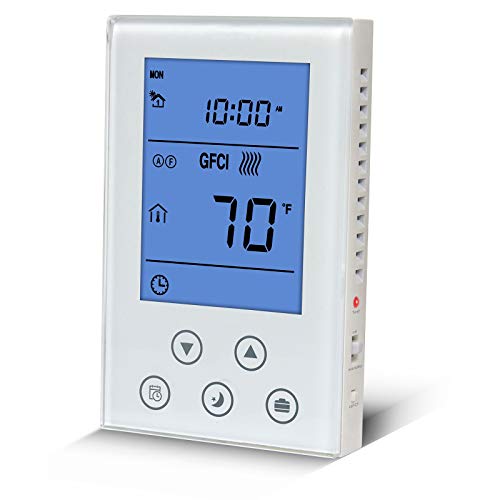
This dual-sensing thermostat supports both 120VAC and 240VAC, enabling up to 3600W at 240V and 1800W at 120V. It includes a floor and air sensor, plus a built-in GFCI with a test function for occupants’ safety. It is suitable for radiant floor mats and tile installations, making it a strong choice for residential bathrooms and kitchens. Best for buyers prioritizing integrated safety and straightforward programming.
Who it’s best for: homeowners requiring reliable GFCI protection and a robust, straightforward programmable interface. Why selected: the internal GFCI and dual-voltage support provide a comprehensive safety and compatibility package. Caution: follow the GFCI testing steps after installation to ensure proper operation and re-check for any leakage if the GFCI trips.
MAXKOSKO 1PC WiFi Smart Thermostat

This WiFi thermostat supports 120V/240V and offers remote control via a smartphone app. It supports voice assistants like Alexa and Google Assistant for hands-free adjustment. It emphasizes programmable settings to optimize energy savings and comfort without manual tweaks throughout the day. Best for: users who want mobile access and voice integration for whole-home heating control.
Why selected: strong emphasis on energy savings and remote operation. Caution: ensure your home network provides reliable connectivity for uninterrupted remote control and scheduling.
OJ Microline UDG4 Touchscreen Thermostat

This model features a 3.5″ color touchscreen, dual sensing (air and floor), and built-in Class A GFCI. It supports 120/240V and includes a floor sensor, offering a self-learning adaptive function to help reduce energy use while maintaining comfort. Best for: users who want a modern interface with adaptive programming and strong safety features.
Why selected: the adaptive function and floor/air sensing provide precise control. Caution: programming can be complex for first-time users; utilize the Install Wizard for setup.
Nuheat Element Dual-Voltage Thermostat

Nuheat Element is a straightforward, non-programmable thermostat with dual-voltage capability and a floor temperature sensor. It’s designed for a broad range of floor coverings and heating mats, cables, and kits. Best for: buyers who want a simple, reliable control without scheduling. Limitation: lacks advanced scheduling features found in programmable models.
Why selected: simplicity and compatibility with multiple floor types. Caution: not suited for buyers who need weekly programming or energy-tracking features.
Schluter Ditra-Heat-E-RT Thermostat

This programmable touchscreen thermostat supports both 120V and 240V Ditra-Heat-E-HK cables. It includes a built-in GFCI, energy tracking, and a 3.5″ display. Best for: those who want an integrated energy-tracking thermostat with a compact, modern interface. Caution: ensure compatibility with Ditra-Heat-E-HK cables in your installation.
SunTouch SunStat ConnectPlus

The SunStat ConnectPlus is a touchscreen, programmable thermostat with voice compatibility and remote access. It features floor and air sensing control, a 7-day schedule, energy monitoring, and weather-display options. Best for: households wanting remote control, energy insight, and versatile scheduling. Caution: some users may prefer simpler interfaces without smart features.
Buying Guide: Key Purchase Considerations
- Voltage compatibility: Most options support 120V and 240V; verify your wiring before purchase to ensure safe operation.
- Programmable vs non-programmable: Programmable models save energy with scheduling; non-programmable models are simpler and quicker to operate.
- GFCI protection: Look for built-in GFCI or near-term testing capabilities for safety on wet areas and tile installations.
- Sensor type: Floor vs air sensing affects response to room conditions; dual-sensing models offer more accurate control.
- Smart features: WiFi, voice control, and remote access provide convenience but require a reliable network and app compatibility.
- Floor compatibility: Check the thermostat’s compatibility with tile, stone, laminate, carpet, and underfloor heating cables/mats.
Frequently Asked Questions
- What is a GFCI in a floor heating thermostat for?
It protects occupants from electric shock by interrupting current if a fault is detected. - Do I need a programmable thermostat for floor heating?
Not always, but programmable models help reduce energy use by scheduling temperatures. - Which thermostat is best for smart home integration?
Thermostats with WiFi and voice assistant support (Alexa/Google) offer the best integration. - Can I use these with any floor type?
Most are designed for tile, stone, concrete, laminate, and engineered wood floors, but verify floor compatibility in product specs. - What is dual-sensing, and why is it important?
Dual sensing uses both air and floor temperature to regulate heating more accurately and efficiently. - How do I avoid nuisance GFCI trips?
Ensure proper wiring, check for leakage along the floor cable, and recheck connections; if tripped, follow safety steps per the device manual.