Answering the common question, the best approach to heat an uninsulated garage is to choose a high-output heater that can withstand temperature swings, directs heat efficiently, and fits your space. This guide highlights five top options suited for garages, workshops, or storage areas. Each heater is evaluated for energy use, heat distribution, and practicality in colder, poorly insulated environments. The buyers most likely to benefit include a DIYer with limited floor space, a contractor running a winter project, or a small workshop owner seeking reliable warmth.
| Product | ||
|---|---|---|
| Comfort Zone Ceiling Mount | Electric ceiling-mounted | Small-to-medium garages with limited floor space |
| Mr. Heater 50,000 BTU | Forced-air propane/natural gas | Large garages or workshops, heavier-duty heating |
| DR. INFRARED DR-975 | Hardwired electric wall/ceiling mounted | Powerful, space-saving heating for uninsulated spaces |
| ROVSUN 7500W | Electric ceiling-mounted with remote & app | Controlled heating with smart features for large areas |
| DR. INFRARED Portable | Portable infrared indoor/outdoor | Temporary or supplemental heat for small areas |
Comfort Zone Ceiling 5000W Garage Heater

The Comfort Zone 5000W ceiling-mount heater is designed for overhead placement in spaces where floor space is precious. With a ceiling-mount and hard-wired installation, it delivers efficient, directed heat to large garages, warehouses, or storage areas. It uses a robust steel body to stand up to harsh environments and temperature fluctuations common in uninsulated spaces. The louvers and adjustable mounting angle help tailor airflow to where heat is most needed.
Best for: workshop or garage owners needing strong overhead heat without consuming floor area. This model is a robust, space-saving option for continuous heating in damp or drafty environments.
Caution: Ensure proper electrical wiring and compliance with local codes; the unit is designed for fixed installation and should be installed by a qualified professional.
Mr. Heater 50,000 BTU Forced-Air Unit Heater

This ceiling-mounted forced-air heater provides substantial warmth for large garages, barns, or workshops. With 50,000 BTUs, it can heat up to about 1,667 square feet and is compatible with standard thermostats (sold separately) for controlled operation. It’s well-suited for spaces that require rapid elevation of temperature and where maintaining a stable climate is essential.
Best for: larger garages or multi-space work areas needing quick and robust heat delivery. Choose this if you require high heat output and can accommodate propane or natural gas fuel sources.
Caution: Fuel-based units require safe venting and fuel storage considerations. Verify compatibility with existing fuel systems and local ventilation requirements.
DR. INFRARED DR-975 7500W Heater
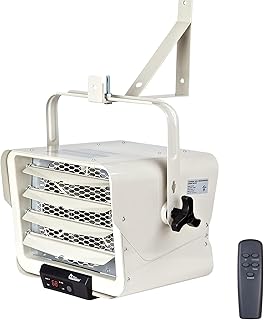
The DR. INFRARED DR-975 provides a high-wattage electric heating option with hardwired installation. It supports 4700W or 7500W on a 240V single-phase supply and emphasizes robust construction to withstand challenging spaces. A remote-controlled thermostat is included to help maintain a comfortable ambient temperature from a distance.
Best for: uninsulated or poorly insulated spaces where strong, steady electric heat is required and hardwired installation is feasible. It is a good match for DIYers who want reliable wall/ceiling mounting with convenient temperature control.
Caution: Power connections require appropriate wire gauge (8 AWG commonly recommended) and professional wiring for safety and compliance.
ROVSUN 7500W Electric Garage Heater

The ROVSUN 7500W ceiling-mount heater features smart controls, including remote and APP operation. It delivers rapid warming with a controlled airflow and offers a 12-hour timer for energy management. It incorporates overheat protection and an ETL safety certification, making it suitable for large workshops or factory spaces that require easy adjustment and reliable safety features.
Best for: larger garages or work spaces where remote monitoring and scheduling help maintain comfort while saving energy. App control adds flexibility for variable usage patterns.
Caution: Ensure the electrical system is wired for high-wattage loads and that the mounting location supports a ceiling-mounted installation.
DR. INFRARED Portable Infrared Indoor/Outdoor Heater

This portable infrared heater offers indoor and outdoor heating with three power settings (900W, 1200W, 1500W). It plugs into a standard 120V outlet and includes a remote for convenient operation. Its portability makes it ideal as a supplemental heat source or for quick warmth in a smaller zone of an uninsulated garage.
Best for: buyers needing a flexible, temporary heat source or a secondary heater to augment a primary system during very cold days. It’s a practical option when you want quick, localized warmth without a permanent installation.
Caution: Portable units may not provide even heat across a large space; pair with a larger fixed heater for consistent warmth in bigger garages.
Buying Guide: Key Considerations For Heating An Uninsulated Garage
Heat output and space size: Match the heater’s BTU or wattage to the garage area. Larger spaces generally need higher BTUs or wattage and sometimes multiple sources. Always check the square footage guidance from the manufacturer.
Installation type: Ceiling-mounted electric heaters save floor space but require professional wiring for high-wattage models. Wall-mounted or portable units offer flexibility but may require strategic placement for even distribution.
Heat distribution: Look for adjustable louvers, directional outlets, or smart controls that allow you to target specific zones. In an uninsulated space, even heat is harder to achieve, so controllable airflow helps reduce cold spots.
Safety and certifications: Confirm safety features such as overheat protection, ETL or UL certifications, and proper enclosure materials. In uninsulated spaces, robust build quality matters due to exposure to drafts and temperature swings.
Fuel source and flexibility: Electric heaters avoid fuel handling but require a suitable electrical supply. Propane or natural gas options offer high heat output for very large spaces but need ventilation and fuel logistics.
Controls and scheduling: App control, remote thermostats, and timers can improve efficiency by aligning heat with occupancy. Consider units with stable thermostat performance in cold environments.
Frequently Asked Questions
- What heater is best for a 2-car garage?
For a 2-car garage, a high-output electric ceiling heater or a propane/gas forced-air unit is typically effective, depending on ventilation and insulation. Consider a 7500W electric option or 50,000 BTU gas units for rapid warming.
- Do I need professional installation for electric garage heaters?
Yes, for high-wattage ceiling-mounted electric heaters, professional wiring ensures safety and code compliance. Smaller portable or plug-in models may require less extensive installation.
- What is the advantage of ceiling-mounted heaters in garages?
Ceiling-mounted units save floor space and distribute heat downward, reducing clutter and improving safety in busy workshops.
- Can a portable heater keep an uninsulated garage warm reliably?
Portable heaters provide flexibility and backup warmth but may not evenly heat large spaces. Use them as supplemental heat alongside a primary system.
- Is heat distribution a concern in uninsulated spaces?
Yes. Uninsulated garages have drafts and cold spots. Look for models with adjustable airflow and the ability to direct heat to the occupied areas.
- Do these units require venting?
Most electric heaters do not require venting, while fuel-based units do. Always follow the manufacturer’s venting and clearance recommendations.