High-efficiency baseboard heaters deliver steady warmth with minimal energy waste, making them ideal for compact rooms, bedrooms, and home offices. This guide highlights five reliable options and clarifies who each is best for. If you’re seeking easy installation, strong heat output, and safety features, these models fit a range of needs—from tight spaces to larger rooms and smart-home setups.
| Product | Best For | Key Feature |
|---|---|---|
| Cadet F Series 48″ (Model: 4F1000W) | Medium rooms, wall or floor mounting | High wattage options with universal wiring |
| KING 6K2412-BW (6′, 1500W, 277V) | Spacious rooms, durable build | Aluminum ribbon fin element |
| Comfort Zone CZ600 (1500W) | Home offices and bedrooms | Adjustable thermostat, safety features |
| Cadet F Series 24″ (Model: 2F350W) | Small rooms, space-saving installs | Compact design with decent output |
| DREO Smart Wall Heater (1500W) | Smart homes, versatile control | App and voice control compatibility |
Cadet F Series 48″ Electric Baseboard Heater
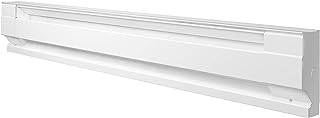
Best for medium-sized rooms that require steady heat with straightforward installation. This 1000/750-watt heater operates at 240/208 volts, delivering robust warmth for spaces that need reliable baseline heat. Its universal wiring and pre-punched knockouts simplify wall or floor mounting, which helps keep installation costs down. A high-temperature safety shutoff adds a critical safety layer for households with children or pets.
Who it’s best for: homeowners wanting strong, consistent heat with flexible installation options in medium rooms. Limitations: not the smallest unit; may be overkill for very small rooms.
KING 6K2412-BW K Series Baseboard Heater

Better for larger or longer rooms where a durable, low-profile design is valued. The aluminum ribbon fin element provides efficient heat transfer, and the heater includes a full-length safety cutout and a crushproof element for long-term reliability. This model is well-suited for households needing a robust baseboard solution with solid construction.
Who it’s best for: spaces requiring a durable, long, low-profile heater. Limitations: Requires appropriate electrical supply for 277V systems.
Comfort Zone CZ600 Electric Baseboard Heater

Ideal for bedrooms or home offices where silent operation and safety are priorities. This model features two heat settings, an adjustable thermostat, tip-over switch, stay-cool body, and overheat protection. It emphasizes quiet performance and user-control, making it a strong pick for spaces that require consistent heat without noise.
Who it’s best for: users prioritizing safety and quiet operation in medium rooms. Limitations: as a convection heater, it may warm more slowly than radiant options in very cold spaces.
Cadet F Series 24″ Electric Baseboard Heater

Best for small rooms where space is at a premium. The 350/262-watt output on 240/208 volts makes this a compact yet efficient option. Best for rooms that require targeted heat without a large footprint. Limitation: lower wattage means it’s less suitable for larger spaces.
DREO Smart Wall Heater
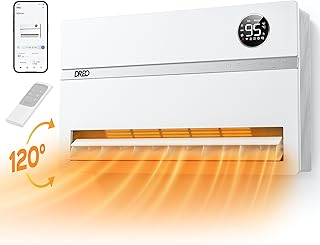
Best for tech-enabled homes seeking remote and voice-controlled heating. The DREO Smart Wall Heater supports app-based scheduling and voice control with Alexa and Google Home, enabling flexible room-temperature management. Its 1500W rating provides strong heat output for spaces that demand quick warmth.
Who it’s best for: users wanting smart control and multi-room convenience. Limitations: smart features rely on compatible devices and stable connectivity.
Buying Guide: Key Considerations When Choosing a High-Efficiency Baseboard Heater
Room size and heat load: Match wattage to room square footage and insulation. Larger spaces typically need higher wattage or longer heaters for even warmth.
Electrical supply: Check voltage and circuit availability (120V, 208V, 240V or 277V). Ensure wiring aligns with local codes and panel capacity.
Installation options: Decide between wall-mounted or floor-mounted configurations. Consider ease of mounting and whether universal wiring or knockouts are required.
Safety features: Look for high-temperature shutoff, tip-over protection, keep-cool surfaces, and overheat sensors to minimize risk in homes with kids or pets.
Noise level and comfort: If quiet operation is important (bedrooms, study rooms), prioritize heaters designed for minimal fan noise or convection-only heat delivery.
Smart controls: For busy households, consider models with thermostats, remote control, or smart-home compatibility for automation and energy savings.
FAQ
- What size baseboard heater do I need for a 200 sq ft room? A heater rated for 1000–1500 watts is typically suitable, depending on insulation and climate. Check recommended wattage per square foot for your space.
- Are high-efficiency baseboard heaters safer than traditional models? Modern units include safety shutoffs, tip-over protection, and stay-cool surfaces, improving safety in everyday use.
- Can I install baseboard heaters myself? If you are comfortable with basic electrical work and follow local codes, installation is possible; otherwise hire a licensed electrician.
- Do smart-baseboard heaters really save energy? Yes, they enable scheduling and zoning, reducing heat output when rooms are unoccupied and improving overall efficiency.
- Should I choose 240V or 120V models? 240V units deliver higher heat output and are common for baseboard heaters in larger spaces; 120V units suit smaller rooms and easier wiring.
- What is the advantage of a long baseboard heater? Longer heaters distribute heat more evenly along a wall, reducing cold spots and improving comfort in larger rooms.