If you’re searching for high efficiency electric baseboard heating, you’re looking for low-noise, even warmth, and simple installation that can integrate with smart thermostats or built-in controls. This guide highlights five top options, explaining who each is best for and why it stands out. It’s ideal for homeowners, renters upgrading a single room, or builders outfitting a new space with reliable, energy-conscious heat. Below, a quick summary table helps compare key points at a glance.
| Product | Best For | Hardwired or Plug-In | Key Benefit |
|---|---|---|---|
| Cadet F Series 24″ (2F350W) | Small rooms, budgets-conscious spaces | Hardwired | Compact, versatile wattage options |
| Stelpro Brava 500W (AB0501W) | Quiet, space-constrained areas up to 50 sq ft | Hardwired | Full-length convection design for even heat |
| Stelpro Brava 1000W (AB41001W) | Living rooms or bedrooms up to ~100 sq ft | Hardwired | One-piece, quiet operation with built-in safety features |
| Cadet F Series 36″ (3F750W) | Medium to large rooms needing steady heat | Hardwired | Higher wattage, universal wiring |
| MOLLIFII 48″ 1000W (4F1000-1W-A) | Large rooms or zones needing strong heat | Hardwired | High BTU output with simple 1000W operation |
Cadet F Series 24″ Electric Baseboard Heater
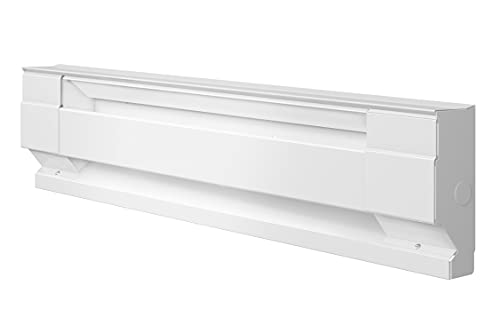
The Cadet F Series 24″ baseboard heater provides a compact option suitable for smaller rooms or zones. It operates at multiple voltages (240/208V) with wattage options that make it a flexible choice for retrofit projects. Its steel construction supports durable, steady convection heat without moving parts. This model is best for budget-minded spaces where a straightforward, hardwired baseboard is preferred.
Best for: small rooms, apartments, or renovation projects where a discreet, reliable heater is required. Limitations: exact thermostat compatibility and wiring scope should be confirmed with a licensed installer.
Stelpro Brava 500W Baseboard (AB0501W)
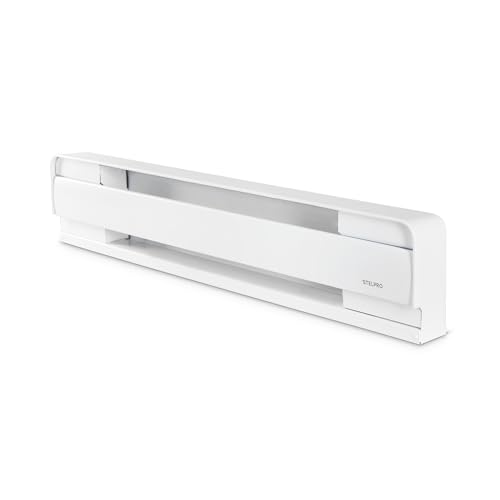
This Stelpro Brava model delivers heat through efficient convection with a quiet profile, suitable for spaces up to about 50 square feet. Hardwired installation supports room-control integration using a wall thermostat (sold separately) or optional built-in thermostat kits. It features a full-length thermal protection system and a no-end-cap, one-piece cabinet design for minimal expansion noise and a clean look.
Best for: compact living spaces or bedrooms where quiet operation matters. Limitation: requires hardwired setup and thermostat integration for full control.
Stelpro Brava 1000W Baseboard (AB41001W)

This 1000W Stelpro Brava offers robust convection heating for mid-sized spaces. It is designed for permanent hardwired installation and supports thermostat control either via a separate wall unit or a built-in option. Its one-piece, no-end-cap construction minimizes noise and ensures even heat distribution across the room. It is best for living rooms or larger bedrooms that require consistent heat without fans.
Best for: medium-sized rooms that need steady, quiet warmth. Limitation: not a plug-in model; installation planning is required.
Stelpro Brava with Built-In Thermostat Bundle (1000W / 240V)

This bundle combines a 1000W Brava baseboard heater with a built-in two-pole thermostat, enabling direct room-by-room control without a separate wall thermostat. The unit maintains quiet operation through natural convection and uses durable steel housing with rounded corners. It suits larger rooms or zones where temperature control is desired without extra wall devices.
Best for: spaces that benefit from integrated control in a single unit. Limitation: the included thermostat is built-in; expansion requires compatible additional controls.
MOLLIFII 48″ Electric Baseboard Heater

The MOLLIFII 48″ model delivers 1000W across a wide length, making it a practical choice for larger rooms or zones requiring substantial warmth. Its simple 120V operation and 3412 BTU/H output provide a straightforward solution without complex wiring. This option highlights a balance between size and power for more purposeful comfort uplift.
Best for: large spaces or open-plan areas where a single heater can cover significant square footage. Limitation: 120V operation limits potential wiring configurations in some retrofit projects.
Buying Guide: Key Considerations for High-Efficiency Electric Baseboard Heating
- Heat output and room size: Match wattage to the room’s square footage. Higher wattage models cover larger areas but may require careful circuit planning.
- Electrical configuration: Most options here are hardwired with 240V or 208V. Assess whether your space supports a wall thermostat or requires a built-in control kit.
- Convection vs. radiant: Convection baseboards offer steady air-based warmth with no moving parts, while radiant units provide heat that feels immediate on contact but may have different install considerations.
- Noise and vibration: Look for one-piece no-end-cap designs and units marketed as quiet to minimize room disturbances.
- Safety features: Choose models with thermal protection, overheat shutoff, stay-cool surfaces, and tip-over protections where applicable.
- Maintenance and installation: Consider ease of wiring, accessibility for service, and whether built-in thermostats or separate controls are preferred for future upgrades.
- Aesthetics and placement: Slim profiles and rounded-corner cabinets help blends into living spaces without drawing attention.
FAQ: High Efficiency Electric Baseboard Heating
- Do baseboards need a thermostat? Many units can be controlled by a wall thermostat or built-in thermostat kits if included with the model or purchased separately.
- Can baseboard heaters be used in all rooms? They work well in bedrooms, living rooms, and offices, but spaces with high ceilings or irregular shapes may benefit from multiple units for even distribution.
- Are hardwired baseboards safer than plug-in? Hardwired units typically integrate with permanent electrical circuits and wall thermostats, often favored for continuous use and temperature consistency.
- What maintenance do they require? Routine checks for dust clearance and thermostat function help maintain efficiency; no fans mean fewer moving parts to wear.
- Which is more energy-efficient: electric baseboard or hydronic baseboard? Hydronic bases can retain heat longer; electric models are simple, fast to install, and effective for spot heating or zone control.
- Can I install these myself? Installation involves electrical wiring and may require a licensed electrician to meet safety codes and local regulations.