Finding the right hot water baseboard radiator helps maintain steady, comfortable warmth while staying energy-efficient. This guide highlights five practical options for residential or light commercial use, with buyers in mind: compact spaces, retrofit projects, or new installs. Each product is evaluated for best-for scenarios, notable features, and practical trade-offs to aid a clear comparison.
Summary table of selected products
| Product | Best For | Key Benefit | Limitations |
|---|---|---|---|
| Embassy 48″ Panel Track Heater | Residential or light commercial | Includes front cover, back panel, damper, 3/4″ element | End caps sold separately |
| Embassy 36″ Panel Track Heater | Compact spaces | Same complete kit as 48″ version | End caps sold separately |
| 5 ft. 30 Series Hydronic Baseboard | Custom-length installs | Built to match exact requirements | Longer lead times may apply |
| Slant/Fin 7′ Hydronic Baseboard | Ready-to-install large rooms | Fully assembled, reliable performance | Length fixed at 7 ft |
| Beacon Morris Hydronic Kickspace Heater | Under-cink or narrow spaces | Made in the United States | Lower heating capacity per unit |
Embassy 48″ Panel Track Heater With 3/4″ Element
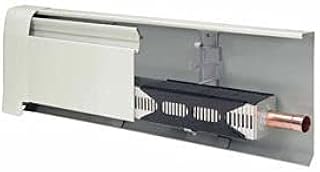
Best for: Homeowners installing a low-profile, high-capacity baseboard in a living space. This Embassy model provides a complete kit including front cover, back panel, damper, brackets, and a 3/4″ element. It is suitable for both new builds and retrofit projects where a clean, finished look matters.
Why it’s selected: The included components simplify installation and reduce the number of separate parts you need to source. The 3/4″ element supports adequate heat output for medium-to-large rooms when paired with a compatible boiler system.
Tips and considerations: End caps are sold separately, so plan for a full trim kit if you need a seamless edge around the heater. Check alignment with your wall stud layout before mounting.
Embassy 36″ Panel Track Heater With 3/4″ Element
Best for: Smaller rooms or spaces where a 36″ panel offers adequate coverage without crowding the wall area. This unit mirrors the 48″ version’s components for a consistent installation experience.
Why it’s selected: It delivers the same front cover, back panel, damper, and brackets with a 3/4″ element, making it a predictable choice for standard hydronic setups. It’s easier to fit in compact layouts while maintaining uniform heat distribution.
Caution: Like the 48″ model, end caps are sold separately—plan for trim pieces if you want a clean finish around the radiator.
5 ft. 30 Series Hydronic Complete Baseboard

Best for: Custom-length installations that require precise heat distribution along a wall. This product is built to meet exact specifications and emphasize reliability and premium materials.
Why it’s selected: The spec-driven approach helps match room size and hot water input with minimal gaps in coverage. It’s well-suited for builders who want a durable, long-lasting baseboard solution.
Limitation: Exact length customization may require coordination with the supplier to ensure compatibility with existing piping and thermostat controls.
Slant/Fin 7′ Hydronic Baseboard 30 Series

Best for: Medium-to-large rooms that benefit from a ready-to-install, fully assembled baseboard. The 7 ft length reduces the number of joints while providing consistent heat output.
Why it’s selected: The fully assembled design saves field labor and ensures a tight, efficient heat transfer surface with the Slant/Fin configuration. It is a dependable mainstream choice for traditional hydronic heating systems.
Limitation: It is a fixed 7 ft length; if your wall requires a different size, you may need to join multiple units or opt for a customizable option.
Beacon Morris Hydronic Kickspace Heater

Best for: Under-cabinet or narrow spaces where vertical clearance is limited but a compact heater is needed. Kickspace models are designed to fit in tight corners while delivering warmth from the floor up.
Why it’s selected: Made in the United States, this option supports localized manufacturing standards and may appeal to buyers prioritizing domestic production. It complements low-profile heating schemes in kitchens, baths, or hallways.
Limitation: This unit typically offers lower surface area than larger baseboard sections, so it may be best paired with other heating zones for uniform room warmth.
Buying Guide
What matters most when choosing hot water baseboard radiators?
- Room size and heat load: Match baseboard length and element size to the room’s heat requirement. Larger rooms may need longer sections or multiple units.
- Installation type: Decide between ready-to-install kits and customizable lengths based on wall configuration and existing piping.
- Finish and trim: Consider front covers, end caps, and brackets to achieve a clean finish that matches decor and space constraints.
- Hydronic compatibility: Confirm your boiler or hot water system supports the baseboard’s 3/4″ or other connection sizes and flow rates.
- Maintenance and durability: Look for units built with robust materials and corrosion resistance for long-term service.
- Location and airflow: Plan for optimal air return paths to avoid hot spots and ensure even room heating.
FAQ
- What size baseboard should I choose for a 200 sq ft room?
Estimate about 20–30 BTU per square foot for a typical living space. Choose baseboard length and element capacity to meet that load, considering insulation and window warmth.
- Can I mix different baseboard brands in the same system?
Yes, provided all units are compatible with your boiler’s water temperature and flow, but ensure similar finish and mounting to avoid installation mismatches.
- Do all baseboards require end caps?
Many complete kits include end caps sold separately for edge finishing. Plan for appropriate trim pieces if your installation requires a clean boundary.
- Are kickspace heaters less effective than standard baseboards?
Kickspace heaters fit tight spaces and can supplement larger zones, but they typically cover less surface area. Use them to target specific narrow areas.
- What maintenance do hydronic baseboards need?
Annual system check for leaks, corrosion inhibitor levels, and thermostat operation. Clean dust from fins to maintain efficient heat transfer.