Answering the common buyer question “which hot water heat exchanger should I choose for reliable heat transfer,” this guide highlights five top options suitable for hydronic heating, pool and spa heating, and outdoor snow melting. These selections balance durability, efficiency, and installation practicality. The target buyer profiles include system installers seeking robust stainless-steel units, homeowners pursuing energy-efficient transfers, and DIYers needing compact, easy-to-hook setups. Below is a quick buying snapshot to compare core attributes at a glance.
| Product | Brand | Best For | Key Benefit |
|---|---|---|---|
| AB Plate Heat Exchanger, 4 x 12 Inch | AB Store | Hydronic heating and snow-melt systems | 316L stainless steel with copper brazing for reliable heat transfer |
| VEVOR Brazed Plate Exchanger, 5″x12″ | VEVOR Store | Floor heating and high-demand cooling | High efficiency with asymmetrical herringbone pattern |
| AB 300 kBTU Heat Exchanger | AB Store | Outdoor wood boilers, pools, spas | Large capacity for big-volume heating |
| Water to Air Exchanger 10×10 | AB Store | Outdoor wood furnaces and forced-air systems | Excellent heat transfer with copper/aluminum construction |
| Water to Air Exchanger 18×18 | AB Store | Hot water coils for air heating | High performance with multiple copper tubes and fins |
AB Plate Heat Exchanger, 4 x 12 Inch, 30 Plates
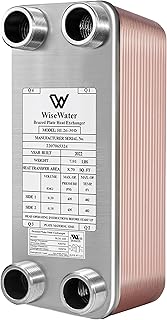
- 316L stainless steel with copper brazed edges for durability and leak resistance.
- 250,000–330,000 BTU per hour, 30 plates, 4″ x 12″ with 1″ MPT.
- Hydronic heating, water heating, and snow-melting systems that demand rugged performance.
This unit is best for buyers who need a compact, high-capacity plate exchanger with strong corrosion resistance. It suits hydronic loops in residential or light commercial setups where durable copper brazing improves long-term reliability. A potential limitation is its 30-plate configuration, which may be more than needed for very small systems, potentially increasing footprint and cost if not required.
VEVOR Brazed Plate Exchanger, EATB28-30
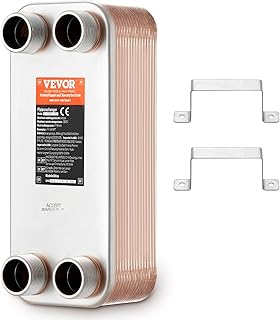
- 316L stainless steel with 99% copper brazing; robust and leak-resistant.
- Asymmetrical herringbone plate pattern for strong turbulence and heat transfer.
- 260–360K BTU per hour; suitable for floor heating and cooling loops; operating range from -292°F to 392°F.
Choose this if you need high heat transfer efficiency in a compact, reliable unit. It’s better for systems where space is constrained but high duty cycles are expected. A caution: installation may require careful gasket-free brazing considerations and alignment during assembly to ensure seal integrity over time.
AB 300 kBTU Heat Exchanger

- Up to 23,800 gallons pool heating, 300 kBtu/hr at 60°C temperature difference.
- Fully made of anti-corrosion 316L stainless steel for pool, spa, or hot tub use with chemical treatment.
- Outdoor pools, spas, and hybrid setups requiring higher heat transfer through stainless steel.
Best for buyers prioritizing large-volume pool or spa heating where stainless steel corrosion resistance is essential. Consideration: the unit may be heavier and bulkier than smaller plate exchangers, requiring adequate mounting and plumbing space. Warranty information should be confirmed with the seller.
Water to Air Exchanger 10×10

- 42,000 BTU base, up to 360,000 BTU/hour depending on setup.
- 12 aluminum fins, three rows of 3/8″ copper tubes per inch; copper/aluminum construction enhances heat transfer.
- Outdoor wood furnaces and forced-air heating systems with water-to-air transfer.
Ideal for buyers integrating water-to-air heat exchange with outdoor boilers or solar-assisted setups. It emphasizes transfer efficiency via fins and copper tubes. A potential limitation is installation compatibility with existing ductwork; ensure plenum fit and airflow requirements are met.
Water to Air Exchanger 18×18

- Up to 120,000 BTU base; can reach 360,000 BTU/hour in larger configurations.
- 12 fins, 3 rows of 3/8″ copper tubes per inch; emphasizes high heat transfer surface area.
- Hot water coils and coil-based air heating in medium-to-large homes or shops.
This model is best for buyers needing a larger water-to-air exchange surface to support robust air-heated spaces. Choose this if the system demands significant heat to be delivered through air, such as larger workshops or multi-zone heating. A limitation is the potential increased footprint and weight, which may require reinforced mounting and more substantial framing.
Buying Guide: Key Considerations For Hot Water Heat Exchangers
- Materials and durability: Stainless steel 316L plus copper brazing offers corrosion resistance and reliable heat transfer. Confirm compatibility with your fluid (water, glycol mixtures) and local water chemistry.
- Plate count and size: More plates increase surface area and capacity but also footprint. Match plate count to your heating load and space constraints.
- Temperature and pressure ratings: Ensure the exchanger’s operating range aligns with your system’s maximum pressure and temperature, especially for outdoor installations.
- Connections and fittings: Check port sizes (e.g., 1″ MPT, 2″ or 1 1/2″ FPT) and ease of installation with existing piping. Some models use standard NPT threads for quick hookups.
- Efficiency and turbulence design: Plate patterns (such as asymmetrical herringbone) impact heat transfer efficiency. Higher turbulence generally improves performance in variable flow conditions.
- Applications: Hydronic heating, pool and spa heating, snow-melt systems, or air heating via water-to-air exchangers each have different operational aims. Choose accordingly.
- Maintenance and serviceability: Look for units with robust seals, accessible brazed joints, and clear installation manuals. Consider future serviceability when choosing a compact model.
Frequently Asked Questions
- What is a hot water heat exchanger used for? It transfers heat from a hot water loop to another medium (water or air) to heat spaces, water, pools, or snow-melt surfaces.
- Which material is best for durability? Stainless steel 316L with copper brazing provides high corrosion resistance and strong heat transfer for diverse systems.
- How many plates do I need? More plates increase heat transfer area and capacity. Select based on the design heating load and space constraints.
- Can these units work with outdoor installations? Yes, many models are rated for outdoor use, but confirm weather resistance, insulation, and mounting requirements for your climate.
- Are water-to-air exchangers suitable for residential HVAC? They can be integrated into hydronic-to-air systems where a water loop powers indoor air heating via a coil.
- Do these exchangers require electricity? Most rely on fluid flow from a pump; the exchanger itself does not require electricity for operation beyond system pumps.