The best hot water heater depends on where you need hot water, how much you use, and what power or fuel the installation requires. For whole-house demand, the Rinnai 80-gallon heat pump model is the strongest fit in this selection. For a sink, consider either 120V ThermoMate or 110V xwdzswgs units; for stored hot water, compare the VEVOR 18-gallon model. RV owners can consider VEVOR’s 42,000-BTU RV heater. These products serve different applications and are not interchangeable.
| Product | Best suited for | Key consideration |
|---|---|---|
| Rinnai 80-gallon heat pump | Higher-demand households | Requires 240V, 30A power |
| ThermoMate 3500W electric | One sink | Hardwired; no plug |
| xwdzswgs 3000W electric | Compact sink installation | Not intended for showers |
| VEVOR 18-gallon heater | Stored hot water needs | Tank capacity is limited |
| VEVOR RV tankless heater | RV hot water | Designed specifically for RV use |
Rinnai 80-Gallon Heat Pump Water Heater

Best for: Households with substantial daily hot-water demand that can accommodate a large storage heater and its electrical requirements. The listed 80-gallon capacity and first-hour delivery of up to 91 gallons make this the most household-oriented option in this selection.
The Rinnai REHP80 is a 240V, 30A electric heat pump water heater. Its listed features include Energy Star certification, a 3.90 Uniform Energy Factor, and a demand-response feature that can communicate with participating local utilities to reduce energy use during peak periods. It draws heat from ambient air rather than relying only on electric resistance heating.
Choose this if you want a large-capacity unit and energy-efficient operation is a priority. It is a better fit for a household than a compact point-of-use heater. Limitation: It needs 240V, 30A power and substantial installation space; check site requirements before choosing it.
ThermoMate 3500W Under-Sink Heater

Best for: A kitchen or bathroom sink that needs on-demand hot water. This 120V unit is listed at 29.2 amps and provides a stated flow range of 0.4 to 0.66 gallons per minute, making it a point-of-use choice rather than a whole-house heater.
The ThermoMate has a temperature display and a setting range of 86°F to 131°F. Its self-modulating power is described as adjusting output as inlet flow and temperature change. The listed construction includes a cast aluminum heating element separated from the water line and a SUS 304 stainless steel water tube.
Choose this if you need hot water at one sink and have an appropriate hardwired electrical connection. It may be a better fit than a larger storage unit when space is limited. Limitation: It must be hardwired and does not come with a plug, so confirm the electrical installation requirements before purchase.
xwdzswgs 3000W Compact Tankless Heater

Best for: A compact, localized hot-water setup where a 110V wall-mounted unit is appropriate. The product listing gives a 3000W rating and describes a digital display, compact design, and temperature rise of 82°F at 0.3 GPM to 131°F at 0.5 GPM.
The display can show Fahrenheit or Celsius; the listing says to hold the power button for six seconds to change the setting. Its small wall-mounted form is intended to save space, and the stated applications include kitchen and bathroom sinks, apartments, RVs, and camping.
Choose this if you want an on-demand unit for a low-flow faucet and need a compact footprint. Limitation: The listing explicitly says it is not suitable for a shower, noting that a shower normally requires at least 1.8 GPM. Do not treat its stated low-flow performance as whole-house capacity.
VEVOR 18-Gallon Electric Water Heater
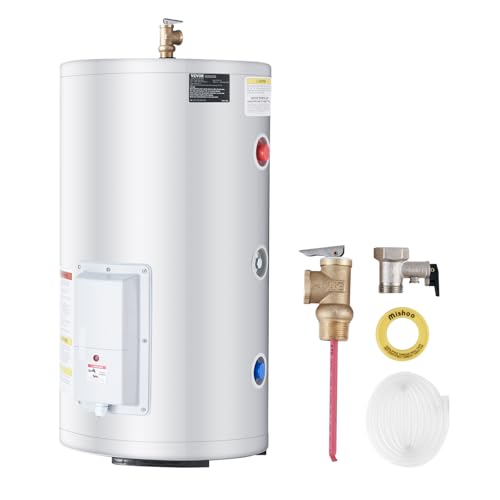
Best for: Buyers who want stored hot water in a relatively small 18-gallon capacity. Although the product name calls it tankless, its listed 18-gallon, or 70-liter, capacity describes a storage-style hot-water supply. That distinction matters when comparing it with true on-demand units.
The heater uses a 1600W immersion element and has rotary temperature control from 86°F to 167°F. The listing describes an LED heating display, an enamel glass coating, and hot water for uses such as dishwashing and laundry. It is described as maintaining hot water for continuous availability.
Choose this if stored water better suits your usage than a small point-of-use tankless heater. Its capacity may be useful where a compact tank is desired. Limitation: An 18-gallon supply is not the same as an unlimited on-demand supply; repeated or simultaneous uses can draw down stored hot water.
VEVOR 42,000-BTU RV Tankless Heater

Best for: RV owners looking for a heater designed for RV hot-water use, including showers and dishwashing. The listing specifies 42,000 BTU of heating output, a 15-by-15-inch black door, and a remote controller.
This VEVOR model uses segmented combustion technology, which the listing says adjusts water temperature for seasonal changes. An LED smart display and touch controls provide temperature and power adjustments. Its RV-specific design makes it a more relevant option for a recreational vehicle than the household sink heaters above.
Choose this if your project is an RV installation and the listed door and control arrangement fit your setup. Limitation: It is an RV-oriented heater, not a general-purpose electric under-sink unit. Confirm installation and fuel requirements for your RV before buying; the product details provided here do not specify every installation requirement.
Buying Guide: How to Choose a Hot Water Heater
Do you need hot water for one faucet or the whole household?
Start by identifying the number of fixtures the heater must serve. A compact electric tankless heater is intended for a limited flow at a sink. It can reduce the wait for hot water at that location, but the listed xwdzswgs model is not suitable for a typical shower. A large-capacity heat pump heater is more relevant to household demand, while an RV heater is designed for a different installation context.
Do not compare flow rates, tank capacities, and heating outputs as if they measure the same thing. Gallons describe stored water, GPM describes flow, and BTU or watts describe heating output. Match each specification to the actual hot-water task.
Should you choose a tank, tankless unit, or heat pump?
- Tank-style storage: Stores a set volume of hot water. The VEVOR listing specifies 18 gallons, so consider how quickly your household uses hot water and whether the stored supply can recover between uses.
- Point-of-use tankless: Heats water as it flows, without storing a large volume. The ThermoMate and xwdzswgs options are aimed at localized sink use, with limited stated flow rates.
- Heat pump: The Rinnai model extracts heat from ambient air. Its listed large capacity and first-hour delivery are aimed at higher household demand, but it requires 240V, 30A power.
- RV-specific: The VEVOR 42,000-BTU unit is described for RV use. Confirm that its installation requirements suit the vehicle.
What electrical or installation requirements should you check?
Verify voltage, amperage, wiring, mounting, and available space before purchase. The ThermoMate is listed as 120V and hardwired with no plug. The xwdzswgs units are described as 110V models, while the Rinnai requires 240V and 30A. These requirements are not interchangeable. Ask a qualified installer to assess wiring and local code requirements when needed.
For a storage heater, check the available location and required plumbing connections. For a tankless unit, check the manufacturer’s stated flow and temperature-rise limits. A small heater may produce a useful temperature rise at low flow but may not supply enough hot water for multiple fixtures.
How much hot water do you use at peak times?
Consider the busiest period of the day, not just average use. A household that runs showers, laundry, and dishwashing close together needs a different capacity than a single sink. A tank’s stored volume and first-hour delivery help describe supply, while a tankless heater’s flow rate and temperature rise help describe on-demand performance. Compare those figures with the expected demand at the fixtures.
Which safety and control details matter?
Look for clearly stated temperature controls, displays, and safety features. The listed xwdzswgs under-sink model describes leakage, dry-boil, overheat, and inactivity protections, while the ThermoMate lists self-modulating power. The VEVOR storage heater lists an enamel coating and temperature control. These claims are product-specific; compare the exact model documentation and installation instructions rather than assuming every heater has the same protections.
Frequently Asked Questions
What is the best hot water heater for a whole household?
Among these products, the Rinnai 80-gallon heat pump model is the most suited to household demand because it lists an 80-gallon capacity and up to 91 gallons of first-hour delivery. Confirm that its 240V, 30A electrical requirement and installation needs suit your home.
Can a small electric tankless heater supply a shower?
Not necessarily. The xwdzswgs 3000W model specifically says it is not suitable for a shower and cites a typical shower flow requirement of at least 1.8 GPM. Check a heater’s stated flow and temperature rise before selecting it for a shower.
Is a tankless heater the same as an 18-gallon water heater?
No. Tankless heaters warm water as it flows, while an 18-gallon model stores a stated volume of hot water. The VEVOR product name uses “tankless,” but its product details specify an 18-gallon capacity, so compare it as a storage-capacity option.
What does first-hour delivery mean?
First-hour delivery describes the amount of hot water a storage heater can provide during the first hour of use under its stated conditions. It is useful for comparing stored-water supply with household demand, but it is not the same specification as tank capacity or tankless flow rate.
What should I check before buying a water heater online?
Check the intended application, capacity or flow, voltage and amperage, wiring method, physical dimensions, plumbing connections, temperature range, and installation instructions. Confirm that the model is designed for the location, such as a sink, household, or RV.