The best in-line gas hot water heater depends on fuel type, installation location, and how many fixtures need hot water at once. For indoor natural-gas use, the MIZUDO is best for high-demand households, while the Rheem is a whole-home option with a stated 7.0 GPM flow rate. The ThermoMate suits smaller demand. The two propane models are outdoor or portable choices, not direct substitutes for indoor natural-gas units.
| Product | Fuel and placement | Best suited for |
|---|---|---|
| MIZUDO 199,000 BTU | Natural gas, indoor | High-demand households |
| Rheem RTG 7.0 GPM | Natural gas, indoor | Multiple simultaneous fixtures |
| ThermoMate CZ422NG | Natural gas, indoor | Smaller household demand |
| Baococo 14L | Propane, outdoor | Outdoor hot water supply |
| RUINOPAR 6L | Propane, portable | Camping, boats, and cabins |
MIZUDO Natural Gas Tankless Water Heater

Best for: Busy households that want to supply several bathrooms and household fixtures from an indoor natural-gas unit. The listed capacity is up to 10.3 GPM, with 199,000 BTU input, and the product is described as supporting demand across two to three bathrooms, kitchen fixtures, laundry, and a dishwasher.
The MIZUDO is a strong option for buyers prioritizing high stated flow and fine temperature control. Its gas modulation is listed as maintaining water temperature within ±1°F. The listed temperature range reaches 149°F, and the low-flow activation point is 0.53 GPM. These specifications can matter when a household uses several fixtures or needs hot water at lower faucet flows.
- Natural-gas indoor model with up to 10.3 GPM stated flow.
- Designed for simultaneous household hot-water demand.
- Includes a stated default comfort setting of 107°F.
Limitation: The listing does not provide enough information here to confirm installation requirements, venting details, or performance at a particular incoming-water temperature. Check the manufacturer’s specifications and have a qualified professional assess the installation.
Rheem RTG Series 7.0 GPM

Best for: Families seeking an indoor natural-gas heater for multiple simultaneous showers or other water-use points. The product lists 160,000 BTU per hour and 7.0 GPM at a 35°F temperature rise. Its description says it can serve two to three simultaneous showers, making it a useful comparison against higher-capacity units such as the MIZUDO.
This is a non-condensing tankless model with a stated 0.82 Uniform Energy Factor. It uses a wall-mount design to free floor space and is described as an indoor unit with a direct-vent system. The listing also positions it as a replacement option for aging tank water heaters.
- Natural gas, indoor installation, and direct vent system.
- 7.0 GPM stated at a 35°F temperature rise.
- Wall-mounted, non-condensing design.
Limitation: The 7.0 GPM figure is tied to a 35°F temperature rise; actual flow available at the desired output temperature can differ with incoming-water temperature and demand. Confirm venting and installation details before choosing it.
ThermoMate CZ422NG Natural Gas Heater

Best for: Smaller households or buyers with more moderate hot-water demand who want an indoor natural-gas unit. The ThermoMate is rated for up to 5 GPM and 113,000 BTU. Its listing describes two showers operating at the same time under a stated condition of 105°F output with 65°F inlet water.
The product lists a smart flow sensor and control chip, with temperature consistency stated as ±1°F. It uses an oxygen-free copper heat exchanger and reports up to 98% thermal efficiency and a 0.81 UEF. Its safety features include protections for overheating, flame-out, freeze conditions, and other listed operating issues. The stated freeze protection activates at 41°F.
- Natural-gas indoor model with up to 5 GPM stated flow.
- Temperature consistency listed as ±1°F.
- Includes multiple stated safety protections.
Limitation: Its 5 GPM maximum is lower than the listed capacities of the MIZUDO and Rheem. Choose a higher-capacity option if several high-flow fixtures may operate at once.
Baococo 14L Propane Tankless Heater
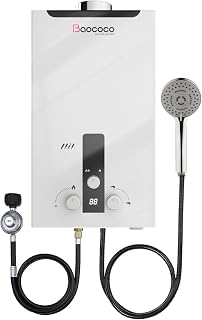
Best for: Buyers who need an outdoor propane water heater rather than an indoor natural-gas appliance. The listing identifies it as an outdoor model with 85,300 BTU per hour and up to 3.66 GPM. It may suit an outdoor water supply where propane is the intended fuel and the flow requirement is modest.
The product’s stated temperature adjustment range is 17°F to 113°F. Its listed minimum starting water pressure is 3.6 PSI, with a maximum working pressure of 116 PSI. The described protections include overheat, dry-combustion, antifreeze, low-flow, flame-fault, and high-water-pressure protection.
- Propane fuel and outdoor placement.
- Up to 3.66 GPM stated flow and 85,300 BTU per hour.
- Listed safety features include low-flow and flame-fault protection.
Limitation: This is not an indoor natural-gas heater. Do not select it as a direct replacement for an indoor natural-gas unit; verify fuel, placement, and local installation requirements.
RUINOPAR 6L Portable Propane Heater

Best for: Buyers seeking a portable outdoor hot-water source for settings such as camping, a boat, or a cabin. The listing describes a 6L unit delivering up to 1.58 GPM, with maximum output of 42,000 BTU per hour. It is designed for propane and is not presented as an indoor whole-house natural-gas appliance.
The heater is described as starting at water pressure as low as 2.5 PSI and offering adjustable heat and water flow. Listed safety features include overheating, antifreeze, flame-out, dry-combustion, high-pressure, and low-flow protection. The listing also describes an antifreeze drain plug for releasing residual water when the unit will not be used.
- Portable propane model for outdoor or mobile use.
- 1.58 GPM stated flow and 42,000 BTU per hour.
- Low-pressure startup and adjustable output are listed features.
Limitation: Its stated flow is much lower than the indoor whole-home options. It is better suited to limited outdoor use than to serving multiple household fixtures.
Buying Guide: How To Choose An In-Line Gas Water Heater
Should you choose natural gas or propane?
Start by matching the heater to the fuel supply already available at the intended installation location. The MIZUDO, Rheem, and ThermoMate products in this comparison are natural-gas indoor models. The Baococo and RUINOPAR products are propane models described for outdoor or portable use. Natural gas and propane appliances are not automatically interchangeable. Confirm the exact fuel requirement on the product documentation before buying.
Also check where the product may be installed. An outdoor portable unit is not a substitute for an indoor heater merely because both heat water on demand. Indoor appliances have placement and venting requirements that should be verified with the manufacturer and a qualified installer.
How much flow rate does your household need?
Estimate how many hot-water fixtures could run at the same time, then consider the flow each one requires. A shower and a kitchen faucet operating together create a different demand from several showers, laundry, and a dishwasher running simultaneously. The MIZUDO lists up to 10.3 GPM, the Rheem lists 7.0 GPM at a specified temperature rise, and the ThermoMate lists up to 5 GPM. The propane options have lower stated flow rates and are aimed at different use cases.
Do not compare maximum GPM figures without checking the conditions behind them. The Rheem specifies its 7.0 GPM rating at a 35°F temperature rise. In general, the incoming water temperature and the desired hot-water temperature affect how much flow a heater can deliver at that temperature rise. Ask an installer to size the unit for your climate, fixture demand, and household use.
What do BTU input and temperature rise tell you?
BTU per hour indicates the heater’s stated heating input, but it is not a standalone measure of how well a unit will meet your household’s needs. For example, the listed input ranges from 42,000 BTU per hour for the RUINOPAR portable unit to 199,000 BTU for the MIZUDO. These products differ in fuel, placement, and intended use, so compare specifications within the correct category.
Temperature rise is the difference between incoming water temperature and the target output temperature. A home with colder incoming water may need a larger rise than a home in a warmer region. Use local winter water conditions and the desired output temperature when reviewing capacity claims.
What installation details should you check?
Before selecting an indoor gas heater, confirm the fuel connection, venting method, location, and any required gas-line capacity. The Rheem listing specifies indoor installation with a direct vent system; the other product information provided does not establish every installation detail. Do not assume that an existing tank heater’s connections or vent can be reused without review.
Gas appliances can require professional installation and must follow applicable local codes. Have a qualified professional check the appliance instructions, vent route, combustion-air needs, gas supply, and water connections. For outdoor or portable units, follow the specified placement and operating instructions, and do not use them indoors unless the manufacturer expressly says that indoor use is permitted.
Which features matter for comfort and safety?
Temperature control and low-flow activation can affect daily comfort. The MIZUDO lists ±1°F temperature control and a 0.53 GPM activation point. The ThermoMate also lists ±1°F consistency and multiple safety protections. The propane products list safeguards such as flame-out, overheating, low-flow, or antifreeze protection. Treat these as manufacturer-listed features, not a substitute for correct installation and operation.
Compare the control range with your household’s needs, especially if the heater may supply a soaking tub or if multiple users prefer different temperatures. Avoid setting hot water to an unnecessarily high temperature, and follow the product’s instructions for safe operation.
Is a tankless unit right for every home?
An in-line tankless heater heats water when a fixture calls for it, rather than storing a tank of heated water. That can reduce standby heat loss, but the unit still needs adequate gas supply, venting where applicable, and enough capacity for peak demand. A high-capacity model may be more appropriate for a large household, while a lower-capacity product may fit limited demand or portable use.
Compare the total installation requirements, not only the appliance’s flow rating. Existing plumbing, gas service, venting changes, and the location of hot-water fixtures can affect the final choice. If the household’s peak use is uncertain, document which fixtures run together and ask an installer to calculate the required capacity.
Frequently Asked Questions
What is an in-line gas hot water heater?
An in-line gas hot water heater, also called a tankless water heater, heats water as it flows through the unit. It does not store a large volume of hot water in a conventional tank.
Which product in this list is best for a large household?
The MIZUDO has the highest stated capacity in this selection, at up to 10.3 GPM and 199,000 BTU. Verify that its actual output suits your incoming-water temperature and simultaneous fixture demand.
Can a propane heater replace a natural-gas heater?
Not automatically. Fuel type and installation requirements must match the appliance. The propane models listed here are described for outdoor or portable use, while the natural-gas models are indoor products.
Does a higher GPM rating always mean more hot water?
No. Flow depends on operating conditions, including temperature rise and incoming-water temperature. Compare GPM ratings at their stated conditions and size the heater for simultaneous household demand.
Can a portable propane water heater be installed indoors?
Do not assume it can. Follow the manufacturer’s placement instructions and use an appliance indoors only if the product documentation expressly permits indoor installation.
Should a gas tankless water heater be professionally installed?
Professional installation is advisable because gas supply, venting, combustion air, plumbing, and local code requirements need to be checked for the specific appliance and location.