The best in-line gas water heater depends on your fuel supply, hot-water demand, and installation location. The ThermoMate is a natural-gas option for moderate household demand, while GASLAND offers higher stated flow for whole-home use. VEVOR is an indoor gas model with temperature controls, and Vancepic and NOVIEEX are propane choices for buyers seeking indoor on-demand heating. Check fuel type, venting, gas supply, and local code requirements before choosing.
| Product | Fuel and use | Stated capacity | Best for |
|---|---|---|---|
| ThermoMate CZ422NG | Natural gas, indoor residential | Up to 5 GPM | Moderate household demand |
| GASLAND Gasmart E | Natural gas, indoor residential | Up to 7.6 GPM | Higher whole-home demand |
| VEVOR Tankless Gas | Gas, indoor whole-house use | 100,000 BTU/h | Digital temperature monitoring |
| Vancepic Tankless | Propane, indoor | Up to 4.3 GPM | Multiple points of use |
| NOVIEEX Tankless | Propane, indoor | Up to 4.3 GPM | Propane users wanting digital controls |
ThermoMate CZ422NG Natural Gas Tankless Heater

Best for: Households with a natural-gas connection that need an indoor, on-demand unit for several water uses. It is listed at up to 5 GPM and 102,000 BTU, and the product description says it can supply two showers at once under stated conditions: 65°F inlet water and a 105°F output.
The unit uses a smart flow sensor and control chip to adjust heating, with the manufacturer stating temperature consistency within ±1°F. Listed protections include freeze, flame-out, overheating, boil-dry, and other operating safeguards. Its oxygen-free copper heat exchanger and stated efficiency figures may appeal to buyers comparing energy use.
Why it was selected: It clearly specifies natural gas and indoor residential use, making it a direct fit for buyers searching for a household in-line gas heater. Limitation: Its stated maximum of 5 GPM may not suit homes with several high-flow fixtures running simultaneously. Confirm actual demand and installation requirements before purchase.
GASLAND Gasmart E High-Flow Natural Gas Heater
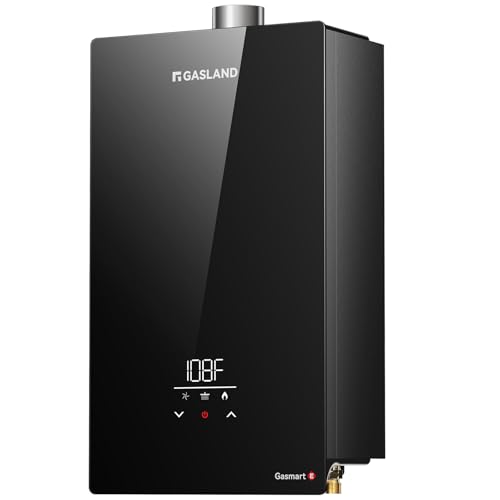
Best for: Natural-gas households that need higher stated flow for multiple daily hot-water uses. GASLAND lists this indoor residential model at 199,000 BTU and up to 7.6 GPM. Its product description positions it for showers, laundry, and dishwashing, and describes a compact, wall-mounted form.
The listing states that the heater is CSA certified and gives a UEF of 0.8. Those specifications may help buyers compare efficiency and safety details with other models, but installation must still meet the unit’s requirements and applicable local rules. A higher maximum flow can be useful for larger demand, but actual delivery depends on incoming water temperature and operating conditions.
Why it was selected: Its listed natural-gas fuel and higher capacity make it a better candidate than smaller models for buyers seeking a whole-house unit. Limitation: The supplied product details do not provide a complete installation specification or explain flow under different inlet temperatures. Verify sizing, venting, and gas-line requirements before choosing it.
VEVOR Indoor Tankless Gas Water Heater

Best for: Buyers who value a visible temperature readout and touch controls on an indoor gas heater. The listing gives a 100,000 BTU/h rating and describes smart sensors that aim to keep temperature within ±1°F of the set value. Its LED screen displays water temperature and operating status.
The product is described as a tankless unit for indoor whole-house use. The display can make it easier to check settings and status at the appliance, while the temperature-control feature is intended to reduce fluctuations. The listing also describes multiple security protections, although it does not name them individually in the supplied details.
Why it was selected: It offers a useful combination of indoor positioning, stated heating power, and an onboard display for buyers comparing control features. Limitation: The provided information does not specify whether this model uses natural gas or propane, nor does it give a GPM rating. Confirm the exact fuel type, flow capacity, and installation requirements with the manufacturer before buying.
Vancepic Indoor Propane Tankless Water Heater

Best for: Buyers with propane service who want an indoor unit designed to serve several water points. Vancepic lists 100,000 BTU and a maximum flow of 4.3 GPM, and says the heater can support three to four water points. Actual simultaneous use will depend on flow demand and temperature rise.
Four preset modes are listed: 4-season, kitchen, bathtub, and shower. The kitchen mode defaults to 100°F, while the bathtub mode includes a volume adjustment. The adjustable temperature range is stated as 95°F to 155°F, and a high-temperature lock is intended to help prevent scalding.
Why it was selected: It offers a clear propane specification and household-oriented controls, making it a better fit than portable outdoor units for buyers seeking an indoor propane model. Limitation: It is not a natural-gas model. Do not select it for a natural-gas connection unless the manufacturer explicitly confirms an approved conversion method.
NOVIEEX 4.3 GPM Propane Tankless Heater

Best for: Propane users seeking a stated 4.3 GPM indoor heater with digital temperature control. The listing gives a 100,000 BTU rating and describes use at several points, including a shower, kitchen faucet, and bathroom sink. Its temperature range is listed as 95°F to 149°F, with stated control within ±1°F.
The product details specify a 110–120V AC, 60Hz power supply, NPT 1/2-inch gas and water connections, and a stated water-pressure range of 1.5–116 psi. It also lists freeze protection. These requirements are important when checking whether the model suits the home’s plumbing, electrical supply, and propane setup.
Why it was selected: Its stated capacity, indoor positioning, and detailed connection and pressure information make it useful for propane buyers comparing installation needs. Limitation: This model uses propane, not natural gas. Its listed supply and connection specifications should be checked against the installation plan rather than assumed to match existing equipment.
Buying Guide: How to Choose an In-Line Gas Water Heater
Which fuel type does your home use?
Start by matching the heater to the home’s fuel supply. The ThermoMate and GASLAND listings specify natural gas; Vancepic and NOVIEEX specify propane. The VEVOR listing says gas but does not identify the fuel in the supplied details, so confirm before purchase. Natural gas and propane appliances are not automatically interchangeable. Choose only a model approved for the available fuel and installation conditions.
How much hot water do you need at once?
Estimate simultaneous demand rather than counting all fixtures in the home. A shower and a kitchen faucet running together require more output than one fixture. Compare the heater’s stated GPM with the combined flow needs of the fixtures you expect to use at the same time. Maximum GPM is not a guarantee of that flow at every temperature rise; colder incoming water can affect the amount of hot water delivered.
- Moderate demand: A model such as the 5 GPM ThermoMate may suit a smaller simultaneous-use load.
- Higher demand: The GASLAND listing gives the highest stated maximum flow among these selections, at up to 7.6 GPM.
- Propane demand: Vancepic and NOVIEEX each list up to 4.3 GPM; compare that figure with the home’s expected combined use.
Is the heater designed for indoor or outdoor installation?
Check the product’s stated location and installation requirements. Several products here are described for indoor use, while portable camping heaters are a different category and should not be treated as indoor residential appliances. Indoor gas heaters require appropriate venting and installation. Follow the manufacturer’s instructions and local building, plumbing, fuel-gas, and ventilation requirements; use a qualified professional when needed.
What temperature controls and safety features matter?
Digital displays and preset modes can make temperature adjustments easier, but they do not replace correct installation or safe operation. Compare temperature ranges, high-temperature locks, freeze protection, and other protections listed for each model. The feature list varies: the ThermoMate names several protective functions, Vancepic lists a high-temperature lock, and NOVIEEX lists freeze protection. Do not assume a feature is included if it is not specified.
Will the existing gas and water connections work?
Before ordering, verify gas pressure and supply capacity, electrical needs, water connections, water pressure, and venting requirements. The NOVIEEX listing, for example, specifies a power supply and connection sizes; the other supplied product details may not include the same level of installation information. Ask an installer to check the appliance specifications against the home’s existing lines. A heater’s advertised BTU rating alone does not prove that the home’s gas supply is adequate.
Should you choose an efficiency feature or a higher flow rate?
Efficiency figures can help compare models when they are provided on a consistent basis, but they are only one part of operating cost. The ThermoMate listing gives a UEF of 0.81, while GASLAND lists 0.8. Consider fuel price, household usage, incoming water temperature, maintenance, and installation costs as well. A higher capacity may help meet peak demand, but it should match the home’s actual use rather than being selected by rating alone.
Frequently Asked Questions
What is an in-line gas water heater?
An in-line gas water heater heats water as it flows through the appliance instead of storing a tank of heated water. It is also commonly called a tankless or on-demand gas water heater.
Can a propane heater run on natural gas?
Not automatically. Propane and natural-gas models are designed for different fuels and operating conditions. Use a heater only with the fuel type stated by its manufacturer, and do not assume a conversion is approved.
How many showers can a tankless gas heater run at once?
That depends on the heater’s flow capacity, incoming water temperature, shower flow rates, and other fixtures running at the same time. Check the manufacturer’s performance conditions and size the unit for peak simultaneous demand.
Does an indoor gas tankless heater need venting?
Indoor gas appliances require installation that follows the manufacturer’s venting instructions and applicable local codes. Confirm the required venting arrangement before purchase and have the installation assessed by a qualified professional.
Is a higher GPM rating always better?
No. A higher GPM rating can support greater simultaneous demand, but the best choice depends on household use, water temperature rise, fuel supply, and installation requirements. Choose capacity based on expected peak use.