For enclosed spaces, an indirect-style diesel air heater is generally the better match than a torpedo heater because it warms circulating air through a heat exchanger while routing combustion exhaust outside. The products below are portable diesel air heaters, mostly designed for vehicles and campers; check each model’s installation and ventilation instructions before use. The VEVOR 8 kW models suit buyers who want altitude compensation, while the BougeRV offers a lower-output camping option. The listed forced-air torpedo heaters are not included because their product descriptions do not establish indirect heating.
| Product | Best For | Notable Feature |
|---|---|---|
| VEVOR 8 kW Bluetooth Portable Heater | Flexible vehicle or camping use | App, remote, and altitude adjustment |
| VEVOR 8 kW Parking Heater | Campers and vehicles at elevation | Altitude compensation up to 18,045 feet |
| VEVOR 8 kW 12V/24V Heater | Buyers needing a portable all-in-one unit | Fuel tank and multiple power options |
| BougeRV 5 kW Diesel Heater | Camping and moderate heating needs | APP control and timer |
| VEVOR 8 kW Heater with LCD | Vehicle users who prioritize simple controls | Remote and LCD thermostat monitor |
VEVOR 8 kW Bluetooth Portable Heater
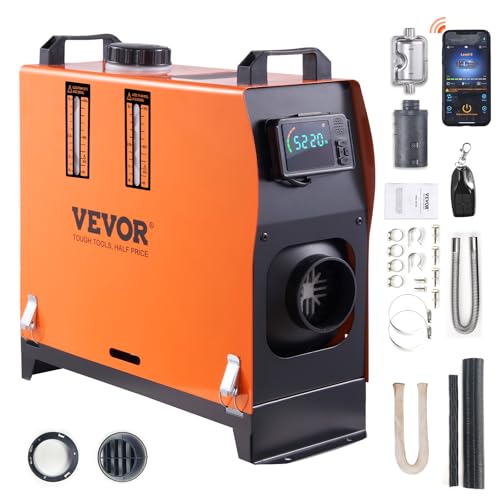
This VEVOR all-in-one heater is best for buyers who want several ways to control a portable diesel heater. The listed features include 8 kW of heating power, 12V operation, Bluetooth app control up to 98 feet, and a remote control with a stated range of up to 32 feet. The LCD and app allow temperature adjustment from 46.4°F to 96.8°F.
The manufacturer lists an applicable area of 215–269 square feet and automatic altitude compensation up to 18,045 feet. It is a suitable choice for campers or vehicle users who expect to travel at higher elevations and want the heater to adjust automatically. The product is described as requiring no installation, but buyers should still follow the supplied instructions for safe exhaust routing and operation.
Limitation: It is a 12V model, so confirm that your intended power source matches. Its stated area is a guide, not a guarantee for every vehicle or room.
VEVOR 8 kW Parking Heater with Altitude Adjustment

This VEVOR model is best for buyers seeking an 8 kW parking heater for a car, SUV, trailer, camper van, boat, or garage. Its listed specifications include 12V power and a stated heating range of 215–269 square feet. A sandblasted aluminum heat exchanger is described as transferring heat rapidly, with the product listing claiming a comfortable interior can be reached within 10 minutes.
Control options include a Bluetooth app, a remote with a stated range of up to 32 feet, and an LCD. The temperature range is listed as 46°F to 96.8°F. Automatic altitude compensation is specified up to 18,045 feet, making this a better fit than a basic model for users who regularly travel to high elevations.
Limitation: This is a 12V heater. Check your power setup and the actual heat demand of the space before choosing an 8 kW model.
VEVOR 8 kW 12V/24V All-in-One Heater

Choose this VEVOR all-in-one heater if power flexibility and a built-in fuel tank matter more than a compact vehicle-specific installation. The listing specifies 8 kW output, 12V/24V DC power, and use with a 110V outlet. It has a 1.9-gallon fuel tank and lists fuel consumption of 0.04–0.1 gallons per hour. The manufacturer describes it as suitable for spaces of 108–161 square feet.
Its listed safety-related features include a carbon monoxide alarm, exhaust-pipe heat sleeve, sealed fuel cap, overheat shutoff, reverse-polarity protection, and overvoltage protection. These details make it a practical option for buyers who want an integrated portable unit with multiple listed safeguards. The listing also claims it can heat a space quickly, but actual results depend on conditions and setup.
Limitation: Its stated area is smaller than the other 8 kW VEVOR models in this selection. Match the claimed coverage to your space rather than choosing by power rating alone.
BougeRV 5 kW Diesel Heater with App and Timer

The BougeRV is best for campers and other buyers who prefer a 5 kW unit rather than one of the higher-output 8 kW options. It is described as an all-in-one portable air heater with a 5-liter tank, app control, a timer, and 110V/12V power. Its listed elevation limit is 9,842 feet, making it more appropriate for moderate elevations than the VEVOR models with higher stated altitude compensation.
The product listing describes a two-step, tool-free side connection and an IPX4 water-resistant control panel. It also lists overheat auto shutoff and a leak-resistant fuel system. The manufacturer reports a test warming a 307-cubic-foot tent from 32°F to 68°F in eight minutes; this is a stated test result, not a guarantee for other tents or conditions.
Limitation: The IPX4 claim applies to the control panel only, not necessarily the entire heater. Its listed maximum elevation is lower than the VEVOR altitude-adjusting options.
VEVOR 8 kW Heater with LCD and Remote

This VEVOR model is best for vehicle users who want an 8 kW diesel air heater with a straightforward LCD monitor and remote control. Its listing describes a 12V unit with an aluminum combustion chamber intended to transfer heat efficiently. It also identifies winter driving, camping, and overnight stays as potential uses, and notes that heating may assist with engine preheating and windshield defrosting.
The stated fuel consumption is 0.18–0.36 liters per hour, or approximately 0.048–0.10 gallons per hour. That figure can help buyers estimate fuel needs, though actual consumption will vary with operation and conditions. The precision fuel pump is described as supporting consistent fuel delivery.
Limitation: The listing does not specify altitude compensation or a coverage area. Buyers who need those details should compare it with the VEVOR models above that provide stated figures.
Buying Guide: How to Choose an Indirect Diesel Heater
What does “indirect” mean for a diesel space heater?
An indirect heater transfers heat through a heat exchanger rather than intentionally mixing combustion exhaust with the heated air. Many diesel air heaters for vehicles work this way: they warm air for the interior while requiring combustion exhaust to be routed outside. The phrase “indirect diesel space heater” is also used for larger commercial heaters, so check the product design and instructions instead of relying on the name alone.
Do not assume every portable diesel heater is safe to operate indoors. Follow the manufacturer’s instructions for installation, exhaust routing, ventilation, and clearances. Never route exhaust into an occupied space. A heater’s safety features do not replace correct setup or carbon monoxide precautions.
How much heating power do you need?
Compare the heater’s stated output and coverage with the space’s size, insulation, and expected outdoor temperatures. The VEVOR models in this selection list 8 kW output, but their stated coverage varies: two specify 215–269 square feet, while another lists 108–161 square feet. The BougeRV is a 5 kW option and reports a tent-heating test. These figures are product-specific claims, not universal coverage guarantees.
For a small camper or vehicle, a lower-output model may be a closer match than a larger workshop-style heater. For a poorly insulated or larger space, actual heat demand may be greater. Avoid selecting a heater based only on a headline power number.
Should you choose a portable all-in-one unit or an installed heater?
All-in-one models integrate components such as the heater and fuel tank into a portable package. They may suit camping or temporary use where portability is important. A vehicle installation can require separate consideration of mounting, power, fuel handling, and exhaust routing. Review what is included and what installation steps remain before purchase; “portable” does not mean that every setup is suitable for every location.
Which power source and fuel details should you check?
Confirm voltage before buying. The listed VEVOR models include 12V-only options and one model described as compatible with 12V/24V power and a 110V outlet. Verify the product’s supplied components and power requirements in its documentation. Compare tank capacity and stated fuel consumption if you plan to heat overnight, but treat consumption as an estimate rather than a guaranteed runtime.
Does altitude compensation matter?
Altitude can affect combustion in fuel-burning heaters. Two VEVOR product listings specify automatic altitude compensation up to 18,045 feet, while BougeRV lists operation up to 9,842 feet. Choose based on the elevations you expect to encounter and the manufacturer’s stated operating limits. If your travel plans exceed a product’s stated range, select a model with an appropriate specification or consult the manufacturer.
What controls and safety information should you compare?
App control can make remote preheating convenient, while an LCD or physical remote may be simpler when a phone is unavailable. Compare the stated control range and temperature settings rather than assuming all apps work the same way. Review listed protections, such as overheat shutoff or a carbon monoxide alarm, but do not treat them as substitutes for correct ventilation and exhaust installation.
Frequently Asked Questions
Can an indirect diesel heater be used inside a camper?
A diesel air heater may be used in a camper only when the specific model and installation are suitable and the manufacturer’s instructions are followed. Combustion exhaust must be routed outside as directed. Do not operate a heater in an enclosed space with exhaust entering the occupied area.
Are all portable diesel space heaters indirect?
No. Product descriptions vary, and “portable diesel heater” alone does not establish whether a model is indirect-fired. Check whether the design separates combustion exhaust from heated air and follow the product documentation.
Is an 8 kW heater automatically better than a 5 kW heater?
No. A higher-output heater is not automatically a better match. Consider room or vehicle size, insulation, climate, power requirements, and the product’s stated coverage. Excess capacity may not be useful in a small space.
Can I run a diesel heater overnight?
Only if the heater’s instructions allow the intended operating conditions and it is set up correctly. Check fuel capacity, stated fuel consumption, exhaust routing, ventilation, and safety guidance before extended use.
Why compare the altitude limits?
Some heaters specify automatic compensation or a maximum operating elevation. If you travel at high elevations, compare that figure with your planned route. The products in this selection have different stated limits, and not every listing provides an altitude specification.