In short, indoor gas tankless water heaters provide on-demand hot water with compact footprints and high efficiency. This guide highlights top options for homes that want reliable heat on demand, energy efficiency, and installation flexibility. The best choices are suited for small-to-medium homes, multi-fixture setups, and households seeking consistent water temperatures. Below, five models are evaluated for different needs, with a quick buyer’s table and practical considerations to compare performance, safety features, and installation needs.
| Brand | Model | Max GPM | BTU | Best For |
|---|---|---|---|---|
| Ranein | Natural Gas Tankless Water Heater, Indoor Max 8.5 GPM, 190,000 BTU | 8.5 | 190,000 | |
| Westinghouse | Smart Tankless Water Heater Gas Indoor, 7.9 GPM, 180,000 BTU | 7.9 | 180,000 | |
| FOGATTI | Natural Gas Tankless Water Heater Indoor, 7.5 GPM, 170,000 BTU | 7.5 | 170,000 | |
| Rinnai | RX199iN Condensing, Up to 11.1 GPM, 199,000 BTU | 11.1 | 199,000 | |
| ThermoMate | CZ422NG, Up to 5 GPM, 113,000 BTU | 5.0 | 113,000 |
Ranein Natural Gas Tankless Water Heater

Best for homes needing strong on-demand heating with a compact footprint. This model offers up to 8.5 GPM and 190,000 BTU, with a design focused on safe, efficient combustion. The blower system adjusts speed automatically to maintain safe operation and adequate oxygen supply. It accepts standard 3/4″ NPT water fittings and measures about 24.25 inches by 15.08 inches by 8.07 inches, making it suitable for tight spaces. It’s better for consumers prioritizing a straightforward installation and reliable on-demand hot water without preheating delays.
Key considerations: It emphasizes safety through a robust combustion system and low-noise operation. A caution: installation support from a qualified professional is advised to ensure ventilation and venting compliance in indoor spaces.
Rheem RTGH Series Indoor Natural Gas Tankless Water Heater
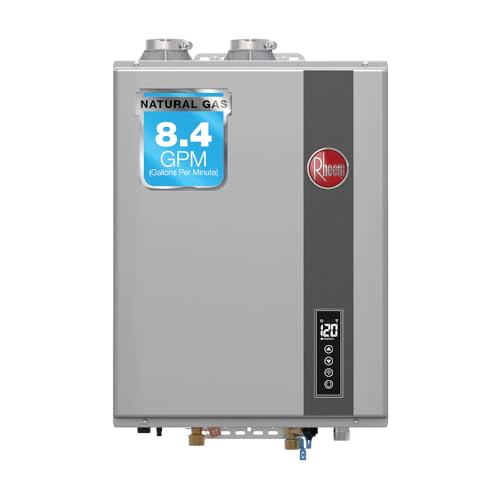
Best for mid-range households seeking consistent flow with a simple control scheme. With a flow range of 0.4–8.4 GPM and temperature settings from 100 to 140°F (default 120°F), this unit supports typical family needs while offering electric ignition for convenient starts. It is well-suited for homes that require reliable hot water across multiple fixtures while maintaining straightforward installation and operation.
Consideration: Its performance varies with incoming water temperature; colder supply water may reduce GPM at higher temperature raises. A professional installation is recommended to optimize venting and gas connections.
MIZUDO Natural Gas Tankless Water Heater

Best for large families needing high flow and remote management. This model delivers up to 10.3 GPM with 199,000 BTU and includes WiFi connectivity for app-based control, allowing temperature adjustments, scheduling, and energy monitoring. It also features 16+ integrated safety measures, including freeze protection and flame-failure detection. Choose this if you want smart-home integration and strong simultaneous-use performance.
Limitation: As with many WiFi-enabled gas heaters, the added electronics may require careful installation planning and network setup for stable remote access.
Rinnai RX199iN Condensing Tankless

Best for large homes needing high hot-water capacity with flexibility for indoor or outdoor installation. This Rinnai model supports up to 11.1 GPM and operates at 199,000 BTU, with Versa Vent and a smart control system that works with propane or natural gas. It is designed for efficiency and adaptability, making it suitable for installations where space is at a premium and future expansion is possible.
Note: Outdoor installation may require a vent cap (RX-OVC) and WiFi control is available via compatible modules, not included with the base unit.
ThermoMate CZ422NG Indoor Tankless Water Heater

Best for compact homes needing precise temperature control and robust safety protections. This unit delivers up to 5 GPM and 113,000 BTU with a multi-point heating philosophy and a high-precision flow sensor. It features eight protective measures, rapid frost protection, and a high-efficiency design with copper heat exchanger. It is well-suited for households that want reliable performance in a smaller footprint and strong safety features.
Caution: Lower maximum GPM means it may saturate more quickly during peak demand in larger households or with multiple simultaneous hot-water outlets.
Buying Guide: Key Considerations For Indoor Gas Tankless Water Heaters
- Flow rate needs: Calculate peak GPM by listing all hot-water fixtures used simultaneously (showers, sinks, dishwasher, laundry). Choose a model with a higher GPM if many fixtures run at once.
- Gas and venting requirements: Indoor installation requires proper venting and room clearance. Verify vent type (direct vent or power-vented) and local code compliance before purchase.
- Gas input and efficiency: Higher BTU often means faster hot-water generation but consider the unit’s energy factor and UEF when comparing operating costs.
- Temperature stability: Models with self-modulating gas and water flow provide steadier temperatures, reducing cold bursts during showers.
- Smart features and controls: WiFi/app compatibility can enhance management and maintenance reminders, but may require network setup and a separate module.
- Space and installation: Look at the unit’s dimensions and mounting options to ensure it fits the chosen indoor location and allows safe ventilation.
- Safety features: Prioritize anti-dry firing, flame-out protection, freeze protection, and automatic shutdown systems for reliability in varied climates.
- Maintenance considerations: Some models offer quick flush features or diagnostic displays to simplify service and maintenance routines.
Frequently Asked Questions
- What is the typical advantage of a tankless water heater over a tank model indoors?
– Tankless units heat water on demand, often saving space and reducing standby energy waste compared to tanks. - Can indoor gas tankless heaters supply hot water for multiple fixtures at once?
– Yes, but capacity varies by model; larger households should select units with higher GPM ratings. - Do all indoor gas tankless heaters require venting?
– Most require proper venting and room clearance; check local code and installation guidelines for venting specifics. - Is WiFi connectivity essential for modern tankless water heaters?
– It’s optional but can offer remote monitoring and scheduling; not all models include native WiFi control. - What happens if incoming water is cold?
– Cold inlet water can reduce GPM at higher temperatures; some models compensate with higher BTU input or better modulation. - How long do these heaters typically last?
– Longevity depends on maintenance, usage, and installation conditions; many units are designed for long service life with regular servicing.