The best industrial electric garage heater depends on your available circuit, mounting options, and heating needs. For high output and remote controls, consider the Comfort Zone 10,000-watt ceiling heater; for a 7,500-watt ceiling-mounted option, compare the InoKraft and Comfort Zone models. The Dura Heat is a plug-in choice, while the Comfort Zone 5,000-watt model suits buyers who want hard-wired ceiling heat and adjustable airflow.
| Product | Best for | Power and installation |
|---|---|---|
| Comfort Zone CZ260ER | High-output heating with remote control | 10,000 watts; hard-wired, ceiling mount |
| Dura Heat EUH4000 | Buyers seeking a plug-in heater | 240 volts; 6-20P plug listed |
| Comfort Zone 5,000W | Directional heat and open floor space | 5,000 watts; hard-wired, ceiling mount |
| InoKraft 7,500W | Digital controls and ECO mode | 7,500 watts; NEMA 14-50P plug |
| Comfort Zone CZ230ERBK | Ceiling-mounted 7,500-watt heating | 7,500 watts; hard-wired, ceiling mount |
Comfort Zone CZ260ER 10,000-Watt Heater

The Comfort Zone CZ260ER is a 240-volt, 10,000-watt fan-forced heater designed for hard-wired ceiling installation. It has directed airflow vents, a digital thermostat, a remote control, and a 12-hour timer. Its heavy-gauge steel body, sheathed heating elements, and enclosed motor are listed as construction and protection features.
Best for: Buyers who need a high-output ceiling heater and want to adjust temperature or airflow without reaching the unit. The remote and timer add control options, while ceiling mounting keeps the heater off the floor.
Limitation: This model requires hard-wired installation and a suitable 240-volt electrical setup. Confirm the circuit and installation requirements before purchase; its high wattage may not suit every garage or electrical service.
Dura Heat EUH4000 Plug-In Heater
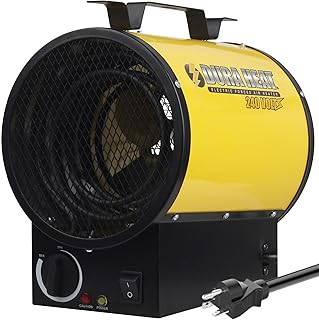
The Dura Heat EUH4000 is a 240-volt electric space heater intended for garages and workshops. The product name describes a 3,750-watt, 12,800-BTU heater and lists a 6-20P plug. The features also describe it as a 20-amp, 4,000-watt model. Because the listed wattage differs, check the product label and manufacturer information before matching it to an electrical circuit.
Best for: Buyers who prefer a plug-in unit over a hard-wired heater and have a compatible outlet. The product name also describes wall and ceiling mounting, a steel body, thermostat, and overheat shutoff.
Limitation: The wattage information is inconsistent in the supplied listing details. Verify the exact electrical load, plug, and mounting instructions before installation.
Comfort Zone 5,000-Watt Ceiling Heater

This Comfort Zone fan-forced heater is rated at 5,000 watts and 240 volts. It is designed for hard-wired ceiling mounting and has three heat settings, overheat protection, louvers, and an adjustable mounting angle. Its heavy-gauge steel construction is intended for demanding indoor environments, including garages, warehouses, and storage areas.
Best for: Buyers who want ceiling-mounted heat with adjustable direction and multiple heat settings. The louvers and mounting angle allow airflow to be aimed toward a work area, while the overhead installation leaves floor space available.
Limitation: This is a hard-wired model, not a plug-in option. The listing describes indoor use, so it should not be selected for outdoor exposure.
InoKraft 7,500-Watt Heater With ECO Mode

The InoKraft is a 240-volt, 7,500-watt fan-forced heater with a NEMA 14-50P plug, digital thermostat, remote, ECO mode, and timer adjustable from one to 24 hours. The listing gives a 40°F to 99°F thermostat range and describes selectable high and low modes. It also lists overheat protection and automatic shutoff.
Best for: Buyers who want a plug-in heater with digital controls and automatic output adjustment. The listing states coverage up to 750 square feet, but actual comfort will depend on factors such as insulation, ceiling height, outdoor temperatures, and air leakage.
Limitation: The NEMA 14-50P plug requires a matching, properly rated receptacle. Check the outlet and circuit before buying; do not assume a standard household outlet is suitable.
Comfort Zone CZ230ERBK 7,500-Watt Heater

The Comfort Zone CZ230ERBK is a 240-volt, 7,500-watt fan-forced heater for hard-wired ceiling installation. Its features include a digital thermostat, remote, 12-hour timer, overheat protection, adjustable louvers, and variable mounting angle. The listing states heating coverage up to 1,250 square feet and describes a heavy-gauge steel body.
Best for: Buyers seeking a 7,500-watt hard-wired heater with remote temperature control and adjustable airflow. It is a better fit than the plug-in InoKraft for someone planning a fixed ceiling installation rather than using a NEMA 14-50P connection.
Limitation: Coverage figures are not a guarantee of uniform heating in every garage. Insulation, room layout, ceiling height, and local climate affect results, and hard-wired installation requires a compatible electrical setup.
Buying Guide: How to Choose an Industrial Electric Garage Heater
What wattage is appropriate for your garage?
Start with the size and condition of the space, but do not choose by square footage alone. Insulation, air leaks, ceiling height, exterior exposure, and the temperature you want to maintain all affect heating demand. A larger space or poorly insulated workshop may require more output than a smaller, well-sealed garage.
Among these options, the 10,000-watt Comfort Zone offers the highest listed wattage. The 7,500-watt models provide a middle range, while the 5,000-watt Comfort Zone is the lowest-output option in this selection. The Dura Heat listing has conflicting wattage details, so verify its rating before comparing it with the others.
Should you choose plug-in or hard-wired installation?
A plug-in model can be convenient when the garage already has the correct receptacle and circuit. The Dura Heat listing specifies a 6-20P plug, while the InoKraft listing specifies a NEMA 14-50P plug. These are different plug types; match the heater to the outlet rather than relying on the fact that both are 240-volt products.
Hard-wired heaters such as the Comfort Zone models are designed for a fixed installation. They can keep a power cord out of the way, but they require appropriate wiring and installation. Have a qualified electrician confirm the circuit capacity, wiring, breaker, and mounting requirements before installation when needed.
Is ceiling mounting right for your workshop?
Ceiling-mounted heaters preserve floor and wall space, which can matter in garages with vehicles, benches, shelving, or equipment. They also allow airflow to come from above. Before choosing one, check the mounting instructions, available ceiling structure, clearance requirements, and whether the airflow can be directed toward the work area.
Adjustable louvers or vents help aim warm air, but they do not eliminate every cold spot. Large or partitioned rooms may need a different layout or more than one heat source, based on a proper assessment of the space and electrical capacity.
Which controls and safety features should you compare?
A thermostat helps regulate the set temperature. A timer can schedule operation, and a remote can make adjustments easier when the heater is mounted overhead. The InoKraft lists ECO mode and a one-to-24-hour timer; the Comfort Zone models listed here include timers and remote controls where specified.
Overheat protection or automatic shutoff is listed on several products, but these features do not replace correct installation and safe clearance. Follow the manufacturer’s instructions, keep combustible materials away, and use the heater only in the locations and conditions described in its documentation.
How should you compare coverage claims?
Coverage-area statements are useful for an initial comparison, not a promise of identical results in every building. The InoKraft listing states up to 750 square feet, and the CZ230ERBK listing states up to 1,250 square feet. Those figures may depend on conditions that differ from your garage, including insulation and temperature differences.
Prioritize the heater’s electrical requirements and installation fit first. Then consider the space’s heat loss and whether the heater’s airflow direction and controls suit how you use the garage. When the required output is uncertain, consult an electrician or heating professional rather than selecting a unit based on coverage claims alone.
Frequently Asked Questions
Are industrial electric garage heaters suitable for home garages?
They can be suitable when the heater is designed for the intended indoor setting and the garage has the required electrical supply and mounting conditions. Check the product instructions and local electrical requirements before installation.
Can I plug a 240-volt heater into a regular household outlet?
No. A 240-volt heater requires the correct voltage, circuit, and connection. For plug-in models, match the listed plug type to a properly rated receptacle. Never use an unsuitable outlet or improvised adapter.
What is the difference between the 7,500-watt Comfort Zone and InoKraft?
The Comfort Zone CZ230ERBK is listed as a hard-wired ceiling heater with a remote, adjustable louvers, and a 12-hour timer. The InoKraft is listed with a NEMA 14-50P plug, a digital thermostat, ECO mode, and a timer of up to 24 hours.
Does a higher-wattage heater always heat a garage better?
Higher wattage means greater electrical heating output, but it does not guarantee better comfort in every space. Room size, insulation, air leakage, ceiling height, heater placement, and electrical capacity also matter.
What should I verify before buying a garage heater?
Confirm voltage, wattage, amperage, plug or hard-wiring requirements, mounting instructions, indoor-use suitability, and electrical circuit capacity. For the Dura Heat EUH4000, verify the exact wattage because the supplied product details list conflicting figures.