Low temperature hydronic radiators use circulating hot water to heat a room, but their heat output depends on water temperature, radiator size, and room heat loss. Among these listed models, the 10-panel options are the better starting point for buyers seeking more stated output, while the 6-panel models suit smaller spaces or lower heat requirements. The product details do not provide output ratings at specific low water temperatures, so confirm suitability with a heating professional before choosing.
| Product | Stated Heat Output | Best Suited For |
|---|---|---|
| Q-Hillstar 6-Panel Aluminum Radiator | Up to 3,500 BTUs | Smaller rooms |
| Hydronic Copper Aluminum 8-Section Radiator | Not provided | Buyers checking an 8-section option |
| Q-Hillstar 10-Panel Aluminum Radiator | Up to 5,800 BTUs | Rooms needing more stated output |
| AB 10-Panel Aluminum Radiator | Up to 5,768 BTUs | Buyers comparing pressure information |
| AB 6-Panel Aluminum Radiator | Up to 3,461 BTUs | Smaller rooms where steam is not used |
Q-Hillstar 6-Panel Aluminum Radiator

This wall-mounted 6-panel radiator is sized at 17.13 by 3.66 by 22.36 inches and is stated to produce up to 3,500 BTUs. Its aluminum construction is described as having high thermal conductivity, and side baffles are intended to support airflow. It circulates hot water from a boiler or central heating system rather than generating heat independently.
Best for: Buyers comparing compact wall-mounted options for a smaller room or a space with a modest heating requirement. Its stated output is lower than the listed 10-panel alternatives, making it easier to distinguish from those larger models.
The manufacturer lists quiet operation, a baked-paint surface, a water flow rate up to 8.77 gallons per hour, and a stated working-pressure range of 174–261 PSI. These figures should be checked against the requirements of the planned system before installation.
Limitation: The listed 3,500-BTU maximum does not specify the water temperature at which that output is achieved. Do not assume the rating applies to a low-temperature system without confirmation.
Hydronic Copper Aluminum 8-Section Radiator

The product name identifies this as an 8-section wall-mount hot water radiator made with copper and aluminum. The supplied listing information does not include a BTU rating, dimensions, pressure limit, flow rate, or other technical specifications. That makes it difficult to compare its heating capacity or confirm whether it fits a particular hydronic system.
Best for: Buyers specifically considering an 8-section copper-aluminum design who can obtain complete technical information before purchase. It was included as a distinct section-count and material option, not as a confirmed low-temperature performer.
Before selecting it, request or verify its heat-output data at the intended supply and return water temperatures, along with connection details and operating-pressure limits. Compare those specifications with the room’s calculated heat loss and system requirements.
Limitation: No performance or installation features were provided in the product information. Without those details, its suitability for low-temperature heating cannot be established from the listing data alone.
Q-Hillstar 10-Panel Aluminum Radiator

This 10-panel model measures 28.54 by 3.66 by 22.36 inches and is stated to produce up to 5,800 BTUs. It uses aluminum and side baffles, and connects to a boiler or central heating system for hot-water circulation. The larger panel count and higher stated maximum output distinguish it from the same brand’s 6-panel option.
Best for: Buyers who need more stated heat output than the listed 6-panel models and have wall space for the larger dimensions. It is a useful candidate to compare for a room with a greater heating requirement, subject to confirming its output at the system’s actual water temperatures.
The listed features include quiet operation, a baked-paint finish, up to 8.77 gallons-per-hour water flow, and a stated working-pressure range of 174–261 PSI. The listing also says the radiator can be used with hot water from a central heating source.
Limitation: The 5,800-BTU figure is given as an upper output without a corresponding water-temperature condition. It is not enough on its own to verify low-temperature performance.
AB 10-Panel Wall-Mounted Radiator
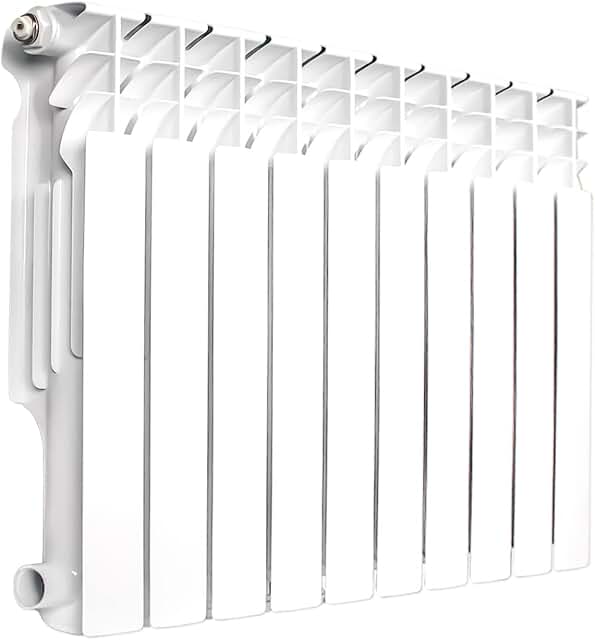
The AB 10-panel radiator measures 28.54 by 3.66 by 22.36 inches and is listed at up to 5,768 BTUs. It is made from aluminum, with side air vents intended to support circulation and heat radiation. The manufacturer describes a baked-paint finish and quiet operation through a plumbing-based heating system.
Best for: Buyers comparing a larger radiator who want the product details to state a recommended working-pressure range. The listed recommendation is 1.2–1.8 MPa, with a stated maximum pressure of 2.0 MPa. Those figures give a system installer information to check against the planned circuit.
The listing says the unit underwent a 24-hour pressure test and describes its welded construction. It is presented for locations including kitchens, bedrooms, and greenhouses, but room suitability still depends on heat-loss calculations and installation requirements.
Limitation: Its maximum stated output is slightly below the Q-Hillstar 10-panel model’s listed figure, and neither listing specifies output at a particular low water temperature. Compare like-for-like output data before choosing.
AB 6-Panel Wall-Mounted Radiator

This AB 6-panel model is listed at up to 3,461 BTUs. Its aluminum construction is described as highly conductive, and the side air vents are intended to improve air circulation. The manufacturer lists a baked-paint surface, quiet plumbing-system operation, and a recommended working pressure of 1.2–1.8 MPa, with a maximum of 2.0 MPa.
Best for: Buyers looking for a smaller-panel option and who need the listing to explicitly address steam compatibility. The product information says it is not suitable for steam, so it should only be considered for an appropriate hot-water hydronic setup.
Its stated output is close to the Q-Hillstar 6-panel model’s maximum, making both relevant options for comparing smaller radiators. The AB listing also reports a 24-hour pressure test and seamless welded design.
Limitation: The explicit steam restriction is important: avoid this model for a steam system. Its stated BTU output also lacks a specified water-temperature basis, so low-temperature capacity needs confirmation.
Buying Guide: How to Choose a Low Temperature Hydronic Radiator
What does “low temperature” mean for a radiator?
A low-temperature hydronic system supplies water at a lower temperature than a conventional high-temperature radiator system. A radiator can still work with lower-temperature water, but it generally releases less heat as the water-to-room temperature difference falls. The equipment must therefore be selected for the actual water temperatures and the room’s heating load.
None of the five product descriptions provides a BTU output table across different water temperatures. Treat the listed BTU figures as product claims with unspecified conditions, not as proof of a particular output at low water temperatures. Ask the seller or manufacturer for output data at your system’s intended supply and return temperatures.
How much heat does the room need?
Start with a room-by-room heat-loss calculation rather than choosing by panel count alone. Window area, insulation, air leakage, ceiling height, climate, and room layout all affect the required heating output. A qualified heating professional can compare the calculated load with radiator output under the expected operating conditions.
As listed, the 10-panel options claim about 5,768–5,800 BTUs, while the 6-panel options claim about 3,461–3,500 BTUs. These figures help compare the products at a glance, but they do not establish the output available at a lower water temperature.
Should you choose six, eight, or ten sections?
Choose a larger panel count only when the available wall space, connection arrangement, system capacity, and heat requirement support it. The listed 10-panel units are longer than the Q-Hillstar 6-panel model, while the AB 6-panel model’s dimensions are not stated in the supplied details. Verify exact dimensions and pipe connections before planning an installation.
The 8-section copper-aluminum model has no supplied output or dimensions. Do not assume its capacity falls between the 6- and 10-panel models; section count alone does not provide a reliable heat-output comparison.
What system details should you check?
- Confirm whether the radiator is intended for hot-water hydronic heating, steam, or both. The AB 6-panel listing specifically says it is not suitable for steam.
- Check the radiator’s pressure limits against the system’s operating pressure. Do not rely on a pressure figure without confirming the product’s installation requirements.
- Verify water connections, flow direction, mounting requirements, and included parts with the seller before purchase.
- Ask for output ratings at the planned water temperatures and the rating conditions used to calculate them.
- Confirm that the boiler or heat source can provide the required flow and temperature for the selected radiator and other zones.
Does aluminum construction make a radiator suitable for low-temperature heating?
Aluminum is described in several listings as having high thermal conductivity, but material alone does not establish room-heating capacity at low water temperatures. Radiator size, design, water flow, temperature difference, and room heat loss all matter. Compare documented output at matching conditions rather than choosing based only on material claims.
How should you compare the listed pressure specifications?
The Q-Hillstar descriptions state a working-pressure range of 174–261 PSI. The AB descriptions give a recommended working range of 1.2–1.8 MPa and a maximum of 2.0 MPa. These are different ways of presenting pressure information; have an installer check the exact requirements and units against the system. The 8-section product has no pressure data in the supplied listing information.
Frequently Asked Questions
Can these radiators be used with a heat pump?
The product descriptions do not confirm compatibility with a specific heat pump. A hydronic radiator may be used in a system that circulates heated water, but the key question is whether it can deliver enough heat at the heat pump’s planned water temperatures. Check output data and system requirements with a heating professional.
Which listed radiator has the highest stated output?
The Q-Hillstar 10-panel radiator has the highest stated maximum at up to 5,800 BTUs. The AB 10-panel model is listed at up to 5,768 BTUs. Neither figure identifies output at a specific low water temperature.
Are the 6-panel models suitable for a large room?
That depends on the room’s heat loss and the radiator’s actual output at the operating water temperature. The listed 6-panel maximums are lower than the 10-panel maximums, but a heat-loss calculation is needed to determine whether either model is sufficient.
Can the AB 6-panel radiator be used for steam heat?
No. Its product information explicitly says it is not suitable for steam. Confirm that the intended system is a compatible hot-water hydronic system before selecting it.
What is the most important detail to request before buying?
Request a heat-output rating at the intended supply and return water temperatures. That information is necessary to judge whether a radiator can meet the room’s heating requirement in a low-temperature system.