Find the best tankless water heaters for households needing on-demand hot water across kitchens, bathrooms, and small to large homes. This guide highlights five electric or gas models suited for multiple uses, with guidance on installation, efficiency, and safety. Ideal buyers include compact-apartment dwellers, small homes, whole-house upgrades, and mid-sized households seeking reliable, energy-efficient hot water without storage tanks. Below is a quick comparison to help choose the right system for your needs.
| Product | Power Source | Flow (GPM / Use) | Best For |
|---|---|---|---|
| 1) 110V Tankless Water Heater Electric, Jflapil | Electric (110V) | 0.3GPM @ 82°F to 0.5GPM @ 131°F | Compact spaces, single sink or small kitchenette |
| 2) Mini Tankless Instant Water Heater Under Sink, 3kW | Electric (120V) | Low-flow only, limited use | Under-sink point-of-use, bathroom sink |
| 3) 14kW Tankless Water Heater Electric ORBEK | Electric (240V) | Up to 3.38 GPM | Two to three outlets, kitchens and baths |
| 4) MIZUDO Natural Gas Tankless Water Heater | Gas | Up to 10.3 GPM | Whole-home, multi-point use |
| 5) VEVOR Tankless Water Heater Propane | Propane | 4.3 Gal (approx. 100,000 BTU/h) | Indoor whole-house hot water |
1. 110V Tankless Water Heater Electric, Jflapil

This 110V, 3000W unit heats water instantly with a compact wall-mounted design. Temperature is adjustable from 82°F to 131°F, with a built-in LED display for real-time monitoring and Celsius/Fahrenheit switching. Best for small kitchens or single sinks where space is limited. It features IPX4 waterproofing, leakage protection, dry-burn protection, and automatic shutoff when idle, contributing to energy efficiency (up to 98%). Use this for under-sink or compact installation in apartments or RVs. A limitation is its lower maximum flow, which is better for low-demand scenarios.
2. Mini Tankless Instant Water Heater Under Sink

This 3kW, 120V plug-in water heater is designed for low-flow use, not ideal for showers or multiple taps. It features an LED digital display, a single temperature control knob (30–55°C), and comprehensive safety protections including overheat, leakage, dry heating, and IPX4 waterproofing. Best for occasional warm water at a single sink or small utility area. A caveat is its limited ability to supply higher-demand hot water, making it less suitable for multi-point use.
3. ORBEK 14kW Electric Tankless Water Heater

This 14kW electric unit provides up to 3.38 GPM with precise temperature control and LED status readouts. It requires a 240V/60A two-pole breaker and proper wiring, plus 1/2″ NPT water connections. Best for households needing hot water across two to three fixtures, such as a bathroom and kitchen. It is more powerful than smaller under-sink models. A limitation is the required dedicated electrical capacity, which may necessitate electrical panel upgrades in older homes.
4. MIZUDO Natural Gas Tankless Water Heater

With up to 10.3 GPM, this gas-powered option supports multi-bathroom use and kitchen demands. It offers ±1°F precise temperature control and a wide 107°F to 149°F range, enabling hot water for deep soaking, dishwashing, and heavy laundry. Best for busy households seeking whole-home hot water with rapid response. The system requires venting and proper gas line installation; ensure professional setup for safe use. A caution is that gas models need appropriate clearance and venting in tight spaces.
5. VEVOR Tankless Water Heater Propane
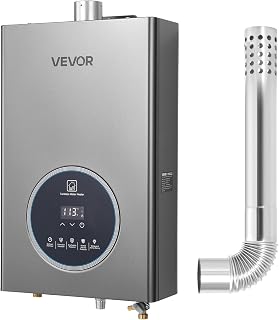
This 4.3 Gal capacity propane unit handles on-demand hot water for multiple fixtures with a 100,000 BTU/h input. It features smart temperature control and multiple security protections. Best for indoor use in homes needing steady hot water across several points of use. A limitation is that venting and proper clearances are required in indoor spaces, and propane models must be installed with appropriate safety measures and ventilation.
Buying Guide
What should you check before buying a tankless heater?
- Flow rate needs: Match units to peak simultaneous usage (kitchens, baths, laundry).
- Power source: Electric models require adequate electrical service; gas models need venting and gas lines.
- Temperature range: Ensure the unit can reach your preferred hot water temperatures reliably.
- Installation footprint: Consider under-sink, wall-mounted, or whole-home installation.
- Safety features: Look for anti-dry burn, leakage protection, and overload protection.
- Energy efficiency: Higher thermal efficiency reduces waste and electricity/gas consumption.
Frequently Asked Questions
- What is the difference between electric and gas tankless water heaters?
- Can a small apartment support a high-flow tankless system?
- Do under-sink models provide enough hot water for more than one fixture?
- Is professional installation required for gas models?
- How do I calculate the right GPM for my household?
- What maintenance do tankless heaters require?