The best tankless water heater depends on the fuel available, the number of fixtures you need to serve, and whether the unit is for a home or an RV. The 3.7 GPM propane model is best for buyers seeking a compact indoor heater for several hot-water points, while the 14 kW and 18 kW electric models suit different electrical setups. The 3,000W unit is aimed at a single nearby sink, and the RV model is designed for camper installations.
| Product | Best For | Key Requirement or Limit |
|---|---|---|
| Propane 3.7 GPM, 85,000 BTU | Several household hot-water points | Propane fuel; confirm indoor installation requirements |
| 110V, 3,000W electric | Under-sink or point-of-use hot water | Listed flow-and-temperature figures vary by flow |
| ORBEK 14 kW electric | Home use with a suitable 240V circuit | Requires a 150-amp-capacity panel and specified wiring |
| RVPart Pro propane RV heater | RV and camper installations | RV-specific unit with a 15-by-15-inch door |
| Rheem 18 kW electric | Higher-demand electric applications | Requires 240V; confirm electrical capacity and flow needs |
Propane Tankless Heater, 3.7 GPM

This indoor propane model is best for households that want one heater to serve more than one hot-water point. The product information lists a maximum flow rate of 3.7 gallons per minute and 85,000 BTU. It is described as supporting two to three hot-water points, such as showers, sinks, or tubs. Actual performance depends on incoming water temperature and simultaneous demand, so the listed flow rate should not be treated as a guarantee for every combination of fixtures.
A stated minimum flow rate of 0.6 GPM is intended to allow operation at relatively low water flow. The LED touch control panel displays settings, while real-time temperature sensing and staged heat control are described as features for reducing temperature fluctuations.
- Best for: Buyers who have propane available and need more than a single point-of-use heater.
- Why it was selected: Its listed flow capacity and multi-point use make it the most directly suited option here for a small household hot-water setup.
- Limitation: It is a propane indoor unit, not an electric alternative. Check the installation instructions and local requirements before purchase.
110V, 3,000W Under-Sink Electric Heater
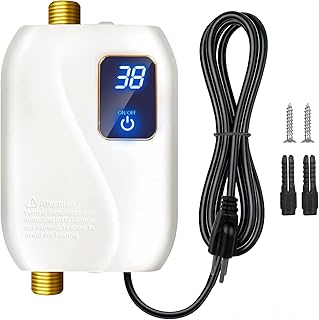
This compact 110V heater is best for a nearby sink or another limited point-of-use application, rather than as a default choice for serving a whole house. The product lists 3,000 watts and states temperature increases of 82°F at 0.3 GPM and 131°F at 0.5 GPM. Those figures illustrate why flow matters: as the flow rate changes, the amount of temperature rise can change too.
The wall-mounted design is intended to save space. Its LED display can show temperature, with Fahrenheit or Celsius selection by holding the power button for six seconds. Listed safety features include leakage protection, dry-boil protection, overheating shutoff, and automatic shutoff after inactivity. The description also states an IPX4 water-resistance rating and ETL standard qualification; verify current product documentation and suitability for your installation.
- Best for: Buyers who need hot water close to a kitchen or bathroom sink and have a suitable 110V supply.
- Why it was selected: Its compact form, stated low-flow figures, and under-sink positioning distinguish it from higher-output home units.
- Limitation: The listed 3,000W output and flow-dependent temperature figures make it important to check whether it can meet your specific flow and temperature needs.
ORBEK 14 kW, 240V Electric Heater

The ORBEK 14 kW unit is best for buyers considering an electric tankless heater for bathroom and kitchen use who can meet its electrical requirements. The product lists a maximum flow of 3.38 GPM and says it can supply two to three points of use. It also describes on-demand heating and says hot water is available in three seconds. Treat these as product specifications, not a promise of a particular temperature or flow at every location.
Electrical planning is especially important for this model. The listing calls for 240V, a 60-amp two-pole breaker, one set of 6 AWG wires, and 1/2-inch NPT water connections. It also says the household breaker panel needs total current capacity of at least 150 amps. Confirm these requirements with a qualified professional and the manufacturer’s instructions before choosing it.
- Best for: Buyers with a compatible 240V electrical setup who want a mid-range listed flow capacity.
- Why it was selected: Its stated 3.38 GPM capacity and multi-point positioning offer a useful comparison with both the small 110V unit and the 18 kW model.
- Limitation: The specified breaker, wiring, and panel capacity can rule it out if the home’s electrical system is not suitable.
RVPart Pro Propane RV Water Heater

This propane heater is best for RV and camper owners shopping for an RV-specific replacement or installation, not for someone seeking a general indoor home water heater. The listing describes a 60,000 BTU heat output, a 15-by-15-inch white door, 12V DC operation, a remote, and high-altitude use up to 5,000 feet or more. It also lists a copper heat exchanger, brushless DC fan, and staged combustion intended to help maintain more consistent water temperature.
The remote control is described as allowing temperature adjustment from 95°F to 123°F. The built-in panel displays fault codes, and the product information lists a 150 PSI pressure-reducing valve. The listing states CSA certification; buyers should verify the documentation and installation requirements for their specific RV.
- Best for: RV or camper owners who need a propane unit with a matching installation format and remote temperature control.
- Why it was selected: It is the only listed product specifically designed for an RV, with RV-oriented details such as the door size, 12V DC supply, and stated altitude capability.
- Limitation: Its RV-specific design makes it a poor match for a standard household installation. Check the opening dimensions and installation instructions before ordering.
Rheem 18 kW, 240V Electric Heater

The Rheem 18 kW model is best for buyers comparing a higher-output electric option with the 14 kW unit. Its product information lists flow up to 4.4 GPM, an external digital thermostatic control with an LED display, and temperature control accuracy of plus or minus one degree. The listed flow rate is a maximum specification; the flow available at a useful temperature depends on incoming water conditions and demand.
The listing also describes self-modulation, which adjusts power to meet hot-water demand, and two durable copper immersion heating elements that are field serviceable. These features may matter to buyers who want adjustable output and serviceable elements, but they do not remove the need to confirm installation requirements.
- Best for: Buyers looking at a 240V electric heater with a higher listed maximum flow than the 14 kW option.
- Why it was selected: It offers an easy comparison point for households weighing stated flow capacity, digital temperature control, and self-modulating operation.
- Limitation: The listing does not provide a complete electrical installation specification here. Confirm required breaker, wiring, and panel capacity before purchase.
Buying Guide: How to Choose a Tankless Water Heater
Is propane or electric the better fit?
Start with the energy source already available at the installation location. The 3.7 GPM indoor unit and the RV unit use propane, while the other three products are electric. An electric heater may need a dedicated circuit or substantial panel capacity; a propane model requires a suitable fuel supply and an installation that meets the manufacturer’s instructions and local rules. Do not assume that a unit can replace another simply because both are tankless.
How much flow do you need?
Estimate which fixtures might run at the same time, then compare their combined flow with the product’s stated capacity. A shower running with a sink draws more hot water than one faucet alone. For these options, the listings state maximum flow rates of 3.7 GPM for the propane home model, 3.38 GPM for the ORBEK, and up to 4.4 GPM for the Rheem. The RV listing does not give a GPM figure, and the 3,000W unit provides temperature-rise figures at specific low flow rates.
Maximum GPM alone does not tell you how hot the water will be. Incoming water temperature affects the temperature rise the heater must provide. Colder incoming water can reduce the flow available at a desired outlet temperature. Compare performance information for the climate and use case where the heater will be installed.
Should you choose a whole-home or point-of-use unit?
A whole-home-style unit is intended to serve more than one location, subject to its capacity and installation conditions. The propane 3.7 GPM unit and the 14 kW ORBEK are described as supporting multiple points. The 110V, 3,000W heater is described as compact and suitable for under-sink placement, making it more appropriate to evaluate for a nearby fixture. A point-of-use heater may reduce the wait for hot water at a distant tap, but its listed power and flow figures should be checked against the task.
What electrical requirements should you verify?
Check voltage, breaker requirements, wire size, and the service panel’s available capacity before buying an electric model. The ORBEK listing specifically calls for a 240V supply, 60-amp two-pole breaker, 6 AWG wire, 1/2-inch NPT water connections, and a panel with at least 150 amps of total current capacity. The 110V product is listed at 3,000W. The available Rheem product details do not specify its full circuit requirements, so ask the manufacturer or an electrician rather than guessing.
Does the installation location change your choice?
Yes. A heater’s intended use and physical fit matter as much as its headline output. The RVPart Pro is made for RV or camper use and has a listed 15-by-15-inch door. The indoor propane unit is identified as an indoor model. Electric options may be wall-mounted or installed near a point of use, depending on their instructions. Confirm dimensions, connections, ventilation or fuel requirements where applicable, and access for maintenance before purchase.
Which controls and safety features are useful?
Digital displays and temperature controls can make settings easier to check. The propane home unit lists an LED touch panel, while the Rheem describes an external digital thermostat. The 110V model lists several protective functions, including dry-boil and overheating protection. The RV unit lists a remote and fault-code display. These are stated product features, not substitutes for following the manual, using a qualified installer where needed, or checking current product documentation.
Frequently Asked Questions
Can a tankless water heater supply more than one fixture?
Yes, if its capacity is adequate for the combined hot-water demand and the incoming water conditions. The propane 3.7 GPM and ORBEK 14 kW listings describe use at two to three points, but simultaneous performance depends on actual flow and temperature requirements.
Is the 3,000W, 110V unit suitable for a whole house?
The product is described as a compact under-sink heater and gives temperature-rise figures at 0.3 and 0.5 GPM. Those specifications make it more appropriate to evaluate for a limited point-of-use need than to assume it can serve an entire home.
Which product is designed for an RV?
The RVPart Pro propane model is specifically described for RV and camper use. Its listing includes a 15-by-15-inch door, 12V DC operation, a remote, and stated high-altitude capability.
Does a higher GPM rating always mean hotter water?
No. GPM describes water flow, not a guaranteed outlet temperature. Temperature rise depends on incoming water temperature, heater output, and flow. Compare the manufacturer’s performance information for the conditions in your home.
Do I need an electrician or plumber to install a tankless heater?
Installation needs depend on the model and local requirements. Electric units may require dedicated circuits and specific wiring, while propane models have fuel and installation requirements. Review the manual and consult qualified professionals when needed before buying or installing a unit.