Efficient oil-filled radiant heaters provide steady indoor warmth, and the best choice depends on how you want to control heat and where you plan to use the unit. The DREO radiator with eco mode is best for buyers seeking temperature regulation; the Amazon Basics model offers three straightforward heat settings; and the De’Longhi uses ComfortTemp to help maintain a selected comfort level. A second DREO model adds dual-knob control, while the EasyAcc is a compact ceramic alternative rather than an oil-filled radiator.
| Product | Best For | Heating Style |
|---|---|---|
| DREO Oil Filled Radiator, B0C6XLMXY4 | Temperature control and quiet warmth | Oil-filled radiator |
| Amazon Basics Portable Oil Space Heater | Simple adjustable heat settings | Oil-filled radiator |
| De’Longhi EW7707CM | Automatic comfort-temperature control | Oil-filled radiator |
| DREO Radiator Heater, B0FHKH1TVZ | Three power levels and dual knobs | Oil-filled radiator |
| EasyAcc 1200W Wall Heater | Compact, directed heat | Ceramic PTC alternative |
DREO Oil Filled Radiator With Eco Mode

This DREO oil-filled radiator is best for buyers who want steady warmth and temperature-focused controls for a bedroom, office, or living room. Its listed features include 1500W heating, seven fins, eco mode, and a sensor with algorithms intended to maintain a consistent temperature. The maker also describes the heater as quiet and designed to distribute warmth around a room.
Safety features listed include triple overheat protection, tilt protection, a burn-proof plug, fire-resistant material, and ETL listing. These details make it a choice to consider when safety protections and quiet operation are priorities, alongside thermostat control.
- Best for: Buyers seeking eco mode and a steady temperature.
- Why it stands out: It combines a 1500W rating and seven fins with several listed protective features.
- Limitation: The supplied information does not specify room dimensions or quantify electricity savings from eco mode.
Amazon Basics Portable Oil Space Heater

The Amazon Basics model is best for buyers who want a simple way to choose among three heat levels. It offers high, medium, and low settings of 1500W, 900W, and 600W, plus an adjustable thermostat. Its seven oil-filled wavy fins are described as helping spread heat more evenly.
Oil-filled radiator designs retain heat, and the product listing says this heater can continue providing warmth after it is switched off. That may suit someone who values lingering warmth, though heat retention should not be mistaken for heat produced without electricity: the heater must first consume power to warm its oil and surrounding room.
- Best for: Buyers who want clear power choices without more specialized controls.
- Why it stands out: Three wattage settings provide a direct way to select a lower or higher output.
- Limitation: The supplied features do not list a timer or a dedicated eco mode.
De’Longhi EW7707CM ComfortTemp Radiator
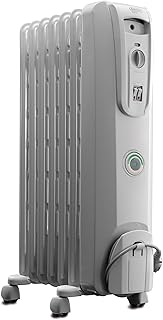
The De’Longhi EW7707CM is best for buyers who want a feature designed to maintain a comfortable temperature without leaving the thermostat at its maximum setting. The manufacturer says ComfortTemp can be up to 20% more efficient compared with using the same unit’s thermostat at the maximum setting without that feature. This is a stated comparison, not a guarantee of the savings an individual household will achieve.
Simple controls allow users to adjust power and temperature. The heater’s thermal-slot design is described as directing heat flow into the room while maintaining a low surface temperature. Those features make it a practical comparison for shoppers prioritizing basic adjustment and automatic temperature management.
- Best for: Buyers interested in a comfort-temperature feature and simple controls.
- Why it stands out: It provides a stated efficiency comparison tied to use of ComfortTemp.
- Limitation: The supplied product details do not identify selectable wattage levels or a specific room-size range.
DREO Radiator With Three Heat Levels
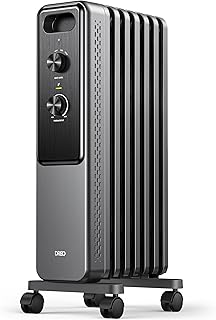
This DREO radiator is best for buyers who prefer direct controls for both heat level and temperature. Its dual knobs allow selection among 600W, 900W, and 1500W settings and adjustment of the thermostat. The product listing also describes seven M-shaped fins, an automatic thermostat, and a quiet design for indoor use.
The selectable wattage levels can help shoppers match output to their comfort needs rather than always using the highest setting. The listing claims the built-in thermostat can reduce energy use by up to 60%, but that figure is a manufacturer claim and should not be treated as a guaranteed result for every room or usage pattern.
- Best for: Buyers who want separate physical controls for power and temperature.
- Why it stands out: Its three listed wattage levels make output selection explicit.
- Limitation: The supplied details do not explain the conditions behind the claimed energy-use reduction.
EasyAcc Wall Heater for Compact Spaces

The EasyAcc is not an oil-filled radiant heater. It is included as an alternative for shoppers who need a compact wall-mounted heater with directed airflow. Its ceramic PTC heating is rated at 1200W, with low and high heat settings of 700W and 1200W, plus a fan-only mode. The listing says it can produce warm air in as little as two seconds.
This model is best for buyers who want to keep floor and countertop space clear or direct airflow at a particular spot. Its airflow angle adjusts up to 30 degrees. Unlike an oil-filled radiator, it uses a fan-based ceramic heating approach, so compare it on the basis of quick, directed airflow rather than retained radiator warmth.
- Best for: Compact spaces where wall mounting and adjustable airflow are useful.
- Why it stands out: It offers three operating modes and an adjustable airflow angle.
- Limitation: It is a ceramic heater, not an oil-filled radiator, and its listed output is 1200W.
Buying Guide: How to Choose an Efficient Oil-Filled Heater
What does “efficient” mean for an electric space heater?
For an electric resistance heater, efficiency is not simply a matter of the oil-filled design using less electricity to make heat. The practical goal is to use only the heat and operating time needed for comfort. A thermostat can help regulate room temperature, while selectable power levels give the user options when full output is unnecessary. Claims about savings depend on the model, settings, room, and how long it runs.
Should you choose 1500W or a lower setting?
A 1500W setting provides the highest listed output among the oil-filled models here. The Amazon Basics and second DREO models also offer lower settings of 900W and 600W. Lower settings can be useful when less heat is needed, but they do not automatically guarantee lower energy use in every situation. Compare the available settings with your room’s heating needs and the heater’s thermostat controls.
How important is thermostat control?
A thermostat helps a heater respond to the selected temperature rather than operating only at a fixed output. The first DREO model lists eco mode and a sensor-based temperature control approach. The De’Longhi lists ComfortTemp, while the second DREO uses an automatic thermostat and dual knobs. If maintaining a steady comfort level is important, compare these controls rather than choosing based only on wattage.
Does an oil-filled radiator keep heating after it is turned off?
Oil-filled radiators retain heat in their warmed oil and metal, so they can continue releasing some warmth after the heating element stops. This is a heat-retention characteristic, not a source of free heat. The unit must use electricity while heating up, and the amount and duration of retained warmth vary with the heater and surroundings.
What safety features should buyers compare?
Check the specific product listing for protections such as tip-over or tilt protection and overheat protection. The first DREO listing additionally names a burn-proof plug, fire-resistant material, and ETL listing. Do not assume that one model has another model’s features. Follow the instructions supplied with the heater and keep it positioned and operated as its manufacturer directs.
Is a radiator or a fan heater better for a small space?
An oil-filled radiator is a better fit for shoppers seeking steady, retained warmth. A fan-based ceramic heater such as the EasyAcc is a different option for buyers who value quick warm airflow, adjustable direction, and wall mounting. Consider the room layout, preferred style of heating, and available placement space. The EasyAcc should not be compared as an oil-filled model.
Frequently Asked Questions
Are oil-filled radiant heaters energy efficient?
They can support controlled heating when paired with a thermostat and used at an appropriate setting. Efficiency in practice depends on the room, temperature setting, insulation, and operating time. A heater’s marketing claim is not a guaranteed household energy saving.
Which listed heater has the most power settings?
The Amazon Basics model and the second DREO radiator each list three wattage settings. The Amazon Basics settings are 600W, 900W, and 1500W; the second DREO lists the same levels.
Which model is best for temperature-focused control?
The first DREO model is a relevant choice for buyers seeking eco mode and sensor-based temperature control. The De’Longhi is another option because it lists its ComfortTemp feature.
Do oil-filled radiators need to be refilled?
The supplied product information does not describe a user refill process. These listings identify the products as oil-filled radiators, but buyers should consult each manufacturer’s instructions for care and operation.
Is the EasyAcc an oil-filled heater?
No. The EasyAcc listing describes a 1200W ceramic PTC heater with adjustable airflow. It is an alternative for buyers seeking compact directed heat, not a substitute with oil-filled radiator construction.