Answering the question “which plug in thermostat is best for a space heater?” this guide compares five reliable options designed to regulate room temperatures efficiently. Each product targets different buyers: do-it-yourself hobbyists, hobbyists running greenhouses, or homeowners seeking simple, safe control over heating and cooling. The following summary highlights key at-a-glance details to help you decide quickly.
| Product | ||
|---|---|---|
| WILLHI WH2408 | Reptile terrariums, seedling mats, home brew | |
| Diymore 1800W | Space heaters needing cycle and countdown modes | |
| DEWENWILS Digital Temperature Controller | Greenhouses, incubators, homebrews | |
| ZILLSEA Digital Temperature Controller | General heating and cooling, year-round environments | |
| DIGITEN Wireless Thermostat Outlet | Remote control spaces, limited outlets |
Note: All listed products are plug-in thermostat outlets designed to regulate space heaters and related devices. The following sections detail each option’s strengths, target buyers, and practical caveats.
WILLHI WH2408 Temperature Controller Review

The WILLHI WH2408 is a digital temperature-controlled outlet switch that emphasizes ease of use. It is best for buyers who want simple two-knob temperature adjustments with reliable performance from -58°F to 230°F. Its memory feature helps maintain settings through power outages, reducing the need for constant reconfiguration. Practical for reptile tanks, seedling mats, and small-scale fermentation setups.
Best for: hobbyists and small setups needing quick, dependable control without complex menus. Caution: the shell is fire-retardant but not waterproof; keep the device dry and avoid saltwater use for extended periods, which can shorten probe life.
Diymore 1800W Plug In Thermostat

The Diymore model offers five temperature controller modes and a data storage function. It supports cycle timer and countdown modes, with a precise -40℉ to 210℉ range and ±1% accuracy for the control. This makes it suitable for users who need programmable cycles in addition to fixed temperature targets.
Best for: users who require flexible timing alongside temperature control. Caution: cycling and countdown modes cannot be used simultaneously, so plan your operation sequence accordingly.
EconoHome Adjustable Thermostat

The EconoHome adjustable thermostat is a non-digital plug-in option with a simple dial. It’s best for users who want a straightforward, low-maintenance device with a clear current temperature readout. Its range of 41-86°F suits indoor climate stabilization without digital complexity.
Best for: renters or minimalist setups seeking a reliable, easy-to-use solution. Caution: dial-based control may offer less precision than digital models, and some users may prefer more granular customization.
Plug In Thermostat Heavy Duty By Ecoartheating

The Ecoartheating model emphasizes heavy-duty use with a maximum 1800W rating and multiple programming options. It features a large LCD and various countdown modes, plus a 1.7-meter probe for flexible sensor placement. It’s designed for infrared heaters and other high-load devices.
Best for: spaces requiring strong power handling and multiple timing modes. Caution: the data storage function stores parameters, but users should still verify mode compatibility before running high-demand equipment.
ZILLSEA Digital Temperature Controller
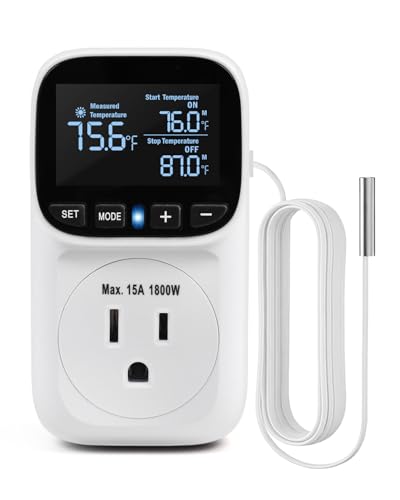
ZILLSEA offers precise digital control from -40°F to 210°F with 0.1°F accuracy and a backlit LCD that stays readable in low light. It supports both heating and cooling modes, making it versatile for greenhouses, fermentation, and reptile habitats. A high-power capable unit handles up to 1800W.
Best for: environments needing tight, precise control and visibility in dim settings. Caution: ensure the probe is kept dry and avoid prolonged exposure to saltwater without a proper probe replacement.
DIGITEN Wireless Thermostat Outlet

The DIGITEN model emphasizes wireless operation and plug-and-play simplicity. It supports up to 1800W and offers easy switching between Celsius and Fahrenheit, with a design that minimizes outlet occupancy. It’s a practical choice for spaces where outlet real estate matters.
Best for: users who want remote-friendly control and a simple, space-saving plug-in unit. Caution: wireless operation may require stable power and occasional battery-free sensor reliance; verify local interference conditions if using in dense electronics environments.
Buying Guide: Key Purchase Considerations
- Power handling: Choose a unit rated at least as high as your heater’s wattage. Look for 1800W (15A) models for most space heaters.
- Control type: Digital controls offer precise settings and memory; non-digital dials are simple but less precise.
- Modes and timing: Decide between cycle modes, countdown timers, or fixed target temperatures based on your use case (greenhouses, incubators, or home heating).
- Sensor placement: Probes should be placed away from direct heat or cold drafts to avoid skewed readings. Some models include longer probes for flexibility.
- Safety features: Fire-retardant housings and isolation features improve safety. Ensure the device is used in dry, indoor environments.
- Display readability: Backlit or VA displays help readings in dim areas. Consider the visibility of the interface in your setup.
- Outage memory: If power loss occurs often, a device with memory that retains settings reduces setup disruption.
Frequently Asked Questions
- What is a plug-in thermostat for space heaters?
- How precise are these digital thermostats?
- Can these be used for cooling as well as heating?
- Do these require professional installation?
- What should I consider when choosing a unit for a space heater?
- Are wireless thermostats safe to use around heaters?
A plug-in thermostat is a device that plugs into a wall outlet and then powers a separate space heater, controlling the heater’s operation based on set temperature targets or timing sequences.
Most digital models offer ±0.5°F to ±1% accuracy, depending on the unit and sensor quality, enabling stable environmental conditions in small to medium spaces.
Yes. Many models support both heating and cooling modes, useful for greenhouses or fermentation rooms that require temperature swings.
No. These are plug-in devices designed for consumer use. Always follow the manufacturer’s safety guidance and keep probes dry.
Power rating, control type, available modes, sensor placement, and safety features are the core considerations. Match the device to your heater’s wattage and your desired level of automation.
Yes, when used as intended. Ensure a stable power source and follow all safety directions regarding placement and venting of space heaters.