The best portable propane boat heater depends on the space you want to warm, the heat output you need, and whether the heater is approved for your specific marine use. The Mr. Heater Portable Buddy suits smaller areas, while the Big Buddy and ROVSUN offer higher output for larger spaces. The Little Buddy is a compact, lower-output option. The onlyfire is an electric alternative, not a propane heater. Important: indoor-use claims do not establish that a heater is safe or approved for use aboard a boat.
| Product | Best for | Listed heat or power | Important distinction |
|---|---|---|---|
| Mr. Heater Portable Buddy | Smaller spaces | 4,000 or 9,000 BTU/hr | Listed for indoor and outdoor use |
| Mr. Heater Big Buddy PRO | Higher heat output | 4,000, 9,000, or 18,000 BTU | Optional hose for two 20-pound tanks |
| ROVSUN 18,000 BTU | Adjustable high output | 6,000, 12,000, or 18,000 BTU | Includes regulator and hose |
| Mr. Heater Little Buddy | Small areas | 3,800 BTU/hr | Listed for up to 95 square feet |
| onlyfire FlexRay 80-inch | Electric-heater shoppers | 1,500 watts | Not a propane heater |
Mr. Heater Portable Buddy

Best for: Buyers considering a portable radiant heater for a relatively small area who want a choice of two heat outputs. This model emits 4,000 or 9,000 BTU per hour and is listed as heating up to approximately 225 square feet.
Why it was selected: Its lower output options make it easier to compare with the larger 18,000-BTU models. The product is described as designed and approved for indoor and outdoor use. That description may be useful for general product research, but it does not establish approval for use aboard a boat.
Limitation: The stated coverage is approximate and may not represent performance in a drafty or poorly insulated marine space. Do not use it in a boat cabin unless the product instructions and applicable marine guidance specifically permit that use.
Mr. Heater Big Buddy PRO

Best for: Buyers comparing heaters with more output and multiple settings. The listed low, medium, and high settings are 4,000, 9,000, and 18,000 BTU, with stated coverage up to 450 square feet.
Why it was selected: Its range of settings allows comparison between lower-output operation and a higher maximum output. The product information also states that it can run for up to 216 hours on two 20-pound propane tanks with an optional hose on the low setting.
Limitation: The long runtime is specifically tied to the low setting and optional hose; it should not be assumed at higher settings. Confirm the approved fuel connection, placement, and operating conditions in the manual. A large BTU rating does not make a heater suitable for an enclosed boat.
ROVSUN 18,000 BTU Portable Heater

Best for: Buyers who want three selectable outputs and a heater supplied with a regulator and hose. The listed settings are 6,000, 12,000, and 18,000 BTU, and the product information gives coverage up to 450 square feet.
Why it was selected: It offers a different low-to-high setting range from the Mr. Heater Big Buddy, which may help buyers compare output needs. Listed features include a push-button piezo ignition, tip-over protection, and an oxygen depletion sensor (ODS). The listing also states up to 69 hours of runtime on a standard 20-pound tank at the lowest setting.
Limitation: Runtime depends on the lowest setting and should not be applied to higher outputs. Listed safety features are not a substitute for checking marine suitability, following the manual, and maintaining required ventilation. Do not infer boat approval from the listing’s indoor-and-outdoor wording.
Mr. Heater Little Buddy
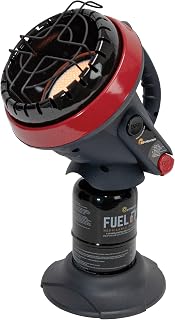
Best for: Buyers looking for a lower-output propane heater for a small area. The product is listed at 3,800 BTU per hour and for spaces up to 95 square feet.
Why it was selected: Its lower listed output and smaller stated coverage distinguish it from the 9,000- and 18,000-BTU options. It may be worth comparing when the goal is modest supplemental heat rather than warming a larger space.
Limitation: The product details supplied here do not specify indoor or marine approval, runtime, or additional safety features. Check the full manual before purchase, and do not use it aboard a boat unless the manufacturer and applicable marine guidance explicitly allow that use.
onlyfire FlexRay Electric Heater

Best for: Buyers willing to consider an electric alternative rather than propane. The product name lists 1,500 watts, three heat modes, a light mode, a magnetic remote, a cover, and overheat and tip-over protection.
Why it was selected: It is the only supplied product that provides a non-propane option. That distinction matters for buyers who are comparing fuel-burning heaters with an electric unit and can provide a suitable power source.
Limitation: This is not a propane heater, and the supplied product details do not state marine approval or boat-specific installation requirements. Its usefulness aboard a boat depends on access to a compatible electrical supply and suitability for the intended location.
Buying Guide: How to Choose a Boat Heater
Is a portable propane heater safe to use aboard a boat?
Do not assume that a heater is safe for a boat because it is described as portable, indoor/outdoor, or equipped with an ODS. Those descriptions do not establish marine approval. Propane combustion can create carbon monoxide, and enclosed cabins can make ventilation and exhaust hazards especially serious. Check the manufacturer’s instructions and applicable marine safety requirements before buying or operating any combustion heater aboard.
Use a carbon monoxide alarm appropriate for the boat, follow its instructions, and never rely on an alarm as permission to use a heater that is not approved for the setting. Keep heaters away from fuel, fabric, and other combustible materials. Use only the specified cylinder, hose, and regulator arrangement, and do not leave an operating heater unattended or use it while sleeping unless the manufacturer specifically permits that operation.
How much heat output do you need?
BTU output indicates the heater’s heat-delivery rate, but the listed square-foot coverage is not a guaranteed result in every space. A boat’s insulation, air leaks, cabin layout, outside temperature, and airflow affect how quickly it warms. Use the supplied coverage figures as comparison points, not as a promise that a model will heat a particular boat.
- For the lowest listed output, compare the Little Buddy at 3,800 BTU/hr with the other models’ lower settings.
- For a two-setting option, the Portable Buddy provides 4,000 and 9,000 BTU/hr.
- For three settings and a higher maximum, compare the Big Buddy PRO and ROVSUN, both listed at up to 18,000 BTU.
Should you choose adjustable heat settings?
Multiple settings let a buyer compare lower and higher heat output within one product. The Portable Buddy has two listed settings; the Big Buddy PRO and ROVSUN each have three. More settings do not establish marine suitability or guarantee efficient operation in a particular cabin. Match the lowest useful setting to the intended space and follow the product’s operating instructions.
What should you know about runtime and propane connections?
Runtime claims are tied to stated conditions. The Big Buddy PRO listing specifies up to 216 hours using two 20-pound tanks with an optional hose on low. ROVSUN states up to 69 hours on a standard 20-pound tank at the lowest setting. Neither figure should be treated as the expected runtime at higher settings or in every operating condition.
Before buying, confirm which cylinder and connection setup the manufacturer specifies, whether an optional hose is required, and how the fuel container must be positioned. Do not improvise adapters or use a connection that the product manual does not identify as compatible.
What safety features should buyers compare?
ROVSUN’s supplied details list tip-over protection and an oxygen depletion sensor. These are product features to compare, not proof that the heater is appropriate for marine use or safe in a confined cabin. The supplied details for the other propane models do not describe comparable safety features, so check their full product documentation rather than assuming they have them.
Regardless of model, read the manual before operation and use the heater only in the settings it permits. Keep the unit stable and clear of objects, provide the ventilation specified by the manufacturer, and stop using it if you notice a problem with the appliance or fuel connection.
Is an electric heater a better alternative?
An electric heater avoids burning propane at the point of use, but it requires an appropriate power source. The onlyfire listed here is a 1,500-watt electric infrared heater, not a propane model. Its suitability depends on the boat’s available electrical supply and whether its instructions permit the intended environment. Confirm the power requirements and marine suitability before choosing an electric unit.
Frequently Asked Questions
Which listed heater has the lowest stated heat output?
The Mr. Heater Little Buddy is listed at 3,800 BTU per hour. Its product details state coverage up to 95 square feet.
Which listed propane heaters reach 18,000 BTU?
The Mr. Heater Big Buddy PRO and ROVSUN heater are both listed with a maximum output of 18,000 BTU. Their settings and runtime claims differ.
Does indoor-use labeling mean a heater is approved for a boat?
No. Indoor-use wording does not establish marine approval. Check the manufacturer’s instructions and applicable marine requirements before using a fuel-burning heater aboard.
Which product listed here is not propane-powered?
The onlyfire FlexRay is an electric infrared heater listed at 1,500 watts. It is an alternative to compare, not a portable propane boat heater.
Are listed runtime figures guaranteed?
No. The supplied runtime claims specify particular conditions, including low heat settings and, for the Big Buddy PRO, an optional hose. Actual runtime can vary with operating conditions and should not be assumed at higher settings.