The best quiet electric baseboard heaters provide steady warmth without distracting operating noise. The Comfort Zone CZ650B is best for buyers who want a digital thermostat, while the CZ600 offers quieter convection heat with a simpler adjustable thermostat. Cadet’s portable model suits people who need plug-in flexibility, and its 24-inch F Series heater is a low-wattage option for installations designed for its voltage. The DREO is not a baseboard heater, but it is a quiet alternative for shoppers open to a different heater style.
| Product | Best For | Notable Detail |
|---|---|---|
| Comfort Zone CZ600 | Simple, quiet room heating | Two heat settings and adjustable thermostat |
| Comfort Zone CZ650B | Digital temperature control | Digital thermostat and temperature display |
| Cadet Portable Baseboard Heater | Moveable plug-in heat | 120V plug and built-in dial thermostat |
| Cadet F Series 24-inch | Low-output fixed installation | 350/262 watts at 240/208 volts |
| DREO 25-inch Space Heater | Quiet non-baseboard alternative | Listed noise level as low as 25 dB |
Comfort Zone CZ600 Baseboard Space Heater

Best for: Shoppers who want quiet, portable convection heat with straightforward manual controls. The CZ600 has a 1,500-watt heating element, two heat settings, and an adjustable thermostat. Its manufacturer describes operation as whisper-quiet, making this a relevant choice for bedrooms, offices, and other spaces where fan noise can be distracting.
The listed safety features include a tip-over switch, overheat protection, and a stay-cool body. Dent-proof end panels are also part of the product description. Those details may matter to households looking for a portable heater with protective features as well as low-noise operation.
Why it was selected: It combines the baseboard form factor, adjustable heat, and a specific claim of silent operation. Choose it if you want a less complex control setup than a digital thermostat.
Limitation: The provided information does not specify a digital temperature display or a precise noise measurement. It is listed for medium-sized rooms, so buyers should not assume it is sized for every room.
Comfort Zone CZ650B Digital Baseboard Heater
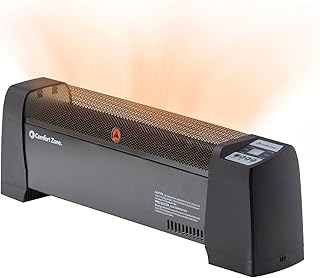
Best for: Buyers who prefer a displayed temperature setting and adjustable digital controls. This 1,500-watt convection heater offers two heat settings and a digital thermostat with a clear temperature display. The product information describes it as suitable for medium-sized rooms and identifies its operation as whisper-quiet.
The CZ650B also lists a tip-over switch, overheat protection, and a stay-cool body. These features provide specific safety considerations for anyone comparing portable electric heaters. The digital display can make it easier to see the selected temperature than a basic dial, although the listing does not provide a temperature accuracy range.
Why it was selected: It is a strong fit for shoppers who want quiet operation and more visible thermostat settings in one portable baseboard-style heater. Choose this model over the CZ600 if the digital display is a priority.
Limitation: Like the CZ600, it is described as a medium-room heater. The supplied details do not give a measured noise level, so “whisper-quiet” is a product claim rather than a numeric comparison.
Cadet Portable 1500W Baseboard Heater

Best for: People who want to move a quiet heater between rooms without arranging a hardwired installation. This Cadet model plugs into a standard 120-volt wall outlet using its included six-foot grounded cord. Built-in handles support moving it, and the product description says it does not require hardwiring, wall cutting, or an electrician.
It provides 1,500 watts and 5,120 BTU of convection heat, with a built-in dial thermostat and an off setting. Cadet describes it as near-silent because it has no moving parts. The listed use cases include small-to-medium rooms, bedrooms, and offices.
Why it was selected: It offers a practical combination of baseboard styling, portability, a standard-voltage plug, and quiet convection heat. Choose it if you need supplemental warmth in more than one room and want the thermostat on the heater.
Limitation: Its corded design means it needs a suitable outlet and a place to position the unit. It is a portable heater, not a fixed wall-mounted baseboard installation.
Cadet F Series 24-Inch Baseboard Heater

Best for: Buyers comparing a compact fixed baseboard heater for an electrical setup designed for its listed voltage and output. This white, steel F Series model is 24 inches long. Its listed ratings are 350 watts at 240 volts and 262 watts at 208 volts, with corresponding outputs of 1,195 and 895 BTU.
Unlike the portable 1,500-watt models in this guide, this unit has a much lower listed wattage. That makes electrical and heating requirements especially important to check before selecting it. The supplied product details identify the material, color, and electrical ratings, but do not provide a noise measurement or thermostat information.
Why it was selected: It represents a fixed, compact baseboard option for shoppers whose installation plans call for this model’s voltage and output. Compare its ratings with the electrical specifications and heating needs of the intended room.
Limitation: Its output is substantially lower than the 1,500-watt portable heaters listed here. The supplied information does not establish that it includes a thermostat or provide a specific quiet-operation claim.
DREO 25-Inch Quiet Space Heater

Best for: Shoppers who prioritize quiet heating but are willing to consider a non-baseboard design. The DREO is a 25-inch indoor space heater, not an electric baseboard heater. Its product details describe a fast airflow design and noise as low as 25 dB, which gives buyers a stated sound figure to compare with products that provide no numeric measurement.
Listed safety features include V0 flame-retardant material, a reinforced plug, tip-over and overheat protection, and a child-lock setting. The product information also identifies ETL certification. These features make it relevant as an alternative for a bedroom or office where low reported noise is a key consideration.
Why it was selected: It offers a quiet-heating alternative for buyers whose main requirement is reduced noise rather than the baseboard format. Choose it if airflow-based heating suits your preference.
Limitation: It does not meet a strict requirement for an electric baseboard heater. Its airflow-based design differs from the convection baseboard models above.
Buying Guide: How to Choose a Quiet Electric Baseboard Heater
How quiet is a baseboard heater?
Electric convection baseboard heaters can operate without the fan noise associated with many forced-air heaters. However, product descriptions use different kinds of evidence. The Comfort Zone models are described as whisper-quiet, while Cadet describes its portable model as near-silent because it has no moving parts. The DREO lists a noise level as low as 25 dB, but it is a different heater style. Compare exact product claims rather than assuming every model has an identical sound level.
Also consider where the heater will be used. A small sound may be more noticeable in a bedroom at night than in a busy living area. If the manufacturer does not publish a measured noise figure, treat descriptive terms as claims rather than precise side-by-side measurements.
Do you need a portable or fixed baseboard heater?
A portable model can be moved between rooms and may connect to a standard outlet. The Cadet portable heater, for example, is listed as a 120-volt plug-in unit with a six-foot cord. Portable heaters need an appropriate location near an outlet, and the cord affects where the unit can be placed.
A fixed baseboard heater is a different purchase. The Cadet F Series model is listed for 208- or 240-volt operation, so buyers should confirm that the planned electrical setup matches the unit. The product details supplied here do not specify installation requirements. Consult the manufacturer’s instructions and a qualified professional when needed.
What wattage and room size should you compare?
Wattage indicates the heater’s electrical input, but it does not by itself establish the right choice for every room. The three portable models in this comparison list 1,500 watts, while the 24-inch Cadet F Series lists 350 watts at 240 volts or 262 watts at 208 volts. Their outputs are not interchangeable. Consider the model’s stated room guidance, the room’s heating needs, and the electrical supply before choosing.
A product described for medium-sized rooms should not automatically be treated as suitable for a large, drafty, or poorly insulated space. Check the manufacturer’s room-size guidance if available and compare it with your intended use.
Which thermostat type is easiest to use?
A manual dial is a straightforward way to set a general comfort level. The Cadet portable model has a large built-in dial thermostat and an off setting. The Comfort Zone CZ600 has an adjustable thermostat and two heat settings, while the CZ650B adds a digital thermostat and temperature display.
Choose a digital display if seeing the selected temperature is important. Choose a dial if you prefer simpler controls. The product information does not provide enough detail to compare thermostat accuracy or programming features, so do not assume those capabilities are included.
What safety and placement details matter?
Compare listed safety features, including tip-over shutoff and overheat protection. The Comfort Zone models list both, along with a stay-cool body. The DREO lists tip-over and overheat protection, a child lock, and flame-retardant material. The Cadet portable product details supplied here emphasize its cord, thermostat, and convection operation rather than specifying the same safety features.
Follow the manufacturer’s placement and operating instructions for whichever heater you choose. Check clearance requirements, keep the heater away from items that could obstruct or contact it, and use the electrical connection specified for that model. Product descriptions alone are not a substitute for the full operating manual.
Frequently Asked Questions
Are electric baseboard heaters quiet?
Many convection-style electric baseboard heaters operate without a fan, which can reduce mechanical noise. Noise varies by model, and not every product listing gives a measured decibel level. Check the manufacturer’s specific description and specifications.
Which product in this guide has a digital thermostat?
The Comfort Zone CZ650B lists a digital adjustable thermostat with a temperature display. The CZ600 has an adjustable thermostat, and the Cadet portable model has a dial thermostat.
Which listed heater can plug into a standard 120-volt outlet?
The Cadet Portable Electric Baseboard Heater is listed as a 120-volt plug-in model with an included six-foot grounded cord. Confirm outlet suitability and follow its operating instructions.
Is the DREO heater a baseboard heater?
No. The DREO 25-inch model is an indoor space heater with an airflow-based design. It is included as a quiet alternative, not as a baseboard heater.
Can the Cadet F Series 24-inch model replace a 1,500-watt heater?
Do not assume so. The F Series model lists 350 watts at 240 volts or 262 watts at 208 volts, substantially below the 1,500-watt portable models. Compare its ratings with the room’s heating needs and electrical setup.