Looking for a retrofit tankless water heater that fits your existing space and delivers on-demand hot water? This guide highlights five well-suited options, ideal for RV upgrades, tiny homes, or whole-house replacements. Each entry notes who it’s best for, why it’s chosen, and any practical limitations. Use this at-a-glance comparison to select the best fit for your redone water heating system.
Summary Table of Chosen Products
- FOGATTI InstaShower 7 RV Tankless Water Heater — Best for compact RV retrofits with multiple door sizes
- FOGATTI InstaShower 9 Pro RV Tankless Water Heater — Best for higher flow needs in RVs
- Furrion Tankless Gas Water Heater FWH09AFA-AM — Best for reliable RV hot water with safety features
- MIZUDO Natural Gas Tankless Water Heater — Best for whole-home, high-flow applications
- FOGATTI InstaShower 9 Pro RV Tankless Water Heater (Second variant) — Best for high-altitude RV use with similar capacity
FOGATTI InstaShower 7: RV Tankless for Small Spaces

The InstaShower 7 is designed to replace RV water heaters with a compact 15″×15″ or 15″×18″ or 18″×18″ door, available in two colors. It delivers 2.5 gallons per minute (GPM) at up to 48,000 BTU, enabling quick hot water for showers and dishes. The unit uses staged combustion to stabilize temperatures and is claimed to work at high altitudes up to 9,800 feet. Best for: smaller RVs and campers needing a ready RV retrofit with solid hot-water output. Caution: installation door size must be available in the listed options; mismatched dimensions require alternatives.
FOGATTI InstaShower 9 Pro: Higher Flow RV Solution
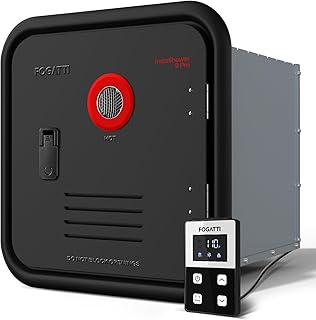
This Gen 3 model offers 66,000 BTU and up to 3.6 GPM, suitable for simultaneous use in an RV’s bathroom and kitchen. It remains compatible with 15″×15″ doors and extends retrofit options to retrofit multiple 13″×13″ openings. It’s designed to operate at high altitudes (up to 9,800 feet) and includes an upgraded fan for stable performance in windy settings. Best for: RV households needing stronger flow for multiple users. Caution: unit size and door compatibility must be checked against your RV’s current opening.
Furrion Tankless Gas Water Heater: RV Reliability

Furrion’s unit delivers 2.4 GPM at 60,000 BTU with premixed water for consistent temperatures. It includes safety features such as a pressure relief valve and automatic shut-off, making it suitable for busy RV lifestyles. Best for: RVers who want quick hot water and built-in safety protections. Caution: ensure compatibility with your RV electrical and gas setup and verify venting requirements before retrofit.
MIZUDO 199,000 BTU Gas Tankless: Whole-House Flow

With 199,000 BTU and up to 10.3 GPM, this model targets whole-house use with capacity for 2–3 bathrooms, kitchens, and laundry simultaneously. It offers precise temperature control (±1°F) and an adjustable range up to 149°F. Best for: households needing high flow across multiple fixtures. Caution: higher BTU models require appropriate gas supply and venting; verify if your space can support larger installation.
FOGATTI InstaShower 9 Pro: Altitude-Ready RV Upgrade

The InstaShower 9 Pro is another high-capacity option, delivering up to 66,000 BTU and up to 3.6 GPM for RV use. It features altitude readiness for up to 9,800 feet and a built-in mixing tank. Best for: families needing robust hot-water supply in a retrofitted RV. Caution: door-size compatibility must be confirmed for retrofit success; some configurations may require alternative openings.
Buying Guide: How To Choose A Retrofit Tankless Water Heater
What space do you have?
Measure door openings and wall clearances. Some models require 15″×15″ doors, others offer 18″×18″ options. Pick a unit that fits your retrofit opening to avoid extra fabrication.
Flow needs and temperature control
Consider GPM requirements based on showers, sinks, and appliances you intend to run simultaneously. Look for models with stable temperature control (±1–2°F if possible) to minimize fluctuations during use.
Altitude and climate considerations
RV and off-grid installations may face freezing temperatures or high elevations. Choose models advertised as altitude-ready and with reliable performance in windy conditions.
Fuel type and installation context
Gas tankless heaters demand venting, gas supply, and appropriate exhaust considerations. Electric or propane variants differ in installation complexity and ongoing operating costs. Ensure your space supports the required venting and connections.
Safety features and reliability
Look for automatic shutoff, pressure relief valves, anti-scald protections, and robust ignition or flame stabilization technologies. These features reduce risk and improve long-term reliability in retrofit scenarios.
Maintenance and availability of parts
Choose brands with wide service networks and readily available replacement parts. This reduces downtime and simplifies retrofit service in the future.
Compatibility with existing components
Verify that the unit can replace or retrofit existing tank heaters or tankless units. Compare door sizes, mounting options, and connection layouts to avoid additional fabrication.
FAQ
- What is a retrofit tankless water heater? A unit designed to replace an existing water heater, often using a different door size or installation footprint, to provide on-demand hot water without a storage tank.
- Do retrofit tankless heaters work at high altitudes? Many models advertise altitude readiness and stable performance up to specified feet, but verify your exact elevation and venting requirements with the manufacturer.
- Is tankless hot water faster than a traditional tank heater? Tankless units heat on demand, eliminating the wait for a full tank to heat up, but flow rate depends on the model and installation.
- What should I check before buying? Door size compatibility, fuel type, GPM needs, altitude readiness, and safety features are key factors to confirm during purchase.
- Can I install a tankless heater myself? Installation usually requires plumbing and venting work. Consult a licensed professional for safe and compliant retrofit.
- How do I choose between gas and electric tankless heaters? Gas models generally offer higher flow for larger homes, while electric units may be simpler to install in some retrofit scenarios; consider fuel availability and energy costs.