When choosing a safe heater for a dog house, look for models with reliable thermostats, chew-resistant cords, and automatic shutoffs to prevent overheating. These picks suit outdoor kennels, insulated dog houses, or shelters where pets need steady warmth without risk. The top products here are designed for safety, energy efficiency, and straightforward operation, making them suitable for new and experienced pet owners alike. The following options cover a range of sizes, power levels, and cord protections to fit different dog house setups.
| Product | Best For | |
|---|---|---|
| Rypet Large Dog House Heater with Thermostat | Outdoor dog houses needing quick warmth | Two power settings (300W/600W) with auto on/off |
| 500W Dog House Heater with Thermostat | Chew-prone areas requiring long cord protection | 9.8 ft chew-proof cord and 24H timer |
| PETNF Dog House Heater 300W Full Metal | Metal shelters needing rugged construction | Full-metal housing and eco mode |
| Heat Storm HS-1500-PHX-WIFI Infrared Heater | WiFi-ready homes and flexible placement | Infrared heat with wall-mount capability |
| DREO Quiet Space Heater | Indoor spaces or small shelters needing quiet operation | 70° oscillation with timer |
Rypet Large Dog House Heater With Thermostat

This 300W/600W heater offers two heat levels to adapt to the dog house size and external temperatures. It heats up to about 150 cubic feet and includes a thermostat that stops heating when temperatures exceed 100°F and restarts below 95°F for consistent comfort. A 6-foot metal anti-bite cord reduces risk from curious chewers. Best for outdoor, insulated kennels or larger dog houses where quick, controllable warmth is needed. Caution: ensure proper ventilation and avoid placing the unit where water can contact electrical components.
500W Dog House Heater With Thermostat
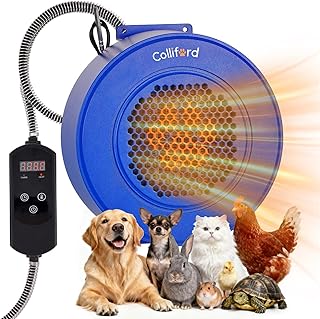
Designed for robust safety, this unit features UL/ETL-compliant construction and a long 9.8-foot chew-resistant cord. The 500W setting provides warmth for up to 125 cubic feet. A built-in sensor activates overheat protection, and a 24-hour timer helps manage energy use. Best for dog houses where distance from the main living space and power outlet is a factor. Choose this if you want extended cord reach and strong safety certifications; limit placement near water or damp areas.
PETNF Dog House Heater 300W Full Metal

PETNF offers a full-metal enclosure for durable daily use and a 45–113°F thermostat with Eco Mode. The 300W output is appropriate for small-to-medium shelters. A chew-resistant power cord and metal housing help withstand pet activity. Best for shelters where longevity and energy efficiency matter. Caution: metal housing can heat quickly; ensure the unit is mounted away from the dog’s reach to avoid accidental contact.
Heat Storm HS-1500-PHX-WIFI Infrared Heater
Heat Storm offers a WiFi-enabled infrared option that can mount on walls for space-saving warmth in smaller shelters. Infrared heating provides direct warmth to the pet without warming the entire space. Best for tech-friendly homes and flexible placement. Limitation: infrared units may require closer proximity to pets for optimal effect and can be less effective in very drafty kennels.
DREO Quiet Space Heater
DREO provides a quiet, oscillating heater with a 12-hour timer, suitable for indoor spaces or smaller shelters. The 1500W unit can deliver steady warmth, while a range of safety protections helps prevent overheating. Best for pet spaces where quiet operation is valued. Limitation: designed for indoor use; outdoor exposure requires a weatherproof enclosure and careful mounting.
Buying Guide: Safe Heating For Dog Houses
What size and placement matter?
Measure your dog house interior volume and choose a heater sized for that space. Place the heater outside the dog’s immediate reach, or mount it high on a wall, so warm air circulates without direct contact with paws. For larger kennels, opt for higher wattage or models offering quick heat-up times.
Which safety features are essential?
- Thermostat with automatic shutoff to prevent overheating.
- Overheat protection and temperature sensors.
- Cord protection, preferably chew-resistant cords.
- Rounded edges and sturdy housing to minimize injury risk.
What about energy use and control?
Look for models with Eco Mode or programmable timers. These features conserve energy when warmth isn’t needed. Some units include 24-hour timers or rear-mounted thermostats for accurate ambient readings. Avoid heaters that run constantly in moderate climates to save energy.
Indoor vs outdoor suitability
Outdoor-ready heaters are designed to withstand weather, with weatherproof housings and corrosion resistance. If you’re heating an indoor dog room or a dry shelter, a compact, quiet model can suffice. Choose a product that matches your shelter’s exposure to wind, moisture, and temperature swings.
Cord and chew considerations
A longer chew-proof cord offers flexible placement, but ensure it remains out of reach and away from water sources. For chewers, reinforced cords and protective sheaths are worthwhile investments to reduce risk.
How to compare products efficiently
- Compare wattage against shelter size and climate.
- Check thermostat range and safety cutoffs.
- Note cord length and chew resistance.
- Consider mounting options and ease of installation.
Quick FAQ
- Q: Is a higher wattage always better for dog houses? A: Higher wattage provides more heat and faster warm-up, but only if the space can safely accommodate it and the thermostat can regulate it.
- Q: Do these heaters work in cold, windy conditions? A: Outdoor-rated models are designed to withstand cold temperatures and wind, but proper shelter insulation improves effectiveness.
- Q: Can I leave the heater on all night? A: Many models include 24-hour timers or Eco Mode to run safely overnight with controlled heat output.
- Q: Are chew-proof cords necessary? A: For homes with curious chewers, chew-proof cords reduce the risk of damage and electrical hazards.
- Q: Should I mount the heater inside or outside the dog house? A: Outside mounting or wall placement reduces direct contact risk and keeps cords away from pets while still delivering warmth.
- Q: Do these heaters require professional installation? A: Most models are straightforward to install with basic mounting hardware; refer to product manuals for details.