The best space heater for a nursery prioritizes safety, quiet operation, and reliable temperature control. This guide highlights five trusted options designed for baby rooms and small bedrooms, with clear notes on who each heater is best for and potential limitations to consider. Use this overview to compare safety features, noise levels, and ease of use when choosing a nursery heater that fits your family’s needs.
| Product | You’ll Learn | Best For |
|---|---|---|
| Vornadobaby Tempa Nursery Space Heater | Cool-touch exterior, tip-over protection, auto shut-off | Parents seeking strong safety features in a compact unit |
| DREO Space Heater (PTC, 1500W) | Advanced safety with tilt-detection and V0 materials | People wanting robust safety systems and precise thermostat control |
| DREO Space Heater With Thermostat (Oscillation) | 70° oscillation, ECO mode, remote | Users needing wide room coverage and energy savings |
| DREO 1500W With Tilt (Vertical Tilt) | Adjustable tilt, rapid heat delivery, safety features | Those who want directed warmth and quick comfort |
| DREO Quiet Space Heater (Remote) | Whisper-quiet operation, multiple safety protections | Nurseries where sleep and low noise matter |
Note: All five selections emphasize safety and practical use in a nursery or small space. When selecting a heater for a baby’s room, prioritize tip-over protection, automatic shut-off, cool-to-touch surfaces, and quiet operation for nap times and nighttime sleep.
Vornadobaby Tempa Nursery Space Heater

Features: Designed to perform gentle whole-room heating across up to 100 sq. ft. It offers two heat settings, a fan-only mode, auto or continuous air circulation, a cool-touch exterior, and tip-over protection with automatic safety shut-off. It also includes hidden cord storage for a neat nursery setup.
Best for: Parents needing a compact, safety-forward heater that covers a small nursery or play area. The Tempa is suited for rooms where a soft, steady warmth is desired without noise disruption.
Limitations: Limited to smaller spaces (up to 100 sq. ft.), so larger bedrooms may require a different solution.
DREO Space Heater, Portable Indoor Use (Remote)
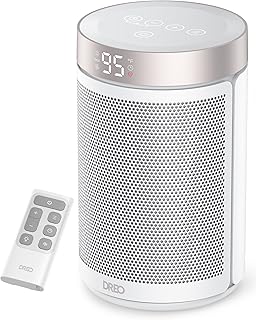
Features: Combines Hyperamics 1500W PTC with a fast heat delivery system, remote control, 12-hour timer, five modes, and 70° oscillation. Includes tilt-detection safety and ETL-listed protections along with a robust overheat protection system. The thermostat supports precise temperature settings down to 1°F increments.
Best for: Users who want quick, far-reaching warmth with flexible control options, including remote operation and a longer timer for daily routines.
Limitations: Higher power draw; verify room size and electrical capacity to avoid tripping circuits in smaller living spaces.
DREO Space Heater 1500W With Vertical Tilt

Features: Vertical tilt from 0° to 60° delivers warmth where it’s most needed. Delivers heat quickly with 1500W Hyperamics tech and provides robust safety with tilt-over protection, V0 materials, overheat protection, and ETL certification.
Best for: Spaces where directed warmth is useful, such as desks or beds, or rooms where you want to aim heat toward a specific area.
Limitations: Tilt-adjustable models may require positioning checks to ensure stability on uneven surfaces.
DREO Quiet Space Heater With Remote

Features: Hyperamics 1500W system delivers efficient heating with wide reach. Quiet operation (low noise) uses a brushless DC motor and winglet fan design. Includes a child lock, tip-over protection, V0 flame retardant material, overheat protection, and ETL certification.
Best for: Nurseries or bedrooms where sleep quality matters and steady, quiet heat is a priority.
Limitations: Quiet operation can sometimes be perceived as slower to respond in very cold rooms; pairing with a thermostat timer can help manage rapid temperature changes.
Buying Guide
Key considerations when choosing a nursery heater include safety, noise, space, and control features. Below are practical questions to guide your decision.
What safety features are essential for a nursery heater?
- Tip-over protection and automatic shut-off on overheating.
- Cool-to-touch exterior surfaces to prevent burns.
- ETL or UL certification for tested electrical safety.
- Locking controls or child-safe features to prevent accidental changes.
How large should the nursery heater be?
- Measure the room and select a unit that effectively heats the space (often 100–200 sq. ft. for baby rooms).
- Consider one with a quiet operation profile to avoid disturbing naps and nighttime sleep.
Is thermostat control important for baby rooms?
- Yes. A precise thermostat helps maintain a stable, comfortable temperature for sleep and daytime play.
- Look for models offering increments of 1°F and a timer mode to align with a baby’s sleep schedule.
Should I prioritize oscillation or directed heat?
- Oscillation spreads warmth evenly in a room, good for shared spaces or play areas.
- Directed heat (tilt or aimed vents) works well when you want to target a specific spot, such as near a crib or feeding chair.
What about noise considerations?
- Quiet operation is important for newborn sleep. Look for decibel ratings or mentions of “whisper-quiet” performance.
How do I manage energy use?
- Choose ECO or energy-saving modes to maintain comfort while minimizing power draw. Pair with an appropriate thermostat range to reduce unnecessary heat.
Installation and placement tips
- Place heaters on a stable, flat surface away from curtains, bedding, and crib bumpers.
- Avoid placing heaters where children can reach the controls; consider models with locking features.
- Use a dedicated outlet if possible to prevent circuit strain and avoid extension cords.
Frequently asked questions
- Q: Are space heaters safe for nurseries? A: Yes, if they have tip-over protection, a cool-to-touch exterior, and automatic shut-off when overheating.
- Q: Can I run a space heater all night? A: Some models include overnight timer modes; ensure it’s in a safe location and monitor for any signs of overheating.
- Q: Do I need a heater with remote control for a nursery? A: Remote control provides convenience for adjusting temperature without disturbing a sleeping baby.
- Q: What size heater should I choose for a nursery? A: For small nurseries up to about 100–200 sq. ft., select a heater that covers the space efficiently without excessive power draw.
- Q: Should I avoid heaters with high noise? A: Not necessarily, but quiet models are preferred to minimize sleep disruption.
- Q: Do these heaters require professional installation? A: Most consumer space heaters are plug-in devices; no professional installation is typically needed.