Answering the common buyer question: which steam heat exchanger best suits hot water needs for pools, spas, and residential heating? This guide highlights five practical options, detailing ideal uses, performance notes, and potential limitations. Choose based on capacity, port sizes, and corrosion resistance to match your system. The top picks are best for outdoor setups, spa and pool heating, and integration with wood-fired or solar heating sources. The following comparison table summarizes the key specs to help you decide quickly.
| Product | Best For | Capacity | Material | |
|---|---|---|---|---|
| AB 300 kBTU Heat Exchanger | Large pools, outdoor setups | 300 kBtu/hr | 316L stainless steel | 1 year warranty |
| AB Pool Heat Exchanger 155kBtu | Medium pools, spas | 155 kBtu/hr | 316L stainless steel | 1 year warranty |
| Water to Air Heat Exchanger 10×10 | Residential heating and cooling | 42,000 Btu (up to 360kBtu/hr) | Copper and aluminum, epoxy-coated fins | For outdoor wood furnaces and forced air |
| AB Plate Heat Exchanger, 4×12, 30 Plates | Hydronic heating and snow-melting | 250,000–330,000 Btu | 316L stainless steel, copper brazed | UL Certified |
| AB Plate Heat Exchanger, 4×12, 20 Plates | Compact hydronic systems | 250,000 Btu | 316L stainless steel, copper brazed | UL Certified |
AB 300 kBTU Heat Exchanger For Outdoor Wood Boiler

Best for large outdoor pools and spa setups. This unit is fully constructed from anti-corrosion stainless steel 316L, suitable for chlorinated water and chemical-treated environments. It handles up to 23,800 gallons with a 300 kBtu/hr heating capacity, making it ideal for substantial pool heating needs. The 2″ and 1 1/2″ FPT ports accommodate robust plumbing connections. A one-year warranty provides basic coverage for manufacturing defects. Choose this if you need a high-capacity exchanger designed to handle outdoor, chemically treated water.
Best for: large outdoor pools, spas, and solar or wood-fired systems that require high output and corrosion resistance. Limitation: installation requires adequate space and appropriate port fittings for the larger inlet/outlet sizes.
AB Pool Heat Exchanger 155kBtu Stainless Steel 316L
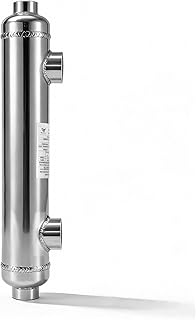
Best for mid-sized pools or spas with moderate heating demands. The 155 kBtu/hr capacity is suitable for 11,900 gallons and features 316L stainless steel for corrosion resistance in chemically treated water. Ports are on the same side (1 1/2″ and 1″ FPT), simplifying plumbing in compact setups. A one-year warranty covers manufacturer defects. Choose this if you need a balanced option between size, performance, and durability.
Best for: mid-size pools and spas; better for tighter installations. Limitation: lower capacity than the 300 kBtu model may require longer heating cycles for large pools.
Water To Air Heat Exchanger 10×10

Best for residential heating and cooling with outdoor wood furnace integration. It offers a capacity of 42,000 Btu and up to 360 kBtu/hr depending on configuration, with a multi-row copper tube design and wavy aluminum fins to enhance heat transfer. The unit uses epoxy-coated fins for durability and features base brazed connections for strength. This exchanger supports energy-efficient transfers from boilers or solar collectors. Choose this if you want flexible water-to-air heat exchange with renewable energy compatibility.
Best for: homes using wood furnaces or solar-assisted heating. Limitation: overall performance depends on fin/tube arrangement and may require proper airflow management.
AB Plate Heat Exchanger, 4 x 12 Inch, 30 Plates
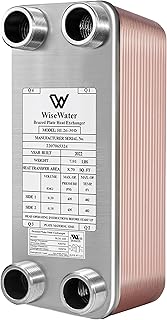
Best for compact hydronic systems requiring high heat transfer in a small footprint. This 30-plate, 4×12 inch plate heat exchanger uses 316L stainless steel with copper brazing to maximize durability and leak resistance. It supports a capacity between 250,000 and 330,000 Btu per hour and features a smooth-threaded design for easy hookups. UL certification provides a recognized standard for reliability. Choose this if you need strong, compact performance for room-constrained installations.
Best for: hydronic heating and snow-melting where space is limited. Limitation: higher plate count means more careful leak prevention and maintenance considerations.
AB Plate Heat Exchanger, 4 x 12 Inch, 20 Plates

Best for smaller or more budget-conscious hydronic systems requiring solid heat transfer. This 20-plate, 4×12 inch design uses 316L stainless steel with copper brazing, and is UL certified for reliability. It provides up to 250,000 BTU per hour capacity and is suitable for efficient heating or cooling tasks in compact setups. Choose this if you need a dependable, lower-plate option with robust materials.
Best for: smaller hydronic configurations; better value for limited spaces. Limitation: lower capacity than the 30-plate model may be insufficient for larger loads.
Buying Guide: Key Considerations For Steam Heat Exchangers
- Capacity vs. demand: Match the BTU/h requirement to pool size, spa use, or home heating needs. Higher capacity units handle larger volumes but require appropriate plumbing.
- Port sizes and connections: Confirm FPT port measurements (e.g., 2″, 1 1/2″, 1″) to fit existing piping without adapters.
- Material and water chemistry: Stainless steel 316L offers corrosion resistance for chlorinated or chemically treated water installations.
- Proximity to heat source: Outdoor and wood-fired setups may benefit from robust weather resistance and durable construction.
- Maintenance and warranty: Consider warranty terms and ease of inspection, especially for units with many plates or complex fins.
- Integration possibilities: Some exchangers are optimized for water-to-air systems or solar/boiler hybrids; assess compatibility with your heat source.
Frequently Asked Questions
- What is the difference between plate and shell heat exchangers?
– Plate exchangers use stacked plates for high surface area and compact size, while shell-and-tube designs prioritize durability for larger flows; both are effective for hot water systems depending on configuration. - Which exchanger is best for outdoor pool heating?
– A high-capacity outdoor-rated unit with corrosion-resistant stainless steel is preferred, such as the 300 kBtu/hr model designed for chlorinated water. - Can these exchangers be used with solar heating?
– Yes, many are compatible with solar or boiler systems, depending on port sizes and flow compatibility. - Do these units require electrical power?
– Most are passive heat-transfer devices and do not require electricity, though some installations may use pumps or fans that need power. - What maintenance is typical for stainless steel exchangers?
– Regular inspection for leaks, cleaning of fouling on fins or plates, and checking gasket integrity as part of routine maintenance. - Are these exchangers covered by warranties?
– Several products include a one-year or manufacturer defects warranty; verify terms on the product page before purchase.