Answering the key question buyers ask: which tankless water heater capacity fits your needs? This guide compares 5 compact, high-capacity options designed for point-of-use and under-sink setups. It highlights best uses, from kitchens to bathrooms, and flags potential limitations. Use the quick reference table and the buying guide to pick the right capacity for simultaneous hot water demands and available electrical service.
| Product | Estimated Capacity / GPM | Best For |
|---|---|---|
| Jflapil 3000W Under-Sink | 0.3 – 0.5 GPM (per temp rise) | Small sink or kitchen tasks |
| ETL 3000W Under-Sink | 0.3 – 0.5 GPM (per temp rise) | Compact spaces, quick hot water |
| Orbek 14kW 240V | 3.38 GPM | Two to three points of use |
| 14kW 240V Sink & Shower | 1–2 simultaneous uses | Kitchen and bathroom combo |
| 8kW 240V Point of Use | Up to 1.9 GPM | Single fixture use |
110V Tankless Water Heater With Digital Display

This 110V, 3000W unit provides instant heating with precise temperature control. It supports 82°F to 131°F, suitable for limited yet immediate hot water needs. The LED display switches between Celsius and Fahrenheit, aiding quick adjustments. Best for small sinks or compact kitchens where space is at a premium and users want real-time temperature monitoring.
Who it’s best for: apartment dwellers, campers, or homes with constrained under-sink space. Why selected: compact, precise control, and ETL-rated safety features. Caution: performance declines at higher flow rates, so plan for low-GPM tasks only.
110V 3000W Under-Sink Tankless Water Heater
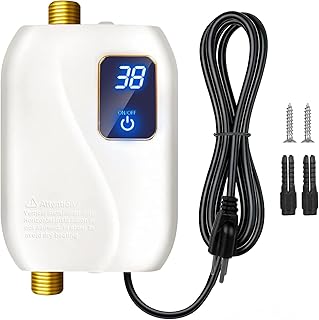
This 110V electric tankless model delivers water temperature rise from 82°F to 131°F with a 3000W heater. It uses an LCD display for status, and includes protections like IPX4 waterproofing and automatic shutoff under unsafe conditions. Ideal for kitchens or bathrooms needing on-demand hot water with minimal wait time.
Best use scenario: single faucet or compact bath vanity. Better for: users who want a straightforward, space-saving solution with strong safety features. Caution: ensure electrical supply meets 6-second power-button hold for unit configuration and Fahrenheit/Celsius switching.
14kW Orbek On-Demand Electric Water Heater

Orbek’s 14kW tankless heater provides up to 3.38 GPM and claims high efficiency with 98% thermal efficiency. It requires a robust electrical setup (240V, 60A two-pole breaker) and proper wiring. Best for: homes with two to three water outlets that occasionally require simultaneous hot water. Choose this if you have ample electrical service and need reliable, quicker hot water for multiple points.
Limitation: installation demands a minimum 150-amp service and appropriate wire gauge; plan accordingly to avoid overloading circuits.
14kW 240V Tankless for Sink & Shower
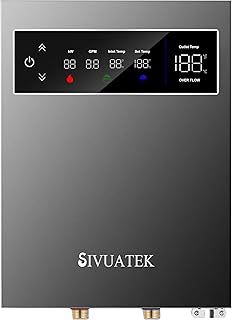
Designed for 14kW at 240V with 99.8% thermal efficiency, this unit shows inlets/outlets and an LED display that indicates temperature, GPM, and kilowatts. It can provide instant hot water for 1–2 simultaneous uses, like kitchen and bathroom. Best for: compact spaces needing dependable hot water for multiple points while preserving energy.
Tip: verify the circuit breaker capacity (60 amps) and space for proper venting and water connections. Avoid this model if you only need a single fixture hot water supply and limited electrical service.
8kW 240V Point-Of-Use Tankless Heater

This 8kW model serves a single fixture with up to 1.9 GPM, ideal for kitchen sinks, bathrooms, or utility spaces. Its compact design and LED temperature display support precise control for finite hot water needs. Best for: one faucet at a time in smaller living spaces or offices. Caution: not suitable for multi-fixture scenarios or whole-house heating.
Buying Guide: Capacity, Setup, and Practical Choices
What capacity should you choose? For under-sink or single-faucet use, 0.3–0.5 GPM at modest temperature rises is common. For two points of use (kitchen plus bathroom), units delivering 1–3.4 GPM at a steady temperature are preferable, depending on incoming water temperature and desired final temperature. Electrical service matters: many 14kW models require 240V and robust circuit breakers, while smaller 3kW units may run on standard 110V circuits but offer limited flow.
How to assess compatibility? Map your hot water needs by fixtures and typical use. If you frequently use hot water at two locations simultaneously, consider models with higher GPM ratings and adequate electrical capacity. If space is scarce, favor compact, wall-mounted units with clear temperature readouts. Safety features like IPX4 waterproofing, dry-burn protection, and auto shutoff reduce risk in wet areas.
Installation considerations: confirm water connections are standard 1/2″ NPT and that your electrical panel has spare capacity for the required circuit. Check the required breaker size (commonly 40A or 60A) and wire gauge (often 6 AWG). ETL or similar certifications indicate compliance with electrical safety standards, which is important for long-term reliability.
Energy efficiency: tankless heaters remove standby heat losses common with storage tanks. Expect up to significant energy savings when hot water is needed intermittently, especially in apartments, cabins, or homes with low simultaneous demand. However, high-GPM models use more power and may require upgrades to electrical service.
Frequently Asked Questions
- What size tankless heater do I need for a single sink? A compact 3kW unit at 82–131°F rise can meet basic faucet tasks, while larger 8kW units handle longer use at higher flow, if electrical service allows.
- Can these be used for a whole-house solution? Most listed models are designed for point-of-use or limited multi-point use. Whole-house systems typically require higher capacity and professional electrical planning.
- What electrical requirements should I plan for? 240V units often require 40–60A breakers and 6 AWG wires. Some 110V units run on standard circuits but with lower flow.
- Do tankless heaters really save energy? Yes, by eliminating standby losses, they only heat water on demand, though savings depend on usage patterns and service capacity.
- Is safety a concern with under-sink heaters? Modern units include IP ratings, water-electric isolation, leak detection, and auto shutoff, reducing common risks in damp spaces.
- How do I choose between 14kW and 8kW models? Compare your needed GPM and available electrical service. 14kW models support more simultaneous uses, while 8kW models suit single fixtures with less power demand.