Answering the typical garage buyer’s question: you can install a compact, point‑of‑use or whole‑home tankless heater to supply hot water where it’s needed without bulky tanks. This guide focuses on compact, efficient options that fit garages, utility closets, or workspaces while delivering reliable on‑demand hot water. The selections below balance compact design, ease of installation, and performance for different usage patterns. Best fits include apartment garages, workshop sinks, and small-to-medium homes where space and efficiency matter.
Quick Reference: Top 5 Tankless Heaters For Garages
- 110V Tankless Water Heater Electric (B0FTCMVRY3) — Compact, under-sink use; best for small wash areas.
- 18kW Tankless Water Heater Electric NOVIEEX (B0GTHYBTJ4) — High flow for multiple fixtures; best for small homes or garages with several needs.
- ThermoMate 4.5kW Tankless Under Sink (B0FPWB9DVP) — Point‑of‑use comfort; best for single-sink setups.
- MIZUDO Natural Gas Tankless (B0GDF9QT35) — Whole‑home gas option; best for multiple baths and higher demand.
- 110V Tankless Water Heater Electric Jflapil (B0H5X3WMH9) — Similar to first option; best for tight spaces and quick installs.
110V Electric Tankless For Small Sinks
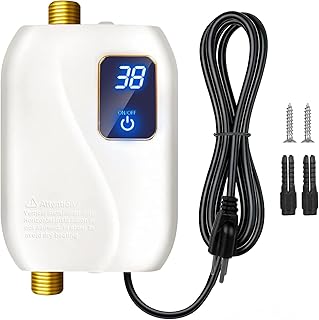
Best for: a compact kitchen or garage sink where a single outlet and limited space define the install. This 3000W unit heats water instantly, eliminating wait times. It supports temperature control from 82°F to 131°F and offers a large LCD display for easy viewing. The unit uses stainless steel and ABS materials for durability and has IPX4 waterproofing and leakage protection. It is ETL certified and designed for wall mounting to save space. A potential limitation is its suitability for only low-to-moderate flow needs, typically around 0.3–0.5 GPM depending on temperature rise.
18kW High-Flow Electric Tankless For Garages

Best for: small-to-medium homes or garages that require simultaneous hot water at multiple fixtures. This 18kW unit delivers up to 4.9 GPM at 240V and is designed for two to three points of use. It’s a space saver with a slim profile and wall mounting. It requires a qualified electrician to confirm electrical readiness (double-pole breakers and adequate wire gauge). Choose this if you need stronger flow without a storage tank, but be prepared for electrical work and dedicated circuits in the garage area.
ThermoMate 4.5kW Under Sink Tankless

Best for: single-sink, point‑of‑use installations where space is strictly limited. This 4.5kW, 110–120V unit provides 0.26–1.0 GPM with 85–131°F output, and features self‑modulating power for efficiency. It requires a 40A double‑pole breaker and 8 AWG wiring. The compact aluminum heater and stainless steel water tube reduce mineral buildup, making it ideal for tight utility closets or under-sink mounting. Limitation: higher flow at 0.5–1.0 GPM may require lower temperature rise or multiple devices for broader use.
MIZUDO Gas Tankless For Whole Home

Best for: homes with multiple bathrooms and higher simultaneous hot-water needs in the garage-adjacent utility area. This gas-fired unit provides up to 10.3 GPM and offers precise ±1°F temperature control, with an adjustable range up to 149°F. It’s CSA certified and supports 2–3 bathrooms plus laundry and kitchen use. The system requires proper venting and gas line installation, making professional setup advisable. Caution: gas installation adds complexity and requires compliance with local codes and safety standards.
Jflapil 110V 3000W Tankless For General Use

Best for: garages or utility spaces needing quick hot water at a single sink. This model mirrors the first option with 3000W, 82–131°F range, and LED temperature readout with Celsius/Fahrenheit toggle. It features IPX4 waterproofing and dry-burn protection, providing safety alongside compact wall-mount design. Limitation: like other 110V units, it may struggle with larger-demand simultaneous uses and is best when hot water flow is limited to one fixture at a time.
Buying Guide: How To Choose A Garage Tankless Water Heater
What capacity do I need?
Consider your typical hot-water demand. If you mainly need water for a sink or small wash station, a 3–4 kW unit may suffice. For multiple fixtures, look at 18 kW or higher, and for whole-home or heavy-use garages, a gas unit with 9–11 GPM might be required. Remember that flow rate (GPM) drops as temperature rise increases; match unit capacity to climate and fixture combination.
Electrical vs. gas: which is easier to install in a garage?
Electric units are generally easier to install where gas lines or venting are restricted. They’re compact and suited for apartments, sheds, or garages with available 240V circuits. Gas units deliver higher flow but require venting, gas supply, and professional installation to meet code requirements. Budget for electrical work or venting when planning installation in a garage.
Space and mounting considerations
Tankless heaters mount on walls to free floor space. For garages with limited height or wall space, choose a slim profile unit and confirm wall studs, clearance around the vent (for gas models), and accessibility for maintenance. Consider accessibility for service panels and the built-in LCD or controls for easy operation.
Safety and certifications
Look for IP ratings (waterproofing), dry-burn protection, overheat protection, and leakage safeguards. ETL or CSA certification indicates compliance with safety standards. In garages, ensure adequate electrical protection and protective clearances from combustible materials.
Installation and maintenance considerations
Verify electrical service capacity and circuit breaker requirements. For gas models, ensure proper venting and gas line sizing. Regular mineral buildup prevention and periodic checks on connections help maintain performance. Prefer units with self-modulating power and long-term durability features to minimize maintenance needs.
Cost and efficiency factors
Higher-wattage electric units and gas heaters typically offer higher flow but require more upfront installation work. Efficiency figures (such as a high thermal efficiency around 98% for some electric models) indicate reduced energy waste over time. Budget not only for the heater but for any required electrical or gas work, venting, and mounting hardware.
FAQ
- Can I install a tankless heater in my garage myself? Installation of both electric and gas tankless heaters can be DIY in simple electric cases, but gas models typically require licensed professionals for venting, gas lines, and code compliance.
- Will these heaters work in winter cold climates? Electric units can heat water down to set temperatures, but actual performance depends on incoming water temperature. Gas models with high flow may maintain performance in colder climates, depending on conditions.
- What maintenance is needed? Regular descaling and checking connections are recommended, especially in hard-water areas. Follow the manufacturer’s maintenance schedule.
- Are these units safe for garages? Yes, when installed with proper clearances, IP ratings, and appropriate electrical or gas safety measures. Always ensure ventilation for gas models and keep electrical panels dry.
- Do these units supply hot water to multiple fixtures? Some models are designed for multi-point use (up to 4–5 fixtures in high-demand setups), while others are best for single-sink use. Check the GPM rating and temperature rise for your needs.
- Do I need a dedicated circuit for electric tankless heaters? Most require dedicated circuits (often 40A or higher) with appropriate gauge wire. Consult a licensed electrician for exact requirements based on the model and local codes.