Answering your search for reliable, on-demand hot water, tankless water heaters provide instant hot water while saving space and energy. This guide highlights five strong options, each best for different home setups—from electric point-of-use needs to whole-house gas systems. Use this to pick the unit that fits your water flow, fuel type, and installation space. The table below compares core details to help you decide quickly before diving into full product sections.
| Product | Best For | Fuel Type | Approximate Flow |
|---|---|---|---|
| Rheem 18kW 240V Tankless Electric Water Heater | Medium households and apartments | Electric | Up to 4.4 GPM |
| EcoSmart ECO 11 Electric Tankless Water Heater | Compact spaces and point-of-use | Electric | Up to 1-2 GPM typical per unit |
| Rinnai RX199iN Condensing Tankless | Indoor/outdoor flexibility, high demand | Gas | Up to 11.1 GPM |
| CAMPLUX 6kW Tankless Electric | Apartments, small sinks, under-sink use | Electric | Up to ~1-2 GPM |
| NOVIEEX 3.6 GPM Natural Gas Tankless | Residential kitchens and bathrooms, multi-fixture | Gas | Up to 3.6 GPM |
Rheem 18kW 240V Tankless Electric Water Heater
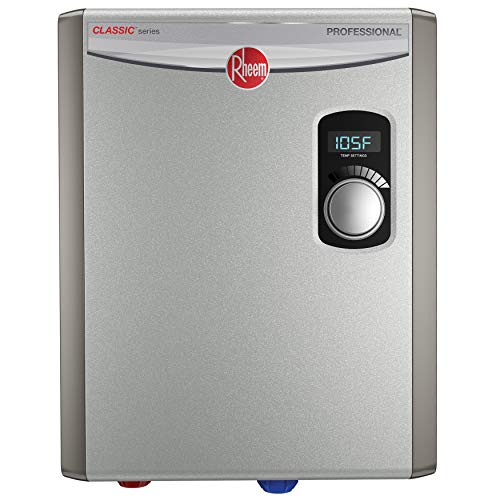
Best for medium demand in apartments or small homes, this Rheem model uses a robust 18kW electric element set with dual copper immersion elements. Features include an external digital thermostat with LED display and self-modulation to adjust power to match hot-water needs. The unit is compact and field-serviceable, offering straightforward maintenance. A potential limitation is its reliance on a 240V circuit that must support the higher amperage for peak flow. Ideal for households where electric-to-hot-water conversion is feasible and space is limited.
EcoSmart ECO 11 Electric Tankless Water Heater

Best for space-saving installs and point-of-use needs, EcoSmart ECO 11 features patented self-modulating technology that adjusts flow to maintain temperature within about 1 degree. It’s notably compact (11.5 x 8 x 3.75 inches) and can be mounted on a wall, offering 90% smaller footprint than traditional tanks. The main caveat is that its maximum practical GPM is lower than larger electric units, so it’s best for single fixtures or tight applications where demand is modest.
Rinnai RX199iN Condensing Tankless

Best for higher demand and flexible installation, this gas-fired condensing model supports up to 11.1 GPM and works indoors or outdoors with Versa Vent. It uses Smart Sense gas control for efficient operation and offers a compact form factor relative to its output. A stated limitation is that outdoor installation may require a vent cap (RX-OVC) and WiFi control is optional via a control module. Choose this for reliable hot-water supply across multiple fixtures and when gas fuel is available.
CAMPLUX 6kW Electric Tankless Water Heater

Best for apartments, under-sink use, or small sinks, CAMPLUX offers 6kW of power with self-modulating technology. It claims substantial energy savings by heating water only on demand, and its compact 10.95″ x 7.4″ x 2.52″ footprint complements tight spaces. A potential limitation is its lower GPM capacity, making it better suited for single fixtures or light simultaneous use rather than whole-house hot-water needs.
NOVIEEX Tankless Water Heater Natural Gas

Best for households needing versatile gas-on-demand hot water with compact dimensions, NOVIEEX delivers up to 3.6 GPM at 86,000 BTU. It is designed for indoor installation and provides precise temperature control with a wide range (95°F to 149°F) and ±1°F accuracy. A caution is that gas-installation requirements and venting considerations apply, so professional installation is advised. This unit suits kitchens and small bathrooms where gas supply and venting are available.
Buying Guide: Key Considerations and Comparisons
- Fuel type and installation space: Electric models require adequate electrical capacity and panel space; gas models need venting and proper venting hardware. Choose electric for easier electrical upgrades in apartments; gas for higher flow without electrical constraints.
- Flow needs and matching: Determine the GPM you typically need across fixtures simultaneously. Electric units typically offer lower GPM in compact forms; gas models can supply higher GPM, better for multi-fixture use.
- Self-modulation and temperature accuracy: Self-modulating units adjust output to save energy. Look for units with tight temperature control (within 1–2 degrees) to avoid temperature swings.
- Size and installation orientation: Compact, wall-mounted units save space but verify mounting space and clearance for vents and connections. Point-of-use models are ideal for single-fixture zones.
- Reliability and maintenance: Field-serviceable elements and accessible components simplify maintenance. Consider units with durable copper heating elements for longevity.
- Energy efficiency: Electric models emphasize space and energy savings through intermittent heating; gas models emphasize high output with condensing efficiency where applicable.
FAQ
- What is a tankless water heater? A unit that heats water on demand as it flows through the device, eliminating the need for a storage tank.
- Do tankless heaters require venting? Electric models do not vent; gas models typically require venting to exhaust combustion gases.
- How do I choose the right GPM? Assess peak simultaneous usage (showers, sinks, appliances) and select a unit rated to handle that flow at your typical water temperature rise.
- Are tankless heaters more energy-efficient than traditional tanks? They generally use energy only when hot water is needed, reducing standby heat losses, but overall savings depend on usage patterns.
- Can you install a tankless heater yourself? Some small electric point-of-use models can be DIY, but gas-fired models usually require professional installation for safety and code compliance.
- What maintenance is required? Descaling and flushing are recommended for mineral-heavy water supplies to maintain performance and longevity.