Answering your search for underfloor heating for tiles: this guide compares top tile-friendly electric systems, highlighting who each product is best for and why. Ideal for bathrooms, kitchens, or any tiled space, these kits offer easy installation, programmable controls, and reliable warmth. The selections below emphasize compatibility with tile installations, uncoupling membranes, and self-leveling needs. Use the quick-reference summary to narrow choices before diving into detailed product insights.
| Product | Best For | Key Benefit |
|---|---|---|
| LuxHeat 40sqft Electric Radiant Floor Heating System | Medium rooms; full floor warmth | All-in-one kit with uncoupling membrane and GFCI thermostat |
| LuxHeat 40sqft Floor Heating Cable Kit | Tile-friendly installations with flexibility | Includes UDG4 thermostat and heater cable |
| LuxHeat 25sqft Floor Heating Cable Kit | Smaller spaces; tile accents | 25 sq ft kit with alarm and floor sensor |
| VEVOR Self-Adhesive Mesh Floor Heating Mat | Tile, stone, vinyl; easy mat layout | Pre-assembled mat with programmable thermostat |
| QuietWarmth Float QWARM1.5X10F120 Mat | Floating floors with quick install | Cuttable mat; low-wattage operation |
LuxHeat 40sqft Electric Radiant Floor Heating System

Best for rooms with tile flooring that need robust, whole-area warmth. The kit includes a LuxHeat 40sqft heating cable, a Prova Flex-Heat uncoupling membrane, a UDG4 touchscreen thermostat with GFCI, a floor sensor, alarm, and installation accessories. The 3-in-1 design supports heating, crack prevention, and waterproofing for tile applications. Suitable for bathrooms, kitchens, and living spaces where consistent tile heat is desired. Note: Heating wires must be embedded under self-leveler or thinset; do not cut the heater wire.
Why choose this: it delivers comprehensive controls and a membrane that helps protect floor structures under tile. Best for buyers seeking a single-package solution with built-in safety features and a memory-reserving schedule.
Caution: The system requires proper surface preparation and layering; misapplication can affect performance. The included membrane supports installation but does not replace professional adjustment in complex layouts.
LuxHeat 40sqft Floor Heating Cable Kit

Best for tile areas where flexibility in cable routing matters. This kit provides the UDG4 programmable thermostat with GFCI, heating cable, strapping, and sensor. The design emphasizes compatibility with under-tile installations and allows for custom cable patterns. It is suited for bathrooms and kitchens where you want precise temperature control and a modular approach. Avoid cutting heater wire; route carefully to avoid obstructions.
Why this stands out: modular components and a focus on flexible layouts make it ideal for irregular room shapes or existing tile patterns. Better for installers who prefer step-by-step customization within a tile-centric project.
Limitation: The kit relies on proper embedding in self-leveling compound or mortar, which can extend install time for complex spaces.
LuxHeat 25sqft Floor Heating Cable Kit

Best for smaller tile spaces or accent warmth in a single zone. The kit includes a 25 sq ft heating cable, a UDG4-4999 programmable thermostat, alarm, floor sensor, and strapping. It provides individual room control for tile floors, with a 50-year heritage claim and a 25-year limited warranty referenced in product materials. The main drawer is consistent tile warmth with room-by-room flexibility.
Why this is recommended: compact footprint makes it ideal for powder rooms or compact kitchens where tile heat is desired without covering larger areas. Choose this if your space is small and you want precise control.
Limitation: The warranty messaging is marketing-oriented; ensure installation details align with your tile thickness and substrate before purchase.
VEVOR Self-Adhesive Mesh Floor Heating Mat
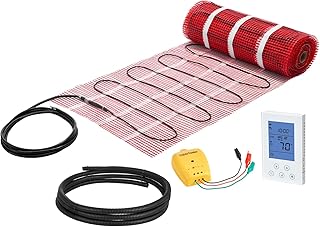
Best for tile and stone installations that benefit from a pre-assembled mat design. The VEVOR mat includes a smart thermostat and alarm, a 41°F–98.6°F range, dual-sensor monitoring, and a 12W per square foot rating. The pre-assembled mat with a cuttable grid (without cutting cables) supports efficient layouts around fixtures. Ideal for bathrooms and kitchens where tile is standard.
Why this works: the pre-attached mat reduces on-site cable work, and the dual-sensor setup helps maintain consistent tile temperature. Better for installers seeking a straightforward mat-based system with reliable GFCI protection.
Limitation: The grid is not fully flexible—shape adjustments require careful planning to avoid gaps in coverage.
QuietWarmth Float QWARM1.5X10F120 Mat

Best for floating floors and scenarios where quick, lightweight installation is desired. This 1.5′ x 10′ cuttable mat covers 15 square feet and is designed for use with floating floors, including luxury vinyl, laminate, and floating tile. It operates at 120V, with a focus on ease of use and reduced installation mess. The mat can be cut to length, but not narrowed in width.
Why select this: ideal for quick, low-diameter installs in spaces that are not fully tiled yet or require guest-room warmth without major structural changes. Choose this if you want a simpler, floating-floor compatible solution.
Caution: Not suitable for traditional mortared tile installations where full embedding is required; ensure compatibility with existing floor assembly.
Buying Guide: Tile-Friendly Underfloor Heating Essentials
What to consider when choosing underfloor heating for tiles:
- Room size and layout: Larger rooms may benefit from 40 sq ft kits; smaller spaces can use 25 sq ft or 15 sq ft mats.
- Tile substrate and underlayment: Ensure compatibility with self-leveling compounds or mortars; uncoupling membranes help crack prevention and tile integrity.
- Thermostat features: Look for GFCI protection, air and floor temperature sensing, 7-day schedules, and easy programming to optimize comfort and energy use.
- Installation method: Systems vary from cable-based to pre-formed mats. Cable kits offer flexibility; mats provide faster, simpler layouts.
- Warranty and service: Check the duration and coverage for the heating element, thermostat, and ancillary components. A clear return policy is helpful for tile projects.
- Maintenance and safety: Ensure built-in safety features like leakage protection and alarms are included; consider professional installation for complex layouts.
FAQ
- What type of underfloor heating is best for tiles? – Electric radiant floor heating systems are commonly preferred for tile due to compatibility with thinset, uncoupling membranes, and precise temperature control.
- Do I need a professional for tile heating installation? – A professional is recommended for wiring connections, proper embedding, and ensuring GFCI and sensor placement meet safety standards.
- Can tile floors be heated in bathrooms? – Yes, many systems are designed for bathrooms with waterproofing and crack-prevention membranes; ensure appropriate floor leveling and clearance around fixtures.
- What should I avoid when installing tile floor heating? – Do not cut heater wires; avoid placing cables under heavy furniture; ensure even coverage and proper substrate preparation.
- Will heated floors save energy? – Thermostats with scheduling and zone control can reduce energy use by heating only occupied rooms and maintaining set temperatures.
- Is a mat or cable kit better for tile installations? – Mats are quicker to install for regular layouts; cables offer more flexibility for irregular rooms or unique tile patterns.