If you specifically need a vented kerosene heater, verify the model’s installation manual before buying: the product information below does not confirm that any of these five heaters has an outdoor exhaust vent. The Dyna-Glo and Comfort Glow are high-output convection options; the Sengoku is a smaller portable heater; and the VEVOR and Mr. Heater are forced-air models. Compare their stated heat output and features, but do not treat “kerosene” or “forced air” as proof that a heater is vented.
| Product | Best suited to | Stated output or feature |
|---|---|---|
| Dyna-Glo WK95C8 | Heating a larger area without electricity | 23,000 BTU/hour; up to 1,000 square feet |
| Comfort Glow KW-24J | All-around convection warmth and longer listed runtime | 23,800 BTU; up to 12 hours |
| Sengoku HeatMate | Portable, lower-output heating | 10,000 BTU; up to 14 hours |
| VEVOR forced-air heater | Large workspaces and high heat output | 215,000 BTU |
| Mr. Heater forced-air heater | Considering a 50,000 BTU forced-air model | 50,000 BTU, as stated in the product name |
Dyna-Glo WK95C8 Convection Heater

The Dyna-Glo WK95C8 is a convection kerosene heater listed at 23,000 BTU per hour, with a stated heating capacity of up to 1,000 square feet. Its listed feature of operating without electricity may suit locations where power is unavailable, provided the heater is approved for the intended setting and used according to its instructions.
Best for: Buyers seeking a higher-output, non-electric convection heater for a sizable area. It earns a place in this comparison because the stated output and coverage are clearly specified.
Limitation: The supplied product details do not establish that this model is vented. Verify exhaust and indoor-use requirements in the manufacturer’s manual before treating it as a vented option.
Comfort Glow KW-24J Convection Heater

The Comfort Glow KW-24J is listed at 23,800 BTU and is described as heating up to 1,000 square feet. Its 360-degree heating radius is intended to distribute warmth in all directions. The listed 1.9-gallon tank, fuel gauge, and runtime of up to 12 hours provide useful comparison points for buyers who want to monitor fuel and reduce refills.
Best for: Buyers comparing convection heaters for broad, surrounding warmth and a stated longer operating period. It is also listed with battery-powered ignition and a pin-type wick system, and does not require electricity to operate.
Limitation: The listed features do not say that the heater vents exhaust outdoors. Confirm the ventilation requirements and safe-use instructions before indoor operation.
Sengoku HeatMate 10,000 BTU Heater

The Sengoku HeatMate is a compact, portable kerosene heater rated at 10,000 BTU. Its listed 1.2-gallon tank supports up to 14 hours of continuous use. The supplied features also identify an automatic safety shutoff and push-button start that does not require matches or electricity.
Best for: Buyers who prioritize portability and a lower stated output over the larger coverage figures listed for the convection models. The carrying-focused design and listed runtime make it a different option from high-output workspace heaters.
Limitation: The product information describes indoor and outdoor use but does not confirm a vented exhaust system or give a coverage area. Check the manual for approved locations, ventilation, and operating instructions.
VEVOR 215,000 BTU Forced-Air Heater
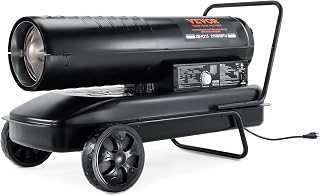
The VEVOR is a high-output forced-air heater rated at 215,000 BTU. Its listing describes use in large workspaces, barns, workshops, and farms, and gives a heating-volume figure of 44,496.6 cubic feet. It has an adjustable thermostat and a temperature display, with a listed adjustment range of 40°F to 110°F. Other stated features include overheat protection, low-fuel shutoff, a fuel gauge, dual fuel filters, and a pressure gauge.
Best for: Buyers comparing high-output forced-air equipment for a large work area, rather than a small room heater. The thermostat and stated safety features are relevant distinctions.
Limitation: This is a substantially higher-output category than the portable convection models. The listing does not establish that it is vented, and it says kerosene and diesel should not be used at the same time. Follow the manual’s fuel and ventilation directions.
Mr. Heater 50,000 BTU Forced-Air Heater

The Mr. Heater product name identifies this as a 50,000 BTU forced-air kerosene heater. The supplied product details do not include further specifications, so coverage, runtime, fuel capacity, thermostat controls, and safety features cannot be assessed from the information provided.
Best for: Buyers who are specifically comparing a 50,000 BTU forced-air model and are willing to verify its full specification sheet before purchase. Its stated output is below the VEVOR’s 215,000 BTU rating, but the available information is too limited for a broader performance comparison.
Limitation: No supplied feature confirms that this heater is vented or describes its ventilation requirements. Review the product documentation before choosing it for indoor use.
Buying Guide: How to Choose a Kerosene Space Heater
What does “vented” mean, and how can you verify it?
A vented heater routes combustion exhaust outside through an approved vent or flue. A product being labeled “kerosene,” “indoor,” or “forced air” does not, by itself, prove that it has this design. Look for explicit manufacturer documentation describing the exhaust connection, installation method, and approved location. If those details are absent, contact the manufacturer or choose a model whose manual clearly confirms the venting arrangement you need.
How much heat output do you need?
Compare BTU ratings alongside the manufacturer’s coverage guidance and the room or workspace conditions. The Dyna-Glo and Comfort Glow list coverage up to 1,000 square feet, while the Sengoku lists a 10,000 BTU output but no coverage figure in the supplied details. The VEVOR’s 215,000 BTU rating is aimed at a different, much larger workspace category. Do not use these figures as a guarantee that a heater will warm every space of that size.
Should you choose convection or forced air?
The Dyna-Glo and Comfort Glow are listed as convection heaters, and the Comfort Glow specifies a 360-degree heating radius. The VEVOR and Mr. Heater are identified as forced-air models. These labels describe different heat-delivery formats, but they do not establish whether a unit is vented. Match the heater type to the space and use case described in its manual, then confirm ventilation separately.
Which features matter if you do not have electricity?
The Dyna-Glo is listed as needing no electricity. The Comfort Glow also lists operation without electricity and specifies battery-powered ignition. The Sengoku lists push-button starting without electricity or matches. Check the exact ignition and power requirements for the model you are considering; do not assume every heater in a product category starts or operates the same way.
How should you compare fuel capacity and runtime?
Compare a stated runtime only when it is provided, and treat it as a listing figure rather than a guarantee for every setting or condition. The Comfort Glow lists a 1.9-gallon tank and up to 12 hours of operation. The Sengoku lists a 1.2-gallon tank and up to 14 hours. The supplied Dyna-Glo and forced-air product details do not provide comparable runtime information.
What safety checks should you make before operating one?
Read the manufacturer’s instructions for installation, fuel, clearances, ventilation, and shutdown. Use a working carbon monoxide alarm where required or recommended for the setting, and follow local fire and building codes. Keep combustible materials away from the heater, and never operate equipment in a way the manual prohibits. If you need a vented heater, confirm the exhaust route and installation requirements before purchase rather than relying on a general product label.
Frequently Asked Questions
Are the heaters in this comparison confirmed to be vented?
No. The supplied product information does not confirm an outdoor exhaust vent for any of the five models. Check each manufacturer’s manual for explicit venting and installation details.
Is a forced-air kerosene heater automatically vented?
No. “Forced air” describes how the heater distributes heat; it does not establish how combustion exhaust is handled. Verify the model’s documentation.
Which listed heater has the highest stated output?
The VEVOR is listed at 215,000 BTU. Its product information describes large workspaces and does not confirm that the heater is vented.
Which listed model has the lowest stated BTU output?
The Sengoku HeatMate is listed at 10,000 BTU. The supplied details describe it as portable and list up to 14 hours of continuous use.
Can these heaters be used indoors?
Use a heater indoors only if its manufacturer expressly approves that setting and its installation and ventilation requirements can be met. The information provided here is not enough to confirm indoor suitability for every listed model.