The best wall-mounted convector heater with a thermostat depends on room size, desired heat output, and installation needs. The EconoHome 400-watt panels suit buyers seeking low-wattage convection heat for a small room, while the 250-watt model is the lower-output option for a smaller space. The DREO adds app control and oscillation, and the Stiebel Eltron is a higher-output hardwired fan heater rather than a convector. Compare their listed features below, especially because their heating methods and electrical requirements differ.
| Product | Best suited for | Key distinction |
|---|---|---|
| EconoHome 400W Panel Heater | Small rooms needing a simple convection panel | 41–86°F range; heat reflector included |
| EconoHome 250W Panel Heater | Buyers seeking lower wattage | IP44 splash-proof listing; keep 12 inches from water |
| EconoHome Updated 400W Panel Heater | Buyers prioritizing reinforced panel construction | Triple-reinforced design and paintable finish |
| DREO Smart Wall Heater | Buyers who want app and voice controls | Oscillating ceramic heater with 41–95°F settings |
| Stiebel Eltron CK Trend | Buyers seeking higher-output hardwired heat | 2000W at 240V; fan heater, not a listed convector |
EconoHome 400W Wall Heater Panel

This flat, 400-watt panel is best for a buyer seeking low-wattage convection heat in a small indoor room. The listing describes it as suitable for rooms up to 120 square feet and gives a thermostat temperature range of 41–86°F. It operates at 120 volts and 3.33 amps, and a heat reflector is included.
It was selected because it directly matches the request for a wall-mounted convector heater with thermostat. The listed heating method is mostly convection, with some radiant heat. The panel warms the air moving behind it, which then circulates into the room. The product listing also states that the unit may be hardwired and includes overheat protection.
- Best for: Small rooms and buyers who want a low-wattage panel heater.
- Why choose it: It combines a stated thermostat range, 400-watt output, and a flat wall-mounted design.
- Consider: The listed coverage is up to 120 square feet, so it is not presented as a high-output heater for a large or poorly insulated area.
The manufacturer describes the casing as warm during operation and says the unit is intended for adults. Keep that surface-temperature detail in mind when choosing its location. The listing also states a three-year manufacturer warranty; buyers should check the current product information for applicable terms.
EconoHome 250W Convection Wall Heater
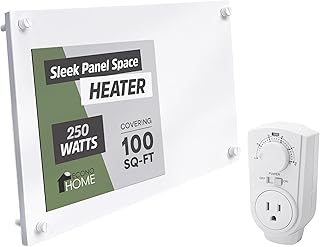
This 250-watt panel is best for buyers who prefer a lower-output wall heater for a compact room. Its listed thermostat range is 41–86°F, and the specifications state 120 volts and 2.08 amps. The product is described as suitable for a 100-square-foot room or bathroom, and its panel measures 24 by 18 by 0.40 inches.
The listing identifies this version as IP44 splash-proof, but that does not mean it should be installed next to water. The manufacturer specifies keeping it 12 inches away from water for safety. That placement instruction is important for bathroom buyers and should be followed along with applicable electrical and local building requirements.
- Best for: Buyers looking for a 250-watt panel and a stated 100-square-foot room application.
- Why choose it: It offers a lower listed wattage than the EconoHome 400-watt panels and has a slim, paintable design.
- Consider: Its lower wattage may be a poor fit when a room needs more heating capacity.
The product description says the panel is triple reinforced, uses calcium silicate material, and is triple insulated. Installation hardware is included, and the unit may be hardwired. Although the listing mentions bathroom use and splash protection, buyers should confirm that the chosen location meets the manufacturer’s clearance guidance and local electrical rules.
EconoHome Updated 400W Convection Panel

This updated 400-watt panel is best for buyers who want a wall-mounted convection heater with a stated thermostat range and reinforced construction. The listing gives a room application of up to 120 square feet, 120-volt operation, and 3.33 amps. Its temperature range is 41–86°F, and a heat reflector is included.
It was selected as a direct match for the keyword and as a distinct option from the other 400-watt EconoHome panel. The product description specifically calls this version crack-resistant, triple reinforced, and made with calcium silicate material. It also describes the panel as triple insulated and paintable, with installation hardware included.
- Best for: Buyers comparing 400-watt panels who value the listed reinforced construction and paintable finish.
- Why choose it: Its output and stated coverage match the other 400-watt panel, while its updated construction features are explicitly described.
- Consider: It is still a 400-watt panel listed for rooms up to 120 square feet; choose a different type or output if that does not suit the room’s needs.
The listing says the heater may be hardwired and includes overheat protection. It also notes that the exterior casing feels warm and describes the product as suitable for adults. Buyers should account for the warm surface when deciding where to mount it and should follow the installation instructions.
DREO Smart Oscillating Wall Heater
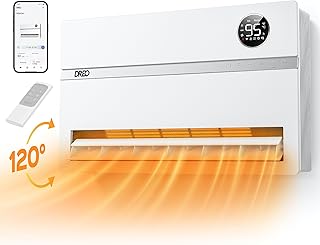
The DREO is best for buyers who value remote settings, schedules, and voice control more than a flat convection panel. Its listed features include 120-degree oscillation, app access, scheduling, and compatibility with Alexa and Google Home. The temperature setting range is 41–95°F, with adjustments described as having 1°F accuracy.
This product broadens the comparison because it is a wall-mounted heater with thermostat-style temperature control, but it is not described as a convector panel. The listing identifies it as a PTC ceramic space heater that distributes warm air through oscillation. Its 1500-watt rating is substantially higher than the EconoHome panels’ listed 250- and 400-watt outputs.
- Best for: Buyers who want app-based settings, scheduled heating, voice control, and oscillating heat distribution.
- Why choose it: The broad temperature range and connected controls offer more listed control options than the panel heaters.
- Consider: Choose a panel convector instead if the priority is specifically a low-wattage convection panel.
The product details provided do not state its room coverage or electrical installation requirements. Check the full manufacturer instructions and product listing before purchase, particularly if the heater will be mounted in a location with specific clearance or wiring needs.
Stiebel Eltron CK Trend Wall Heater

The Stiebel Eltron CK Trend is best for buyers comparing higher-output, hardwired wall heaters. It is a fan heater rather than a convector panel, so it is an alternative for shoppers who are open to a different heating method. The listed output is 2000 watts at 240 volts or 1800 watts at 208 volts, with corresponding heat outputs of 6824 and 6142 BTU per hour.
Its electrical requirements are a key comparison point: the provided specifications say it must be hardwired with a 15-amp breaker and 14 AWG wire. The product name also states that it has no cord or plug. These details make it different from a plug-in room heater and should be considered before purchase.
- Best for: Buyers seeking a higher-output wall-mounted fan heater and planning for hardwired installation.
- Why choose it: Its listed wattage is higher than the panel models, and the specifications state output at both 208 and 240 volts.
- Consider: It is not listed as a convector heater, and the supplied feature information does not specify a thermostat or thermostat range.
Do not assume that the CK Trend matches the thermostat feature requested in the search. Confirm its control options and installation details in the complete product documentation before choosing it as a thermostat-controlled heater.
Buying Guide: How to Choose a Wall-Mounted Heater
Do you need a convector panel or a fan heater?
A convector panel heats air that moves around the panel and circulates through the room. The EconoHome products in this comparison are described as mostly convection heaters, with some radiant heat. A fan heater, such as the Stiebel Eltron, uses a different listed heating approach. The DREO uses a ceramic heating element and oscillates to distribute warm air.
Choose a convector panel if you specifically want a flat, low-wattage panel that relies mainly on convection. Consider a fan or oscillating ceramic model if those heating methods and features better match your needs. Do not treat all wall-mounted heaters as equivalent simply because they mount to a wall.
How much wattage does the room need?
The products listed here range from 250 watts to 2000 watts. The EconoHome 250-watt model is described for a 100-square-foot room, while its 400-watt models are described for up to 120 square feet. These are manufacturer-stated applications, not a guarantee of performance in every home. Insulation, drafts, ceiling height, outdoor temperatures, and the room’s existing heating system can affect comfort.
The DREO is listed at 1500 watts, and the Stiebel Eltron produces 2000 watts at 240 volts. Higher wattage does not automatically make a model the right choice: the product must fit the room, electrical supply, and installation plan. Check the heater’s complete instructions and confirm that its stated capacity fits the room.
What thermostat range and controls are important?
The EconoHome panels list a 41–86°F temperature range. The DREO lists a 41–95°F range, 1°F adjustment accuracy, app controls, scheduling, and voice control with Alexa and Google Home. These are not identical control features. Compare the actual temperature range and available controls rather than relying only on the word “thermostat” in a product title.
The provided Stiebel Eltron details do not identify its thermostat or temperature settings. Buyers who require a built-in thermostat should confirm that feature in the full documentation before selecting that model.
Will it plug in, or does it need to be hardwired?
Installation method can determine whether a heater is practical for a particular room. The EconoHome listings say the units may be hardwired. The Stiebel Eltron listing says it must be hardwired and specifies a 15-amp breaker and 14 AWG wire. The supplied DREO information does not give wiring requirements. Verify the full instructions and local electrical requirements before installation, and use a qualified professional when needed.
Can a wall heater be used in a bathroom?
The EconoHome 250-watt panel is described as suitable for a bathroom and listed as IP44 splash-proof, but the manufacturer also says to keep it 12 inches away from water. Splash protection is not permission to install a heater wherever water may reach it. Follow all stated clearances and installation instructions, and check local rules for bathroom electrical equipment.
What placement and surface details should you consider?
The EconoHome product information says the exterior casing feels warm and describes the heaters as intended for adults. Consider the location carefully, especially where people may touch the panel. Keep the heater clear of anything that could obstruct its operation, and follow the manufacturer’s required mounting and clearance instructions.
Also compare panel dimensions and appearance. The EconoHome 400-watt panel measures 23.5 by 23.5 by 0.25 inches, while the 250-watt model measures 24 by 18 by 0.40 inches. The 250-watt and updated 400-watt listings describe a paintable design, which may matter when coordinating a heater with a room.
Frequently Asked Questions
Which product is the closest match to a wall-mounted convector heater with a thermostat?
The EconoHome 250-watt and 400-watt panels are the closest matches in this selection. Their listings identify them as convection wall heaters and specify thermostat temperature ranges.
What is the difference between the EconoHome 250W and 400W panels?
The 250-watt model is listed for a 100-square-foot room and uses 2.08 amps at 120 volts. The 400-watt models are listed for up to 120 square feet and use 3.33 amps at 120 volts. Follow the product guidance and consider your room’s conditions when comparing them.
Does the DREO have a wider temperature range than the EconoHome panels?
Yes. The DREO listing states a 41–95°F range, while the EconoHome panels list 41–86°F. The DREO also lists app access, scheduling, and voice control.
Is the Stiebel Eltron CK Trend a convector heater?
No. The provided product information identifies it as a wall-mounted fan heater. Its listed electrical requirements are hardwired installation with a 15-amp breaker and 14 AWG wire.
Can the EconoHome 250W model be mounted in a bathroom?
The listing describes it as suitable for a bathroom and IP44 splash-proof, but specifies that it must remain 12 inches away from water. Follow that instruction and verify applicable installation requirements.
Should I choose a heater by room coverage alone?
No. Consider stated coverage alongside wattage, insulation, drafts, thermostat range, heating method, electrical requirements, and installation clearances. Manufacturer-stated room coverage may not reflect every home or room condition.