The best wall-mounted electric heater for a basement depends on room size, insulation, and whether you need quick, directed warmth or quiet supplemental heat. The DREO 1500W model is a strong fit for app and voice control, while the EconoHome panel is specified for rooms up to 120 square feet. The Envi is designed for quiet, low-wattage targeted heating. Compare the listed controls, heating style, and room-size information before choosing; the product details do not provide a basement-specific coverage rating for every model.
| Heater | Best for | Notable listed feature |
|---|---|---|
| JNDRO Wall-Mounted Space Heater | Remote adjustments and oscillating heat | Three oscillation angles and ECO mode |
| DREO Smart Wall Heater, 1500W | App and voice control | 120° oscillation and 41–95°F setting range |
| DREO Smart Electric Wall Heater | Quiet operation and flexible controls | App, remote, and Alexa control |
| EconoHome Wall Heater Panel | Smaller rooms with a stated size limit | 400-watt convection heating for up to 120 sq. ft. |
| Envi Plug-in Electric Panel Heater | Quiet, targeted supplemental warmth | Fanless design and wall-sense safety sensor |
JNDRO Wall-Mounted Space Heater

Best for: Basement users who want remote adjustments and the ability to direct warmth across different parts of a room. It was selected for its combination of ECO mode, timer, and three oscillation-angle choices.
The JNDRO heater has an ECO thermostat mode that adjusts heating power based on ambient temperature. Its listed temperature range is 41°F to 95°F. A remote control and LED display provide access to settings, including temperature, fan speed, timer, and oscillation angle. The 24-hour timer can help coordinate operation with a daily routine.
Choose this model if adjustable coverage matters: its oscillation settings are 60°, 90°, and 120°. That flexibility may be useful in a basement where occupants use more than one area. The product description says it warms large areas, but it does not give a specific square-foot coverage figure, so do not assume a particular basement size is supported.
Limitation: The remote requires two AAA batteries, which are not included. Confirm the installation instructions and suitable wall location before mounting.
DREO Smart Wall Heater, 1500W
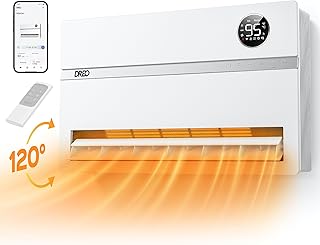
Best for: Buyers who want to schedule basement heating or control the heater through an app or compatible voice assistant. Its listed 1500-watt rating and 120° oscillation distinguish it from the lower-wattage panel options in this selection.
This DREO model uses a PTC ceramic heating system and offers a temperature setting range of 41°F to 95°F, with 1°F adjustment accuracy according to the product details. Its 120° wide oscillation is designed to spread warm air through a room. Scheduling and remote access are available through the DREO app, and the heater is listed as compatible with Alexa and Google Home.
Choose it if hands-free control, precise temperature settings, and broad oscillation are priorities. The app scheduling feature can also suit a basement used at regular times, such as a home office or recreation space.
Limitation: The provided product information does not state a specific square-foot coverage rating. A 1500-watt rating alone does not establish that a heater will adequately warm every basement, especially a large or poorly insulated one.
DREO Smart Electric Wall Heater

Best for: Buyers who value several control options and quieter operation. It was selected for its included remote, app and Alexa controls, stated 28 dB noise level, and adjustable airflow direction.
The heater uses a PTC heating system and an airflow design listed at 11.5 feet per second. Its 30° manual oscillation lets users direct the heat rather than sweep it across a wide angle. ECO mode provides temperature-based operation, and the DREO app includes a temperature-calibration function. The display lighting can also be adjusted through the available controls.
Choose this model if you want app-based settings and the option to aim the airflow toward a particular part of the basement. The low listed noise level may also be useful in a study or sleeping area where sound matters.
Limitation: The product information provided does not specify wattage, a temperature range, or a room-size rating. Check the full product specifications before comparing its heating capacity with a basement’s needs.
EconoHome Wall Heater Panel

Best for: A smaller basement room where a low-profile panel and a stated coverage limit are useful. EconoHome lists this 400-watt, 120-volt convector heater for rooms up to 120 square feet.
The panel measures 23.5 by 23.5 inches and has a listed temperature range of 41°F to 86°F. The description says it primarily heats through convection, with some radiant heat, and includes a heat reflector. It also states that the unit may be hard-wired and lists overheat protection. These details make it easier to compare with portable-style wall heaters that emphasize airflow and remote features.
Choose this model if the basement area is within the stated size guidance and you prefer a panel-style heater. It may be a better match for steady supplemental warmth than for quickly directing air across a large open basement.
Limitation: The product description says the exterior casing becomes warm and describes the heater as safe for adults only. Take that warning into account if children may be in the room. The listed coverage is up to 120 square feet, not a guarantee for every basement layout.
Envi Plug-In Electric Panel Heater

Best for: Buyers seeking quiet, targeted supplemental warmth without a fan. The Envi stands out for its fanless “Stack Convection” design, wall-sense safety sensor, and stated ability to run continuously.
The product is designed for specific areas of a home and is described as low-wattage, although the supplied details do not give a wattage figure. Its wall-sense sensor cuts power if the heater is removed from the wall. The description also says its casing operates at 90°F and that the fanless design does not blow dust and allergens around the room.
Choose this model if quiet operation is more important than directed airflow or app-based controls. It may suit a basement workspace or seating area where gentle, localized heating is the goal.
Limitation: No exact room-size coverage, wattage, or adjustable temperature range is included in the provided information. Because it is described as targeted heating, do not assume it will heat an entire large basement by itself.
Buying Guide: How To Choose A Basement Wall Heater
How large is the basement area you need to heat?
Start with the square footage of the specific room or zone, not automatically the full basement. The EconoHome listing gives a clear guideline of up to 120 square feet. The other supplied product details do not provide an exact coverage figure, so compare their full specifications with your room size before purchasing.
Basements can vary in insulation, ceiling height, drafts, and layout. A heater’s listed wattage or airflow is useful for comparison, but it does not by itself confirm that the unit will maintain a comfortable temperature throughout a particular space.
Do you need fast airflow or quiet, steady warmth?
Oscillating heaters move warm air across a wider angle. The JNDRO offers 60°, 90°, and 120° settings, while one DREO model lists 120° oscillation. The other DREO heater uses 30° manual oscillation to direct airflow. These styles may suit rooms where people want heat distributed or aimed at a specific area.
Panel heaters use a different approach. EconoHome describes convection with some radiant heat, while Envi uses fanless convection. A fanless design may be a better fit when quiet operation is a priority, but it does not provide the same kind of directed airflow as an oscillating heater.
Which controls will you actually use?
For simple adjustments from across the room, the JNDRO includes a remote and LED display. For scheduling, app access, or voice control, the DREO 1500W model lists app features and Alexa and Google Home compatibility. The other DREO model lists a remote, app, and Alexa control. The supplied information for EconoHome and Envi does not list app or voice controls.
Temperature range can also help distinguish models. JNDRO and the DREO 1500W heater list ranges from 41°F to 95°F; EconoHome lists 41°F to 86°F. Compare the controls and settings you need rather than choosing based only on the number of features.
What should you check before mounting a heater?
Read the product’s current installation instructions and identify a suitable wall location before buying. Check electrical requirements, mounting method, clearances, and whether professional installation is needed. EconoHome’s description says the panel may be hard-wired; confirm the requirements for the exact configuration you plan to use.
Basements can have damp conditions. The supplied product details do not establish that any of these heaters is suitable for wet or damp locations. Check the manufacturer’s instructions and the heater’s labels before installing it in a basement with moisture concerns. Do not infer damp-location suitability from a wall-mounted design.
Should a wall heater replace central heating?
That depends on the heater’s capacity, the room, and the home’s heating setup. The Envi is described as targeted supplemental heat, and the EconoHome panel has a stated room-size limit. For any model, compare the manufacturer’s coverage guidance with the area and conditions you need to heat. A basement with multiple rooms may need a different heating plan than one enclosed room.
Also consider how you will operate the heater. A timer or schedule can help align heating with room use, while a thermostat or ECO mode can adjust operation around a set temperature. Follow the manufacturer’s instructions for safe operation and do not block the heater’s air paths or surrounding clearances.
Frequently Asked Questions
What is the best wall-mounted electric heater for a basement?
There is no single best choice for every basement. The DREO 1500W model is suited to buyers who want app scheduling and voice control; EconoHome gives a stated room-size guideline of up to 120 square feet; and Envi is designed for quiet, targeted warmth.
Can a wall-mounted electric heater warm a whole basement?
It depends on the heater’s capacity and the basement’s size, insulation, and layout. The supplied product details do not establish whole-basement coverage for these models. Compare the manufacturer’s room-size guidance with the area you need to heat.
Which heater is the quietest option listed?
The Envi is described as having a completely silent, fanless design. The second DREO heater lists a noise level of 28 dB. These are product-description claims, not independent measurements in a basement.
Which models include oscillation?
The JNDRO heater lists 60°, 90°, and 120° oscillation angles. The DREO 1500W heater lists 120° oscillation. The other DREO model lists 30° manual oscillation.
Is a low-wattage panel heater enough for a basement?
It may be suitable for a small or targeted area, but the answer depends on room conditions and the model’s coverage guidance. EconoHome specifies up to 120 square feet. The Envi is described as low-wattage targeted heating, but the provided details do not state its wattage or coverage.
Can these heaters be installed in a damp basement?
The product details provided do not confirm damp-location suitability for any of these heaters. Check the exact model’s installation instructions and labels, and do not install it in a damp area unless the manufacturer expressly permits that use.