Answer: For hard water, use a scale prevention system or descaler that targets mineral buildup before it harms heat exchangers. This guide highlights five options suited for homes with hard water, including traditional inline inhibitors and salt-free descalers. Best for households with mineral-heavy supply, rate-sensitive appliances, and those seeking low-maintenance solutions. The top picks balance effectiveness, installation simplicity, and compatibility with standard 3/4 inch water lines.
| Product | Best For | Key Benefit |
|---|---|---|
| ScaleRX ¾-Inch Water Heater Descaler and Scale Prevention System | Homes needing inline scale prevention | Reduces lime scale buildup |
| Waterdrop AP431 Whole House Scale Inhibitor | Full-house scale control | High flow, NSF/ANSI 372 compliance |
| 3M Aqua-Pure AP430SS Inline System | Proactive scale reduction | Polyphosphate-based |
| H&G Lifestyles Inline Water Heater Filter | Before tankless or traditional heaters | Brass fittings, anti-scale media |
| iSpring ED2000 Whole House Descaler | Salt-free descaling | Keeps minerals in water, reduces deposits |
ScaleRX ¾-Inch Water Heater Descaler and Scale Prevention System

Best for homes needing a straightforward inline scale prevention solution. The ScaleRX unit is designed for water heaters and focuses on reducing lime scale buildup to protect heating elements and extend equipment life. It is a compact option that fits standard ¾-inch plumbing. Use this when you want a simple installation with direct impact on heater efficiency. Caution: Effectiveness depends on existing mineral content and flow configuration, and it does not remove existing scale.
Waterdrop AP431 Whole House Scale Inhibitor with T-fitting

Best for whole-house protection with high flow needs. This system uses polyphosphates to inhibit scale formation across the home without removing minerals. It protects hot water heaters, dishwashers, and downstream fixtures while potentially improving appliance efficiency. It’s well-suited for households with higher water demand, but ensure compatibility with existing piping since a ¾” NPT inlet/outlet is standard. Caution: Some users may prefer alternative methods if they require chemical-free treatment only.
3M Aqua-Pure Whole House Scale Inhibition Inline System AP430SS

Best for proactive scale reduction in plumbing and appliances. This inline system uses polyphosphates to prevent scale from forming by keeping minerals in a soluble state. It helps extend the life of water heaters, clothes washers, dishwashers, and fixtures. It is not a filter, but a corrosion and scale reduction system. Choose this if you want centralized protection with minimal maintenance. Caution: It treats only a portion of water to inject polyphosphates; not a full water purification solution.
H&G Lifestyles Water Heater Filter Anti Scale

Best for pre-heater protection before tanked or tankless units. The H&G inline filter uses scale-inhibiting media and features 3/4 inch NPT brass fittings for easy integration with existing plumbing. It’s a practical choice when you want a compact, dedicated anti-scale filter close to the heater. Limitation: Not a full-system inhibitor; it primarily protects the immediate heater area rather than the entire house plumbing.
iSpring ED2000 Whole House Descaler
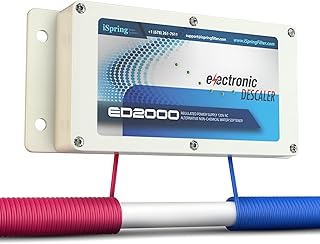
Best for households seeking a salt-free descaler that preserves beneficial minerals while reducing lime-scale. The ED2000 treats the entire home system by descaling deposits and preventing new buildup. It’s particularly suitable for very hard water areas (10–19 grains per gallon) and can contribute to energy savings by maintaining appliance efficiency. Caution: Results depend on water chemistry and pipe layout; some users may still observe mineral content in water after treatment.
Buying Guide
- What type of solution do you need? Inline descalers address immediate heater protection, while whole-house inhibitors protect broader plumbing and appliances.
- Flow and compatibility: Check whether the unit uses ¾” NPT connections and if it matches your home’s pipe size and flow rate demands.
- Chemical vs. salt-free: Decide if you prefer chemical-based polyphosphate systems or salt-free electronic/descale methods. Both aim to reduce buildup but work differently.
- Maintenance and replacement: Some systems rely on ongoing media replacements or periodic checks; others are more maintenance-free.
- Impact on existing scale: Consider whether you need to address existing scale or only prevent future buildup.
- Appliance compatibility: Ensure compatibility with your heater type (tank, tankless) and with other water-using devices in the home.
Frequently Asked Questions
- Do these systems remove existing scale? Some systems prevent new buildup and descalers can help break down existing scale, but results vary by system and water chemistry.
- Will a water heater scale inhibitor affect water taste? Inhibitors generally do not alter taste; polyphosphate-based systems may affect water clarity slightly but are designed for scale control.
- Are salt-based water softeners necessary with these products? Not always. Salt-free descalers and inhibitors provide scale control without traditional salt-based softening.
- Is professional installation required? Some units are DIY-friendly, especially inline kits; others may benefit from professional installation to ensure correct sizing and flow.
- How do I choose between an inline system and a whole-house inhibitor? Inline systems protect the heater area, while whole-house solutions protect multiple fixtures and appliances; choose based on your hard-water level and number of affected devices.
- Do these products require maintenance? Most inline inhibitors require little ongoing maintenance beyond occasional checks, while some may need periodic media replacement.