Answering common buyer questions about home hot water, this guide compares five practical water heater options. The focus is on efficiency, space, and suitability for typical American homes. The top picks include compact electric tankless units for small spaces, propane and gas tankless systems for larger households, and versatile electric tanks for steady supply. The buyer profiles below help determine who benefits most from each model. A quick summary table follows to aid side-by-side comparison.
| Product | Type | Best For | Approx. Flow/Capacity | Notes |
|---|---|---|---|---|
| 110V Tankless Water Heater Electric | Electric Tankless | Small spaces, apartments, under-sink needs | 0.3–0.5 GPM temp rise dependent | Compact; LED display; ETL listed |
| Ranein Propane Gas Tankless Water Heater | Gas Tankless | Whole home, multiple fixtures | Up to 3 fixtures simultaneously | High BTU, energy efficient with precise temp control |
| 18kW Tankless Water Heater Electric | Electric Tankless | Small-to-medium homes, apartments | Up to 4.9 GPM | Wall-mount saves space; high power |
| MIZUDO Natural Gas Tankless Water Heater | Gas Tankless | Busy homes with 2–3 baths | Up to 10.3 GPM | Wide temp range; WiFi/app capable |
| VEVOR Electric Water Heater | Electric Tank | Families needing stored hot water | 18 gal capacity; 1.6 kW | Enamel coating; simple controls |
Note: This guide emphasizes practical, fact-based information and avoids unverified claims. Each product section explains who should consider the unit, along with a caution to help you avoid common pitfalls.
Best Compact Electric Tankless For Small Spaces
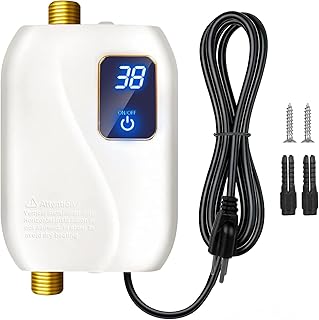
This 110V tankless electric unit is designed for under-sink or compact-installation needs. It features a stainless steel and ABS build, LED display, and 3000W heating that can raise water temperature quickly. It’s best for single-usage scenarios like a kitchen sink or small bathroom where space is limited. The unit supports Fahrenheit or Celsius and includes safety protections like water-electrical isolation and dry-boil protection. Choose this if your priority is space savings and on-demand hot water for one fixture.
Limitation: Flow is limited at very low water usage, and higher-demand use may require a larger or additional point-of-use heater.
Ranein Propane Gas Tankless Water Heater

Best for whole-home use with multiple outlets, this propane-powered tankless model delivers up to 3.6 GPM and 80,000 BTU. It uses precision temperature control with a 95°F–149°F range to minimize hot/cold spikes. The system emphasizes energy savings through dual heating mechanisms and optimized combustion. It’s a strong choice for households that want continuous hot water at several fixtures without a storage tank. It’s particularly suitable for homes with reliable propane supply and a dedicated venting setup.
Caution: Gas installation requires professional venting and piping; improper setup can affect safety and efficiency.
NOVIEEX 18kW Electric Tankless Water Heater

Constructed for demanding hot water needs, this 18kW electric tankless unit delivers up to 4.9 GPM at 240V. It requires two 40A double-pole breakers and 8 AWG wiring with a ground. The compact wall-mount design frees space, making it a practical choice for apartments, garages, or utility closets. Temperature range allows concurrent use across multiple fixtures without noticeable pressure drop. It’s best for households that can support its electrical needs and desire a compact high-capacity electric solution.
Limitation: Electrical installation must meet specific circuit requirements; professional electrical work is recommended.
MIZUDO Natural Gas Tankless Water Heater

This gas-powered unit delivers up to 10.3 GPM, suitable for 2–3 bathrooms and busy households. It offers a wide temperature range (95°F–149°F) with precise modulation to minimize temperature swings. WiFi and app control provide convenient monitoring and adjustments. It’s a strong pick for households seeking high flow with fewer interruptions and a modern control interface. The system is best for homes with reliable gas supply and venting.
Caution: Proper venting and gas installation are essential for safety and performance; seek professional installation if needed.
VEVOR Electric Water Heater With Tank

This 18-gallon tank-style electric water heater provides a reliable storage solution with a 1.6 kW heating element and an enamel-coated inner tank for durability. The LED display and knob-style temperature control simplify daily use, and the tank’s size makes it suitable for family households that want a readily available hot-water reserve. It’s best for homes needing a straightforward, stored hot-water supply for busy morning routines.
Limitation: Tank storage means standby heat loss is possible when not in use, and space should be adequate for installation.
Buying Guide: Key Considerations For Water Heater Systems
What type is right for you? Electric tankless models are ideal for compact spaces and point-of-use needs. Gas tankless units deliver high flow for whole-home use but require proper venting and gas lines. Electric tanks provide steady stored hot water and are simpler to install in many homes, but they may consume more space and can have standby losses. Consider your household size, peak hot-water demand, and available electrical or gas capacity when selecting a system.
How much hot water do you need? Determine simultaneous fixture usage to estimate GPM needs. For two to three baths, a higher-flow gas tankless or an 18kW electric tankless unit can be effective. For apartments or single fixtures, compact electric tankless or under-sink heaters can suffice.
Space and installation: Wall-mounted, compact units save space. If choosing a tank unit, ensure storage location has adequate space and accessibility for maintenance. For gas units, verify venting, clearance, and clearance from combustibles.
Electrical and safety considerations: Electric models require appropriate circuit capacity and grounding. Look for units with safety protections such as temperature control, dry-boil protection, and water–electric isolation. Gas models should comply with venting and local code requirements; professional installation is often necessary.
Energy efficiency and operating costs: Tankless models offer on-demand heating with potential energy savings, but total savings depend on usage patterns and standby losses with tanks. Compare energy factors and installation costs to assess total ownership value over time.
Frequently Asked Questions
- What is the difference between a tankless and a tank-style water heater?
A tankless unit heats water on demand and saves space but may require careful sizing for high concurrent use. A tank-style heater stores hot water, providing instant supply but uses more space and can incur standby heat loss. - Do I need professional installation?
Gas tankless and high-wattage electric units typically require professional installation due to venting, gas lines, and electrical requirements. - How do I determine the right GPM for my home?
Estimate peak usage by counting fixtures used simultaneously (showers, sinks, dishwashers, laundry). A higher GPM rating supports more simultaneous hot water needs. - Can these systems improve energy efficiency?
Yes, especially tankless models, which heat water only as needed. Proper sizing and installation maximize efficiency and reduce waste. - Is storage water heater necessary in every home?
Not necessarily. If your daily hot-water demand is predictable and moderate, a compact tankless or a small storage unit can meet needs efficiently. - What maintenance is required?
Periodic flushing (for tank heaters) and vent checks (for gas/electric tankless systems) help maintain performance and longevity.