Looking for a water heater with a heat exchanger? This guide highlights five solid choices designed to improve heating efficiency and deliver reliable hot water. Each product is evaluated for who it’s best for, plus practical pros and limitations. Whether you want robust outdoor heating, compact plate exchangers, or versatile indoor/outdoor tankless options, these picks cover varied setups from residential to RV and marine use. The table below compares core specs to help you decide quickly.
| Product | Type | Best For |
|---|---|---|
| VEVOR Heat Exchanger Water to Air, 20″x 20″ | Air-to-water heat exchanger | Outdoor wood furnace setups and forced air heating |
| Whale Premium Water Heater | Rugged tank-style | Boats, RVs, off-grid living |
| AB Plate Heat Exchanger, 4×12 Inch | Plate heat exchanger | Hydronic heating and snow melting |
| MIZUDO 120,000 BTU Tankless Water Heater | Gas tankless | Whole-house hot water with flexible install |
| Water to Air Heat Exchanger 10×10 | Air-to-water heat exchanger | Residential heating and cooling with various heat sources |
VEVOR Heat Exchanger Water To Air 20×20

Best for robust outdoor heating systems. This unit uses 3 rows of 3/8″ copper tubes and 12 fins per inch for strong heat transfer. It is copper brazed at joints to improve leak resistance and withstands temperatures from -40 to 356°F (-40 to 180°C). The fins are epoxy-coated to resist corrosion and wear, extending service life in exposed installations. The exchanger delivers up to 160 kBtu per hour, providing substantial heat exchange when paired with suitable air handlers or furnaces. Choose this if you need a heavy-duty, leak-resistant exchanger for outdoor wood-fired or forced-air heating. Caution: installation should ensure proper support and pressure management to prevent stress on copper tubes.
Whale Premium Water Heater
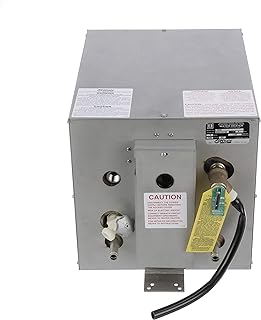
Best for compact, mobile setups where space and durability matter. This 120V unit comes in 3- or 6-gallon configurations, designed for boats and RVs, emphasizing rugged construction and a reliable hot water supply in small spaces. It’s a straightforward option when you need quick, steady hot water for limited-volume use. Best for: mobile living or small cabins where a larger residential heater isn’t practical. Limitation: capacity is limited compared to whole-house units; consider future expansion if daily hot water demand increases.
AB Plate Heat Exchanger, 4 x 12 Inch
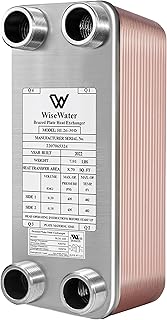
Best for hydronic heating and snow-melting systems with compact design. This 4×12 inch plate exchanger features 30 plates and 316L stainless steel with copper brazing at edges for robust leak resistance. It operates within a high-pressure, high-temperature range and offers a capacity of 250,000 to 330,000 BTU per hour depending on the application. Smooth threading simplifies connections, and the plate design enables efficient heat transfer with low electrical or auxiliary energy needs. Choose this for precise, space-efficient heat transfer in radiant heating or snow-melting setups. Caution: ensure correct plate orientation and gasket compatibility for long-term seal integrity.
MIZUDO 120,000 BTU Tankless Water Heater

Best for whole-house hot water with flexible installation options. This natural gas tankless unit offers up to 5.1 GPM flow and indoor/outdoor installation versatility (with optional kits). It includes smart WiFi/app control for remote temperature management and monitoring. Advanced temperature stability is designed to maintain consistent output during simultaneous fixture use, with precise modulation to avoid temperature swings. Choose this if you want scalable, on-demand hot water for multiple outlets. Limitation: requires gas supply and venting, which may affect installation costs and location choices.
Water To Air Heat Exchanger 10×10

Best for versatile residential heating and cooling tied to diverse heat sources. This 10×10 exchanger uses 12 aluminum fins and 3 rows of 3/8″ copper tubes per inch to maximize heat transfer. The steel shell and base-brazed joints are designed for durability under higher pressures and temperatures. Coated fins improve wear resistance, extending service life in challenging environments. It can support up to 360 kBtu per hour depending on system design. Choose this when you want a flexible, renewable-energy-friendly hot/cold exchange path. Caution: ensure compatibility with your existing boiler or solar thermal system to avoid performance mismatches.
Buying Guide
Key considerations when selecting a water heater with a heat exchanger include compatibility with your current heating system, whether you need hot water on demand or radiant cooling, and space constraints.
- Heat source compatibility: Gas, electric, solar, or wood-fired systems require different exchanger designs. Match the exchanger’s materials (copper, stainless steel, aluminum) to your medium to prevent corrosion.
- Flow capacity and BTU ratings: Choose a unit with adequate BTU output and flow rate for your household or application. Over-sizing adds cost, under-sizing reduces comfort.
- Installation environment: Outdoor installations need weather-resistant fins and corrosion protection. Indoor setups require venting and space for safe operation.
- Maintenance and durability: Epoxy-coated fins and copper brazing improve longevity. Plan for periodic inspection to prevent leaks in high-pressure circuits.
- Energy efficiency: Plate exchangers often minimize energy loss and can integrate with renewables. Consider how the exchanger will interact with boilers, solar panels, or heat pumps.
FAQ
- What is a water-to-air heat exchanger used for? It transfers heat between water and air to provide space heating or cooling in a building.
- Do plate heat exchangers require special maintenance? Yes, periodic inspection for leaks and gasket integrity is recommended, particularly in high-pressure systems.
- Can I install a tankless heater with a heat exchanger? Many can be integrated, but check compatibility with venting, gas supply, and flow requirements.
- Is corrosion protection important for heat exchangers? Yes, coatings and corrosion-resistant materials extend life in humid or outdoor environments.
- Which unit is best for RVs and boats? Compact, rugged tank-style heaters like Whale Premium are designed for smaller, mobile spaces with limited capacity.
- What should I consider for outdoor installations? Weather resistance, anti-corrosion coatings, and robust leak resistance are essential.