A zero-clearance fireplace grate must fit the fireplace’s firebox and meet the appliance manufacturer’s instructions; a grate’s size or material alone does not confirm it is safe for a zero-clearance unit. Of these five options, the 17-inch models are best for compact fireboxes, while the 24-inch models suit larger spaces only if the manual permits them. None of the supplied product descriptions specifically confirms zero-clearance fireplace compatibility, so check the fireplace manual before buying or using any of them.
| Product | Best suited to | Key listed feature |
|---|---|---|
| UniFlame 18 Inch Cast Iron Grate | Buyers seeking a simple indoor grate | Cast iron; fully assembled |
| Jusgym 17 Inch Grate | Buyers prioritizing support and coal retention | Six legs; five closely spaced bars |
| WILLOW WEAVE 17 Inch Grate | Buyers seeking an ember-retaining design | Wrought iron; ember retainer |
| AMAGABELI 24 Inch Grate | Buyers needing a wider assembled grate | Reinforced center legs; assembly required |
| AGTEK 24 Inch Grate | Buyers seeking a single-piece rack | Cast-iron construction; no assembly |
UniFlame 18 Inch Cast Iron Fireplace Grate

Best for: Buyers who want a straightforward indoor grate that arrives ready to place. Its 18-inch size may be worth considering for a smaller firebox, but the actual interior dimensions and required clearances must be checked first.
The listed features describe a cast-iron design with a natural texture and indoor use for wood-burning fireplaces. It is fully assembled: the instructions in the listing say to open it, place it, and add logs. That makes it a simple option for buyers who do not want to assemble a rack.
Why it was selected: Its compact listed width and ready-to-use design make it a relevant comparison for shoppers looking at smaller fireplace grates.
Limitation: The product information does not identify it as approved for zero-clearance fireplaces or specify the required firebox clearances. Confirm suitability in the fireplace manual before use.
Jusgym 17 Inch Grate With Six Support Legs

Best for: Buyers who want a compact grate with several support points and bars intended to keep logs and coals in place. The listing describes five tightly spaced steel bars and six evenly distributed legs.
The grate raises firewood four inches from the ground, according to the product details. Its maker presents that height as a balance between helping fires start and limiting the speed of coal buildup at the bottom. The closely spaced bars are also described as helping prevent logs from slipping and keeping hot coals in place.
Why it was selected: The six-leg layout and 17-inch size provide a useful comparison for buyers who prioritize a supported base in a smaller firebox.
Limitation: The listing does not provide confirmation of zero-clearance compatibility or detailed firebox clearance requirements. Its stated four-inch height may also be unsuitable if the fireplace manual specifies a different maximum grate height.
WILLOW WEAVE 17 Inch Grate With Ember Retainer

Best for: Buyers looking for a compact grate with an ember-retaining design. The listing describes heavy wrought iron, one-inch-wide flat bars that are 5/16 inch thick, and a weight of 10 pounds.
The listed dimensions are 17 inches wide by 10 inches deep, with a two-inch inner height and four-inch overall height. The product description says its bars hold logs in place and its ember design supports burning efficiency. It also describes the grate as easy to clean by sweeping it.
Why it was selected: Its stated dimensions, ember-retainer feature, and heavier construction make it a distinct option to compare with the other 17-inch models.
Limitation: The product description gives multiple height measurements, so compare the overall height and inner height with the fireplace manual and firebox dimensions. It does not state that the grate is approved for zero-clearance fireplaces.
AMAGABELI 24 Inch Reinforced Fireplace Grate
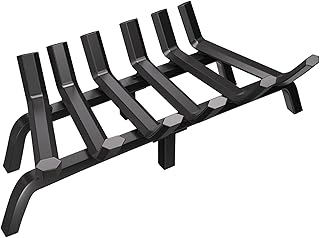
Best for: Buyers with a larger fireplace opening who want a wider grate with additional center support. The listed design has four solid corner feet and two reinforced center T legs intended to resist sagging.
The product is described as a solid-iron grate with a hexagonal grid. It consists of two log racks that are assembled with the center T legs and bolts. The listing presents the grid as a rigid design with larger weld contact areas than a traditional diamond pattern.
Why it was selected: Its 24-inch width and center supports make it a useful large-grate comparison for shoppers whose fireplace manual allows a grate of this size.
Limitation: Assembly is required, and the provided product information does not specify overall depth or confirm zero-clearance use. Do not assume a wider grate fits based on the opening alone; check the usable firebox dimensions and manual.
AGTEK 24 Inch Single-Piece Fireplace Grate

Best for: Buyers who prefer a larger grate that does not require assembly. The listing describes a single-piece cast-iron construction and a design that cradles firewood.
The stated dimensions are 24 inches across the front, 20.5 inches across the back, and 15 inches deep. The product description also specifies 2.2 inches of leg clearance for airflow beneath the grate. It is listed as heavy-duty cast iron with a black powder-coated finish.
Why it was selected: Its one-piece construction and detailed dimensions make it easier to compare against the usable space in a larger firebox.
Limitation: The listed 15-inch depth may rule it out for many smaller fireboxes. The product description does not confirm that the grate is suitable for a zero-clearance fireplace, so verify the manual before purchase.
Buying Guide: How to Choose a Zero-Clearance Fireplace Grate
What does zero clearance mean for grate selection?
A zero-clearance fireplace is a factory-built fireplace designed to be installed with specified clearances around its exterior. That description does not mean any grate can be placed inside it. The fireplace manufacturer’s instructions control which accessories and fuel arrangements are allowed. A grate that fits physically may still be unsuitable if the manual restricts its size, position, height, or use.
None of the five product descriptions supplied here explicitly states that the grate is approved for zero-clearance fireplaces. Treat these as products to investigate, not as confirmed compatible accessories. Check the fireplace model’s manual or contact its manufacturer if the instructions are unclear.
How should you measure the firebox?
Measure the usable interior width, depth, and height where the grate would sit. Account for sloped firebox walls, side obstructions, doors, and any required spacing stated in the manual. Compare the measurements with the grate’s full footprint, not just its front width. For example, the AGTEK listing gives a 24-inch front width, a 20.5-inch back width, and a 15-inch depth, while the WILLOW WEAVE listing gives a 17-by-10-inch footprint.
Do not estimate fit from the visible fireplace opening alone. The firebox may narrow toward the back, and the manual may require open space around or above a grate. If complete product dimensions are missing, get clarification before purchase.
Which grate size is better: 17, 18, or 24 inches?
A 17- or 18-inch model may suit a smaller firebox, but only if its full dimensions and clearances meet the fireplace requirements. The listed 17-inch options are Jusgym and WILLOW WEAVE; the UniFlame model is 18 inches. The AMAGABELI and AGTEK grates are 24 inches wide, and the AGTEK listing also specifies a substantial 15-inch depth.
Choose the largest grate only when the manual permits it and the measured firebox provides adequate space. A grate that is too wide or deep can interfere with the fireplace’s intended layout. A smaller grate is not automatically safe or suitable; verify its permitted placement and height as well.
Does grate material or support design matter?
The products use different listed constructions: UniFlame is cast iron; Jusgym uses steel bars and six legs; WILLOW WEAVE is described as heavy wrought iron; AMAGABELI is solid iron with corner feet and center T legs; and AGTEK is a single-piece cast-iron design. These details help compare construction, but they do not establish that a product meets a particular fireplace’s requirements.
Support features can be relevant if you want to compare how each grate holds logs. Jusgym highlights six legs, and AMAGABELI describes reinforced center supports. Consider the grate’s stated construction alongside its dimensions and the manufacturer’s permitted accessories—not as a substitute for compatibility checks.
What height and airflow details should you check?
Grate height affects how far wood sits above the firebox floor. The listings give different figures: Jusgym states a four-inch lift, WILLOW WEAVE gives a two-inch inner height and four-inch overall height, and AGTEK specifies 2.2 inches of leg clearance. These figures may describe different parts of each product, so compare like measurements and confirm the maximum permitted height in the fireplace manual.
Do not assume that more clearance beneath a grate is always better. Follow the fireplace maker’s instructions for placement, airflow, and the allowed fuel load. If a product listing does not explain a measurement clearly, ask the seller or manufacturer rather than guessing.
Should you choose an assembled or one-piece grate?
UniFlame is listed as fully assembled, and AGTEK is described as a single-piece grate with no assembly required. AMAGABELI requires the buyer to connect its two log racks with the center T legs and bolts. Assembly can be a deciding convenience, but it does not determine whether a grate is appropriate for a zero-clearance unit.
Before using an assembled model, follow its instructions and check that the components are firmly fitted. For any model, confirm the fireplace’s rules first and inspect the product information for dimensions and placement guidance.
Frequently Asked Questions
Can I use any fireplace grate in a zero-clearance fireplace?
No. Check the fireplace manual for approved accessories, grate placement, dimensions, and operating instructions. A product listing that describes indoor fireplace use does not by itself confirm zero-clearance compatibility.
Are any of these five grates confirmed for zero-clearance fireplaces?
No. The supplied product details do not explicitly confirm that any of these models is approved for a zero-clearance fireplace. Contact the fireplace manufacturer or consult the manual before selecting one.
How much space should be around a fireplace grate?
Use the spacing required by the fireplace manufacturer. The appropriate clearance depends on the specific fireplace and cannot be established from these grate listings alone.
Is a 24-inch grate too large for a zero-clearance fireplace?
Not necessarily, but it is suitable only if the firebox measurements and manual allow its full footprint. The AGTEK grate is listed as 24 inches wide and 15 inches deep, so measure both width and depth before considering it.
Does a grate with more legs guarantee safer use?
No. Leg count is one construction detail, not proof of compatibility or safety in a specific fireplace. Confirm that the fireplace maker permits the grate and follow the appliance instructions.