Answering the question “what is the best 240 volt water heater for my home or apartment?” this guide highlights five proven options that balance space, efficiency, and performance. These 240-volt models are ideal for households that need quick hot water without a bulky tank. They’re suitable for small homes, apartments, or point-of-use upgrades where electrical capacity and space are considerations. The selections below emphasize clear setup, energy efficiency, and dependable temperature control to help readers compare at a glance.
Quick comparison of top 5 240V choices
- GE 18 Gallon Versatile Electric Water Heater (Lowboy, 240V): compact, easy replacement, good for 1–2 people.
- Rheem 11kW 240V Tankless Electric Water Heater: compact, self-modulating, up to 2.68 GPM.
- Rheem 18kW 240V Tankless Electric Water Heater: higher flow, external digital control, up to 4.4 GPM.
- EcoSmart ECO 11 Electric Tankless Water Heater: space-saving, extremely compact, on-demand heating, 54 A draw.
- CAMPLUX Tankless Water Heater 6kW at 240V: under-sink unit, energy-saving, self-modulating, space-saving.
GE Appliances 18 Gallon Versatile Electric Water Heater — 240 Volt

Best for: small households or apartments needing whole-home hot water without a large tank.
Why selected: This lowboy design fits tight spaces where height is a concern and provides hot water for 1–2 people. It uses standard water and electrical connections for straightforward installation.
What to know: Ensure space constraints align with the unit’s dimensions. The model is sized for modest hot water demand, so larger households may need a higher-capacity option.
Rheem 11kW 240V Tankless Electric Water Heater
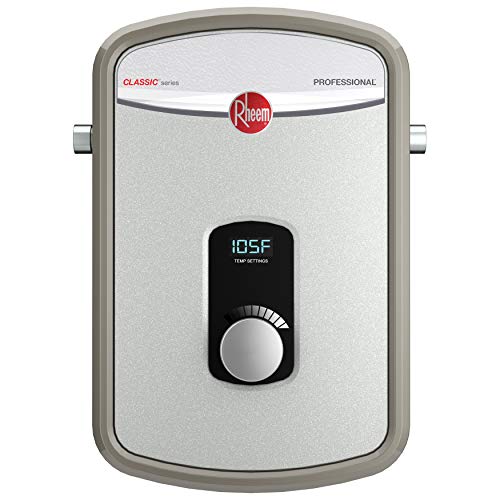
Best for: individuals or couples needing compact, on-demand hot water with moderate flow.
Why selected: This model offers simple on/off control and self-modulating power, with a flow rate up to 2.68 GPM, which is suitable for one bathroom or small sink usage at a time.
What to know: It’s best for low to mid-demand scenarios. If multiple outlets require hot water simultaneously, consider a higher-flow option.
Rheem 18kW 240V Tankless Electric Water Heater — Gray
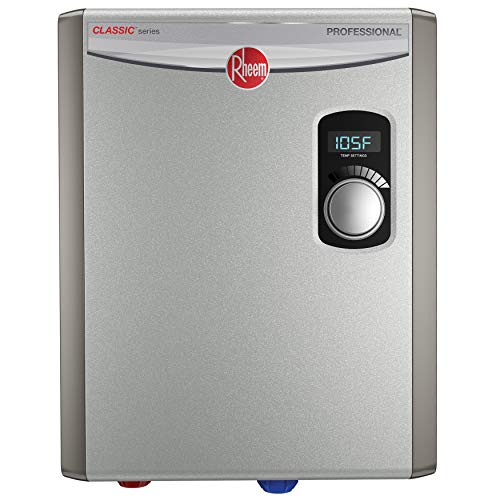
Best for: households needing higher hot-water flow, such as two bathrooms or multiple points of use.
Why selected: External digital thermostatic control with LED display and advanced self-modulation raise efficiency while delivering up to 4.4 GPM. Copper immersion elements improve durability and heat transfer.
What to know: Higher kW models demand greater electrical service; verify panel capacity before install.
EcoSmart ECO 11 Electric Tankless Water Heater — 240V

Best for: compact homes or point-of-use installations needing space efficiency and energy savings.
Why selected: The ECO 11 is 90% smaller than traditional tank heaters and 99% thermally efficient because it heats water only on demand. It’s rated for on-demand hot water with continuous monitoring for stable temperatures within 1 degree of setpoint.
What to know: It draws about 54 A, so confirm your panel and wiring can support this load, and plan for potential downstream water use to avoid overloading the unit.
CAMPLUX Tankless Water Heater 6kW at 240 Volts

Best for: under-sink or small-space hot water needs in apartments or offices, especially where space is at a premium.
Why selected: Self-modulating technology helps save energy by adjusting power to match demand, with easy temperature display and compact dimensions for easy installation in tight spaces.
What to know: This unit’s 6 kW output is best for single-use hot water at a time; plan for simultaneous taps accordingly to avoid shortfalls.
Buying Guide: Practical considerations for selecting a 240V model
- Flow requirements: Tankless units vary widely in GPM. For homes with multiple outlets, choose higher flow models (e.g., 3–4+ GPM) or install multiple units at strategic points.
- Electrical service: Verify available amperage and panel capacity. Tankless units can pull substantial current; some models require dedicated circuits.
- Space and installation: If space is limited, consider compact or lowboy designs. Point-of-use units can eliminate long hot-water runs.
- Temperature control: Look for digital thermostats and precise temperature displays. Self-modulating technology helps maintain efficiency and comfort.
- Maintenance and serviceability: Field serviceable components and copper heat exchangers can extend lifespan and simplify repairs.
- Water pressure and piping: Confirm compatibility with 1/2″ or 3/4″ NPT connections and ensure proper venting and drainage for installation locations.
Frequently asked questions
- What is a 240V water heater best used for?
240V models are ideal for homes needing on-demand hot water with compact footprint and for point-of-use installations where space or wiring constraints exist.
- Do tankless 240V heaters require special electrical upgrades?
Yes, many require a robust electrical service and sometimes a dedicated circuit. Verify panel capacity before purchasing.
- Can I install a 240V tankless water heater myself?
Installation should be performed by a licensed professional to ensure safety, proper venting (if needed), and correct wiring.
- What is the difference between 11kW and 18kW models?
Higher kW ratings generally deliver higher flow rates and better performance under heavier hot-water use, but require more electrical load.
- Are 240V units suitable for apartments?
Yes, many 240V models are designed for apartment use, especially compact tankless and lowboy options.
- How do I choose between tank-style and tankless 240V heaters?
Tank models are simpler and provide steady reserves of hot water, while tankless units save space and energy by heating on demand.