If you’re shopping for an affordable hot water heater, you want options that fit tighter budgets without sacrificing essential function. The top picks here are ideal for small homes, apartments, under-sink needs, and replacement setups where space and cost matter. This guide highlights five practical choices with clear buyer benefits and limitations.
The table below helps compare the five selected products at a glance.
| Product | ||||
|---|---|---|---|---|
| GE Appliances 10 Gallon Versatile Plug and Play Electric Water Heater | Electric Tank | 10 Gallons | Small apartments or spaces needing a plug-and-play unit | Under counter or compact installation |
| GE Appliances 2.5 Gallon Versatile Mini Tank Water Heater | Electric Mini Tank | 2.5 Gallons | Under-sink or under-counter hot water needs | Point-of-use applications |
| 110V Tankless Water Heater Electric, 5000W | Tankless Electric | 5000W rated | Overcome short hot-water waits in compact spaces | Under-sink or small bathroom/kitchen |
| 110V-120V 1500W Small Instant Electric Tank, 4 Gallon | Instant Electric Tank | 4 Gallons | Compact, budget-friendly under-sink option | Kitchen, RV, or compact setup |
| 110V Tankless Water Heater Electric, 3000W | Tankless Electric | 3000W | Compact tankless option with adjustable settings | Under-sink or small-space installation |
GE 10 Gallon Versatile Plug & Play Electric Water Heater

Best for small apartments or spaces that require plug-and-play setup. The 10-gallon GE model is designed for easy installation, making it a practical option where plumbing work is limited. It’s best for buyers who need a compact, ready-to-use solution with adjustable thermostat settings.
Limitations to note: A 120-volt supply is required, which may limit capacity for high-demand scenarios. This unit is optimized for limited, short-term hot water use rather than heavy domestic continuous hot water.
GE 2.5 Gallon Mini Tank Water Heater

Best for under-sink use or point-of-use hot water needs. The 2.5-gallon mini tank is compact and easily installed under counters, making it suitable for tasks like quick hand-washing stations or small apartments where space is at a premium.
Limitations to note: Small capacity means it won’t supply hot water for multiple fixtures simultaneously. Efficiency benefits depend on consistent power availability and usage patterns.
110V Tankless Water Heater Electric, 5000W

Best for spaces needing higher flow without a storage tank. The 5000W tankless unit delivers hot water on demand, reducing standby waste. It suits under-sink installations or compact bathrooms where you need reliable hot water without a bulky tank.
Limitation to consider: Higher wattage requires appropriate electrical capacity and wiring; ensure your setup can handle 5000W without overloading circuits.
110V-120V 1500W Small Instant Electric Tank
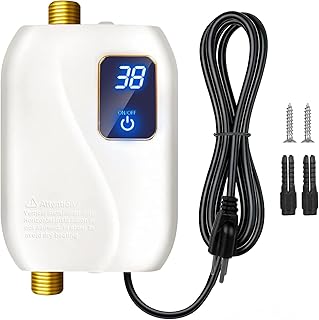
Best for tight budgets and under-sink installs. This 4-gallon unit provides instant hot water for limited tasks at a modest price point and fits smaller spaces. It’s a practical pick when a full-size heater is unnecessary.
Limitations to note: It has a smaller capacity and may not support simultaneous hot water needs across multiple fixtures. Efficiency depends on installation quality and water usage patterns.
110V Tankless Electric, 3000W
Best for compact, adjustable, on-demand hot water. The 3000W tankless option supports on-demand hot water with a digital display and Fahrenheit/Celsius switching. It’s designed for efficient operation in small spaces and is ETL-listed.
Important limitation: Lower wattage may limit hot-water output compared with higher-watt tankless models; performance depends on water pressure and inlet temperature.
Buying Guide: Affordable Hot Water Heaters
What is the right type for you?
Consider whether you need a storage tank or a tankless solution. Storage tanks provide ready hot water in reserve but take more space. Tankless units save space and can be more energy-efficient when sized correctly for your flow needs.
What capacity do you need?
For single-task use (under-sink or point-of-use), 2.5–4 gallons may suffice. For small apartments or limited fixtures, a 10-gallon or compact tankless option can balance hot water availability with space constraints.
Electrical requirements and safety
Check voltage and wattage to ensure your electrical system can handle the unit. Higher-wattage tankless heaters require appropriate circuit capacity. Look for units with safety features such as automatic shutoff, waterproofing, and dry-boil protection.
Installation considerations
Under-sink or cabinet installations save space but may require professional plumbing adjustments or permissions. Plug-and-play models offer easier setup, while tankless systems may demand more complex installation.
Energy and efficiency
Tankless models generally reduce standby energy use. If choosing a tank heater, look for well-insulated tanks and thermostat control to avoid wasted energy from overheating or unnecessary reheating.
Maintenance and durability
Fewer moving parts in tankless systems can reduce maintenance needs. Regular descaling may be necessary in hard-water areas for longer life and consistent performance.
Summary tips
- Match the unit to your actual hot-water demand to avoid over- or under-sizing.
- Verify electrical compatibility before purchase to prevent circuit overloads.
- Prefer units with adjustable thermostats for better comfort and energy control.
FAQ
- What defines an affordable hot water heater?
– It typically balances upfront cost, installation simplicity, and ongoing energy use for light to moderate hot-water needs. - Can I install these myself?
– Some plug-and-play and mini-tank units are designed for easier installation; more complex tankless setups may require professional assistance. - Do these units work for apartments?
– Yes, many compact models are suitable for apartments or small homes where space is limited. - Will a tankless unit save energy?
– Tankless systems can reduce standby energy but depend on usage patterns and proper sizing for your flow rate. - What maintenance is needed?
– Periodic checks for leaks and mineral buildup, especially in hard-water areas; descaling may be necessary for some models.