Answering your search for reliable on-demand hot water, this guide compares five top tankless options and explains who each is best for. Whether you’re outfitting a kitchen, apartment, or whole house, these picks balance performance, efficiency, and space saving. The top choices cover electric under-sink units, compact point‑of‑use heaters, and whole‑home gas or electric systems designed for multiple fixtures. Use the quick comparison below to narrow choices, then dive into detailed product sections for fit and trade‑offs.
| Product | Best For | Key Strength | Notes |
|---|---|---|---|
| 110V Electric Under-Sink | Small apartments, kitchens, RVs | Compact, 82°F rise in seconds | 110V, ETL listed |
| Westinghouse 14kW 240V | Two points of use, smart home | Smart WiFi, 3s heating | Requires dedicated circuit |
| Rheem 8kW 240V | Space-saving for modest hot water needs | Up to 1.95 GPM | Single unit, easy sizing |
| MIZUDO Natural Gas 199,000 BTU | Whole-home, 2–3 bathrooms | Up to 10.3 GPM | WiFi & app control |
| Rheem RTG 7.0 GPM Gas | Large homes with multiple showers | 7.0 GPM at 35°F rise | Indoor, space-saving |
Important buying considerations include energy source (electric vs gas), flow needs (GPM at your temperature rise), space, installation requirements, and smart controls. Use the product sections to compare how each option handles peak demand, temperature stability, and installation constraints. The best pick depends on whether you prioritize entire‑home capacity, compact installation, or smart integration with a home automation system.
110V Tankless Electric Under-Sink Model
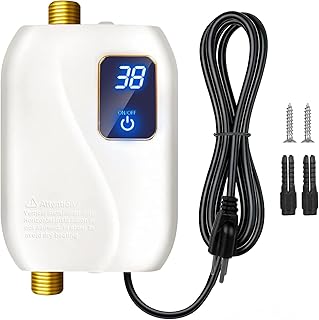
Best for compact spaces where only a small, continuous hot water supply is needed. This 3000W electric unit uses stainless steel and ABS components with an LED display and a 6-second power-button hold to switch between Fahrenheit and Celsius. It can raise water by up to 82°F at 0.3 GPM or 131°F at 0.5 GPM, enabling rapid hot water for sinks or dishwashing. It is designed for wall mounting to save space in kitchens, bathrooms, or RVs. Cautions: ensure proper clearance for electrical safety and verify compatibility with your existing plumbing line. This model emphasizes quick response and compact design over high-flow performance, making it ideal for single-faucet use or small fixtures.
Westinghouse 14kW 240V Tankless Water Heater

This model is best for two fixtures simultaneously, delivering up to 3.4 GPM when inlet water is around 62°F and the outlet is set to 105°F. It includes smart WiFi compatibility for voice control and temperature memory, allowing last presets to be restored after a power outage. It requires a dedicated 60A double-pole breaker and 6 AWG wire, with compact dimensions suitable for wall mounting. Choose this if you want strong performance, modern smart features, and integration with Alexa or Google Home. Caution: installation requires electrical work and correct venting considerations for a safe, reliable setup.
Rheem 8kW Electric Tankless Water Heater

Best for small spaces where users want a straightforward electric tankless setup. The 8kW model provides up to 1.95 GPM, suitable for single or limited fixtures with careful electrical planning. It emphasizes reliable on-demand hot water and space savings, with the expectation of professional installation and correct sizing for your home. Best when paired with modest hot water needs or as a supplementary unit for sinks and small bathrooms. Limitation: flow is lower than larger units, so avoid this if multiple showers or high simultaneous demand are expected.
MIZUDO Gas Tankless Water Heater

Best for whole-home hot water with high flow. The MIZUDO gas model delivers up to 10.3 GPM with a heating input of 199,000 BTU, supporting 2–3 bathrooms and multiple fixtures simultaneously. It offers ±1°F temperature stability and a wide adjustable range up to 149°F, making it suitable for deep soaking and heavy-duty laundry. It includes WiFi and app control for remote adjustments. Caution: gas installation requires venting and professional service, and continuous demand can increase energy use. Choose this if you need robust, whole-house performance and smart monitoring.
Rheem RTG Series 7.0 GPM Gas Tankless

Best for large homes needing continuous hot water across multiple showers. The 7.0 GPM unit provides 160,000 BTU/hr and an indoor, non-condensing design with a direct vent system. It’s positioned for households with higher simultaneous demand, delivering consistent performance under variable temperatures. It saves space with a wall‑mounted installation. Avoid this if your home’s venting or gas line requirements are not compatible, or if you only have very low hot water needs. This model suits larger families or multi-bath homes seeking dependable whole-house hot water without storage tanks.
Buying Guide: Key Considerations For Choosing A Tankless Water Heater
- What is your hot water demand? Estimate GPM at your typical temperature rise to avoid undersizing or oversizing. For multiple bathrooms, gas models generally handle higher flows better, while electric units suit smaller needs or point-of-use installations.
- Where will you install it? Consider space, venting (for gas units), electrical service capacity, and whether a wall‑mounted unit fits your layout.
- Electric vs gas: Gas models offer higher flow for whole-house use; electric units are simpler to install in apartments or spaces without a venting requirement, but may require significant electrical upgrades for higher GPM needs.
- Smart features and control: WiFi or app control can provide remote temperature management and usage monitoring. Temperature memory helps restore settings after outages for seamless hot water delivery.
- Safety and efficiency: Look for protection features (dry‑fire, overheating, and leakage protection) and high energy efficiency. Non-condensing gas systems are common; consider venting efficiency and local codes.
- Installation and maintenance: Some models require professional electrical or gas work. Verify compatibility with existing fixtures, line sizes, and accessibility for service.
Frequently Asked Questions
- What size tankless heater do I need for a two-bath home? Answer: Most two-bath homes can be served by 6–10 GPM gas units or appropriately sized electric units, depending on climate and simultaneous demand.
- Is a tankless heater more energy-efficient? Answer: Yes, tankless systems heat water on demand and typically reduce standby losses, though overall savings depend on usage patterns and unit efficiency.
- Do tankless heaters require venting? Answer: Electric units generally do not require venting. Gas models typically require venting and proper combustion air supply.
- Can I install a tankless heater myself? Answer: Some electric or point-of-use units may be DIY-friendly, but gas models usually require licensed professionals for venting, gas connections, and code compliance.
- How long does it take to get hot water with tankless heating? Answer: Electric units provide near-instant hot water at the point of use, while gas systems may take a moment to heat incoming cold water, depending on distance from the heater.
- What maintenance is needed? Answer: Regular checks for leaks, venting integrity (gas models), and periodic flushing to prevent mineral buildup are common maintenance tasks.