If you’re shopping for a double pole thermostat for baseboard heaters, you want reliability, easy installation, and precise control. These devices switch both legs of the electrical circuit for safer, more complete shutoffs and better energy savings. This guide highlights five solid options best suited for different baseboard and wall-heater setups, ranging from DIY-friendly replacements to built-in controls for Cadet and other brands. Each choice is explained with who it’s best for and a key limitation to consider.
Summary table of selected products:
| Product | Best For | Key Feature | Limitations |
|---|---|---|---|
| Cadet Double Pole Line Voltage Thermostat | DIYers replacing old line-voltage stats | Color-coded wires for quick install | Some installations may require basic wiring familiarity |
| Cadet F Series Double Pole Built-In Thermostat (BTF2W) | Built-in comfort on Cadet baseboards | Mounts at heater ends, no extra wiring | Designed for Cadet baseboard heaters (sold separately) |
| Dr. Infrared DR-001 Wall Thermostat | Versatile compatibility 120–277V | High wattage range across voltages | Not brand-specific to Cadet; may require mounting space |
| Cadet Double Pole Built-In Baseboard Thermostat | Built-in control for Cadet heaters | No extra wiring needed when replacing end plate | Only for Cadet baseboard heaters |
| Stelpro SWT2F Double Pole Line Voltage Thermostat | Cold climates or full shutoff needs | Fully disconnects power for greater safety | Works across 120–277V; may be less common in some markets |
Cadet Double Pole Line Voltage Thermostat for Baseboard & Wall Heaters

This model is ideal for homeowners replacing an older, non-digital line-voltage thermostat. It supports 120, 208, and 240-volt systems and can handle up to 5,280 watts at 240V or 2,640 watts at 120V. It uses a double pole, 4-wire design to switch both legs, improving safety and energy control. Best for: DIYers who want a straightforward swap with color-coded wires and a simple twist-dial control. Limitation: installation assumes some basic wiring comfort and correct wiring alignment to existing lines.
Cadet F Series Double Pole Built-In Baseboard Thermostat (BTF2W)

Designed for Cadet F series baseboard heaters, this 22 Amp, 120/208/240-volt thermostat offers a built-in control option. It installs at either end of the heater, eliminating extra wiring. Best for: Cadet baseboard users who want a seamless, factory-style built-in feel. Limitation: compatibility is limited to Cadet F series heaters (sold separately).
Dr. Infrared Heater DR-001 Wall Thermostat
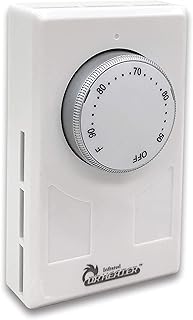
This thermostat supports 120–277V and high wattage ranges, with multi-range control and a wall-mount design that fits flush against walls. Best for: households with mixed heat sources or higher heat needs where a broad voltage range is beneficial. Limitation: not a Cadet-built unit; ensure compatibility with your specific baseboard heater type and mounting space.
Cadet Double Pole Built-in Baseboard Heater Thermostat
Built-in control that mounts to either end of a Cadet baseboard heater, this 22 Amp, double pole model allows control without extra wiring to a separate wall location. Best for: Cadet baseboard users seeking a non-invasive, end-mounted solution. Limitation: compatibility is restricted to Cadet baseboard systems.
Stelpro Line Voltage Wall Thermostat SWT2F

The SWT2F is a double-pole thermostat suitable for 120–277V systems up to 22A. It offers a mechanical dial with a wide 50–90°F range and fully disconnects power for safety and energy efficiency. Best for: spaces that require total power disconnection in cold climates. Limitation: mechanical dial lacks modern digital precision and programming features.
Buying Guide: Key Considerations for Double Pole Baseboard Thermostats
- Voltage compatibility: Confirm your baseboard heater voltage (120, 208, 240V, or 277V) and choose a thermostat rated for that range.
- Pole configuration: Double-pole thermostats disconnect both hot lines, improving safety and energy control. Consider whether you need a device that also supports a wall-mount or built-in installation.
- Installation approach: Some models replace end plates on Cadet heaters; others require mounting near a wall or at the heater ends. Assess whether you prefer in-heater or wall-mounted control.
- Wattage capacity: Ensure the thermostat can handle the heater’s wattage. Higher wattage units are needed for larger baseboards or convectors.
- Control type: Dial-based, non-programmable controls are simple and reliable. Some models offer broader temperature ranges or easier DIY wiring for replacements.
- Safety features: Look for a positive off position, full shutoff, and robust construction for long-term reliability.
- Brand ecosystem: If you already use Cadet heaters, a Cadet-built thermostat may offer the simplest replacement path.
- Physical fit: Check end-cap mounting options and space available around the heater to accommodate the thermostat’s size and dial.
Frequently Asked Questions
- What is a double pole thermostat, and why use one? – A double pole thermostat disconnects both live wires, providing safer shutoff and more complete power control for baseboard heaters.
- Can I install a baseboard thermostat myself? – Many units are designed for DIY replacement, especially those with color-coded wires or end-plate mounting. Follow the manufacturer’s wiring instructions and shut off power before work.
- Will a thermostat fit all baseboard heaters? – Not all models fit every heater. Some are built for Cadet heaters, while others work with a broader range of brands. Check compatibility with your heater model.
- What voltage ranges should I expect? – Most common options are 120V, 208V, and 240V, with some models supporting 277V. Verify your system’s voltage before purchasing.
- Is a built-in thermostat better than a wall-mounted one? – Built-in thermostats install at the heater end and can simplify wiring, while wall-mounted models can be easier to access and service from a room location.
- Do I need programming features? – For basic comfort control, non-programmable dial thermostats are sufficient. Programmable options exist but may not be necessary for standard baseboard heating.