When you need hot water instantly without storing it, an electric on-demand (tankless) heater is the answer. This guide highlights top options for American homes, apartments, and small living spaces. For buyers, these units are best for compact spaces, point-of-use hot water, and setups where energy efficiency matters. Below is a quick summary of five suitable choices, followed by detailed sections to help you decide.
| Product | Best For | Notes |
|---|---|---|
| 14kW Tankless Electric (Gray) — 14kW, 240V | Single to two-use points, under-sink installs | Compact, energy efficient, LED temp display |
| 18kW Tankless Electric — NOVIEEX 240V | 2–3 simultaneous fixtures in small homes | High flow, space-saving wall-mount |
| 12kW Self-Modulating Electric — White Unit | 1–2 points-of-use in tighter spaces | Self-modulating temp stability |
| MIZUDO 120,000 BTU Gas Tankless — Indoor/Outdoor | Whole-house gas option for 2–4 points | WiFi/app; flexible installation |
| 14kW Orbek Electric Tankless — 3.38 GPM | 2–3 fixtures; compact setup | LED indicators; 150A panel requirement |
14kW Tankless Electric 240V — Fast 3s Heating
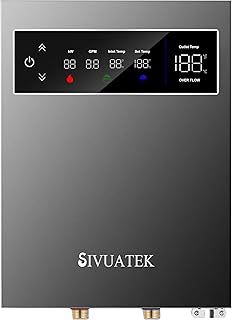
Best for: Small kitchens or bathrooms with two active water points. This unit delivers instant hot water with up to 99.8% thermal efficiency, and it fits compact spaces. It is ideal for users who want energy savings and quick hot-water readiness without a storage tank.
Why selected: It offers fast on-demand heating, compact installation, and clear LED temp readouts to monitor inlet/outlet temperatures. It supports a single or two-point setup efficiently.
Caution: Requires a dedicated 60-amp circuit breaker. Check if your electrical panel can accommodate the load before purchase.
18kW Tankless Electric — High-Flow 3s Heating

Best for: Small-to-medium homes, apartments, or studios needing 2–3 simultaneous water points. It provides robust flow (up to 4.9 GPM) while remaining space-efficient with a wall-mount design.
Why selected: High power supports multiple fixtures, and its slim profile helps maximize space in utility closets or garages. It requires professional electrical installation due to 75A draw.
Caution: Requires two 40A double-pole breakers and proper gauge wiring; ensure your electrical system meets this requirement before purchasing.
12kW Self-Modulating Electric — 1–2 Points

Best for: Single bathroom or compact kitchen setups needing consistent on-demand hot water at 77–131°F. The self-modulating feature maintains steady temperature with minimal fluctuation.
Why selected: Compact white design fits tight spaces and offers reliable temperature stability. ETL-rated with multiple protections for safe, durable operation.
Caution: Suitable for 1–2 points of use; ensure adequate electrical capacity and wiring before installation.
MIZUDO 120,000 BTU Gas Tankless — Flexible Gas Option

Best for: Whole-house hot water with 2–4 use points where gas-powered on-demand is preferred. Indoor/outdoor install flexibility expands placement options.
Why selected: Features WiFi/app control and precise temperature modulation to maintain comfort across multiple fixtures. This model is suitable for homeowners seeking modern control features.
Caution: Gas systems require venting and professional installation. Verify local codes and installation requirements before purchase.
14kW Orbek Electric Tankless — 3.38 GPM

Best for: Two to three fixtures at once in compact homes, apartments, or kitchen/bathroom pairings. It heats quickly and maintains efficiency with LED status indicators.
Why selected: Efficient operation and dependable on-demand heating with a compact footprint. The unit requires a 150-amp panel capacity and a 60A two-pole breaker with 6 AWG wiring.
Caution: Check electrical panel capacity; exceeding panel limits may necessitate service upgrades.
Buying Guide
Key considerations when choosing an electric on-demand heater include electrical service, flow rate needs, space, and installation complexity. Use these practical questions to compare options.
What size electric tankless heater do I need?
Determine your peak simultaneous water usage, measured in GPM. Typical showers require about 1.5–2.5 GPM, sinks around 0.5–1.5 GPM, and appliances add to demand. Higher kW units (like 18kW) support more simultaneous fixtures but require robust electrical service (two 40A breakers or more).
Can my electrical panel handle a tankless unit?
Most 240V tankless heaters demand substantial amperage. Verify panel amperage, available spaces for breakers, wire gauge, and grounding. Some models specify a minimum total panel capacity (for example, around 150A) to operate safely.
Where should I install an electric tankless heater?
Under-sink or wall-mounted installations save space. Ensure proper venting is not required for electric units, and locate away from potential leaks. Consider cabinet clearance and accessibility for service.
What about installation and safety?
Electrical and plumbing connections must meet local codes. Professional installation is recommended for high-power units, especially those requiring multiple breakers or heavy gauge wiring. Look for UL/ETL certified models with built-in safety protections.
Which features matter for reliability?
Self-modulating technology helps maintain temperature with varying flow. LED displays can simplify temperature monitoring. Units with protective features like dry heating prevention and leakage protection improve durability in everyday use.
How do I compare operating costs?
Electric tankless heaters save energy by eliminating standby losses. Compare energy efficiency, installation costs, and expected lifetime service to gauge total cost of ownership. More efficient units can offset higher upfront electrical requirements over time.
FAQ
- Q: Do I need professional installation for these heaters?
A: Yes. Most units require electrical work and proper gas connections where applicable; professional installation ensures compliance with safety standards. - Q: Can these units supply hot water to multiple rooms simultaneously?
A: Yes, up to the unit’s GPM rating; higher-wattage models support more simultaneous fixtures. - Q: Will these work in cold climates?
A: On-demand heaters provide heated water at the outlet, but overall performance depends on incoming water temperature. In very cold climates, higher power units perform better. - Q: Are there maintenance requirements?
A: Routine checks for mineral buildup and water quality are advised. Some models include anti-scale features to reduce buildup. - Q: How do I choose between electric and gas tankless options?
A: Electric models are easier to install in many homes and don’t require venting, but gas units can deliver higher flow rates for entire-house usage and can be cheaper to operate in some markets. - Q: What safety protections should I look for?
A: Look for high-temperature protection, dry heating prevention, leakage protection, and ETL/UL certification for safety and reliability.